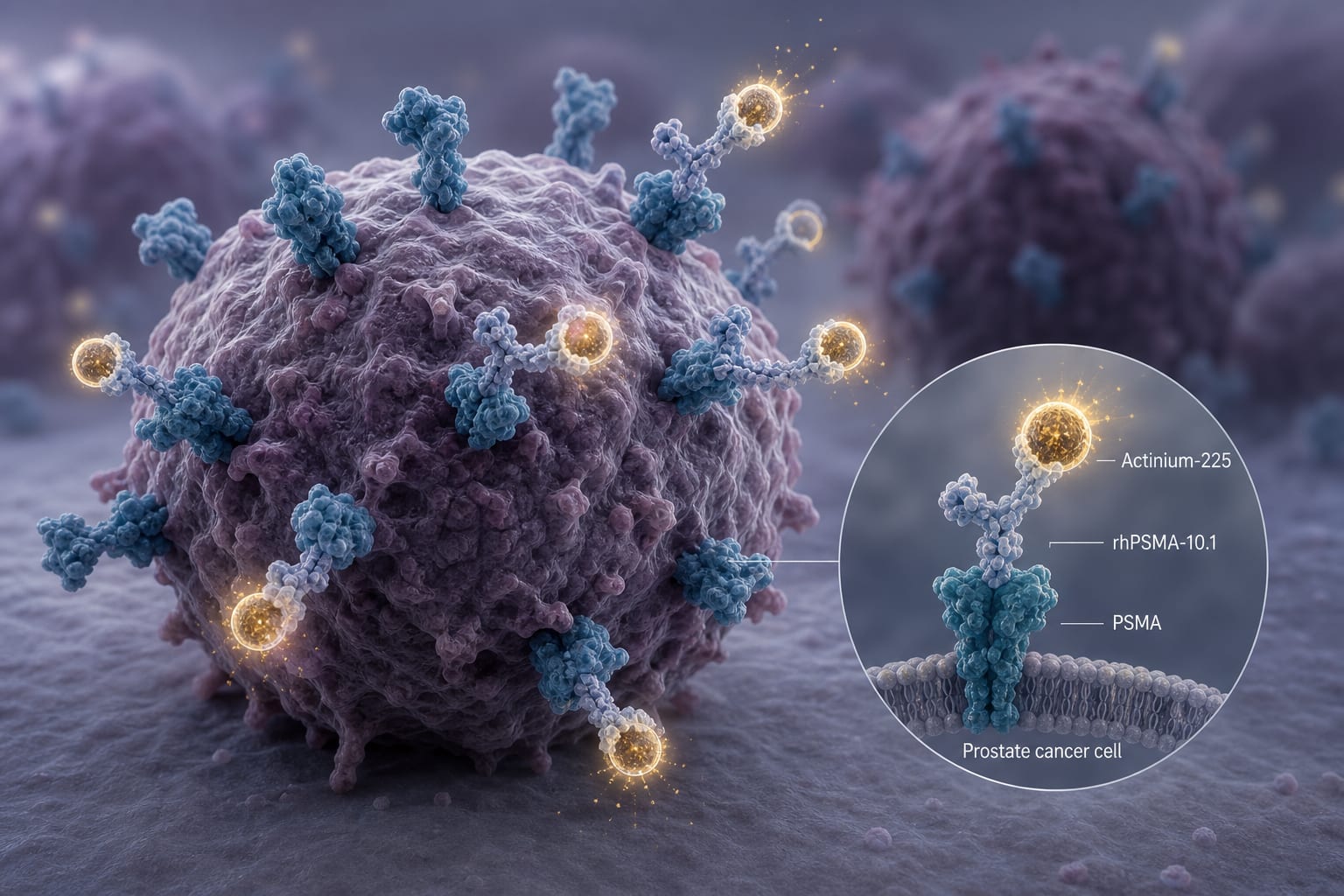
Clinical Report: Evaluation of Actinium-225-rhPSMA-10.1 for Prostate Cancer
Overview
This study evaluates [225Ac]Ac-rhPSMA-10.1 as an alpha-particle therapy for prostate cancer, demonstrating efficacy in preclinical models. Significant reductions in tumor growth and prolonged survival were observed in xenograft models.
Background
Prostate cancer remains a leading cause of cancer-related morbidity in men, with metastatic castration-resistant prostate cancer (mCRPC) being particularly challenging to treat. PSMA-targeted radiopharmaceutical therapies have emerged as promising options, yet many patients do not respond adequately to existing treatments. The exploration of alpha-particle therapies like [225Ac]Ac-rhPSMA-10.1 is ongoing.
Data Highlights
Parameter
[225Ac]Ac-rhPSMA-10.1
[177Lu]Lu-rhPSMA-10.1
Lipophilicity (log Doct/PBS pH 7.4)
-3.4 ± 0.2
-3.8 ± 0.1
PSMA Binding Affinity (IC50)
3.6 ± 0.6 nM
1.6 ± 0.1 nM
Cellular Internalization
99% ± 14
108% ± 5
Median Survival
43.5 days
27.0 days
Key Findings
[225Ac]Ac-rhPSMA-10.1 and [177Lu]Lu-rhPSMA-10.1 exhibited low lipophilicity.
Both radiopharmaceuticals showed high PSMA binding affinity.
Cellular internalization rates were comparable between the two therapies.
[225Ac]Ac-rhPSMA-10.1 significantly reduced tumor growth compared to controls.
Median survival was significantly prolonged with [225Ac]Ac-rhPSMA-10.1 compared to control groups.
Both therapies were well tolerated with no significant differences in adverse effects.
Clinical Implications
Further clinical evaluation is warranted to confirm these results in human subjects.
Conclusion
[225Ac]Ac-rhPSMA-10.1 demonstrates efficacy in preclinical models.
by Caroline Foxton, Bradley Waldron, Alexander Wurzer, Calogero D’Alessandria, Alfred Morgenstern, Frank Bruchertseifer, Tea Kirkegaard Nielsen, Rikke Veggerby Grønlund, Mathias Wikke Hallund, Daniel J. Stevens