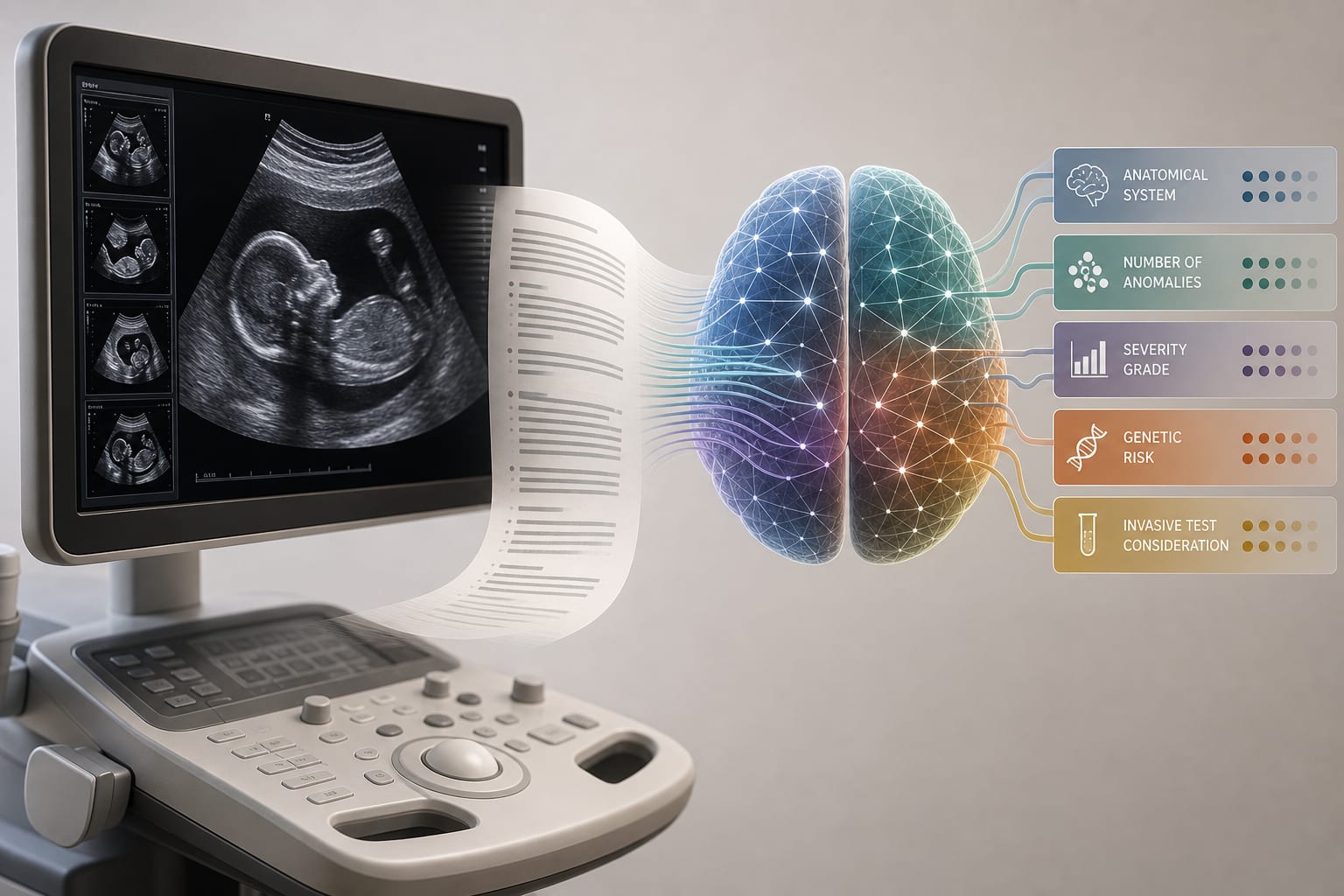
Adaptive Fast-Slow Large Language Model Framework for Multidimensional Classification of Prenatal Ultrasound Reports: Comparative Study - Report - MDSpire

Adaptive Fast-Slow Large Language Model Framework for Multidimensional Classification of Prenatal Ultrasound Reports: Comparative Study

  • By

  • Wei Zhong

  • Huihui Yan

  • Yifan Liu

  • Yan Liu

  • Kai Yang

  • Huimin Gao

  • Zhengyang Yao

  • Wenjing Hao

  • Yousheng Yan

  • Chenghong Yin

  • May 28, 2026

  • 0 min

Share

Framework for Adaptive Fast-Slow Large Language Models in Prenatal Ultrasound

Overview

This study evaluates the effectiveness of adaptive large language models (LLMs) in classifying prenatal ultrasound reports. It highlights the importance of multidimensional risk assessment in fetal anomaly detection and the comparative utility of retrieval-augmented generation versus chain-of-thought reasoning in this context.

Background

Prenatal ultrasound is crucial for fetal assessment, yet converting narrative reports into structured data for clinical decision-making poses significant challenges. Accurate classification of ultrasound findings is essential for risk assessment regarding genetic disorders, especially when considering invasive testing options like amniocentesis. The integration of advanced LLMs may enhance the efficiency and accuracy of this classification process.

Data Highlights

No numerical data or trial data presented in the article.

Key Findings

  • Adaptive LLMs can improve the classification of prenatal ultrasound reports.
  • Retrieval-augmented generation (RAG) is effective for factual tasks, while chain-of-thought (CoT) reasoning is necessary for subjective assessments.
  • Multidimensional classification correlates strongly with genetic outcomes from amniocentesis.
  • Fast base models (V3.2-B) and reasoning-enhanced models (V3.2-R) serve different clinical needs.
  • Expert-verified results provide a gold standard for evaluating model performance.

Clinical Implications

The findings suggest that integrating adaptive LLMs into clinical workflows can enhance the accuracy of prenatal assessments. Clinicians should consider the strengths of both RAG and CoT reasoning when interpreting ultrasound findings to inform decisions regarding invasive testing.

Conclusion

The study underscores the potential of adaptive LLM frameworks to transform prenatal ultrasound report analysis, facilitating better-informed clinical decisions regarding fetal health.

Related Resources & Content

  1. npj Digital Medicine, 2025 -- A Transparent Deep Learning Approach for Screening Fetal Cardiac Health in the First Trimester
  2. Archives of Gynecology and Obstetrics, 2026 -- The role of large language models in the diagnosis and management of obstetric patients: a pilot feasibility study using simulated obstetric cases
  3. Frontiers in Endocrinology, 2026 -- Multimodal Deep Learning Fusion Model for Assessment of Fetal Lung Development in Gestational Diabetes Mellitus and Pre-eclampsia
  4. npj Digital Medicine, 2026 -- Assessment of Large Language Models for Generating Diagnostic Impressions from Brain MRI Reports: A Multicenter Benchmark Study
  5. ISUOG Practice Guidelines (updated) -- performance of the routine mid‐trimester fetal ultrasound scan
  6. Screening for Fetal Chromosomal Abnormalities | ACOG, 2026
  7. ISUOG Practice Guidelines (updated): performance of the routine mid‐trimester fetal ultrasound scan
  8. Screening for Fetal Chromosomal Abnormalities | ACOG
  9. RadReport reporting templates | RSNA

Original Source(s)

Related Content