Consumer Understanding of Skin Concerns With an AI-Powered Informational Tool - Report - MDSpire

Consumer Understanding of Skin Concerns With an AI-Powered Informational Tool

  • By

  • Rory Sayres

  • Ayush Jain

  • Maya Venkatraman

  • Preeti Singh

  • Yuan Liu

  • Samantha Winter

  • Mike Schaekermann

  • Aaron Loh

  • Sonali Verma

  • Yossi Matias

  • Greg S. Corrado

  • Avinatan Hassidim

  • Dale R. Webster

  • Peggy Bui

  • Steven Lin

  • Justin Ko

  • Yun Liu

  • June 1, 2026

  • 0 min

Share

Clinical Report: Patient Comprehension of Dermatological Issues Through an AI-Enhanced Educational Resource

Overview

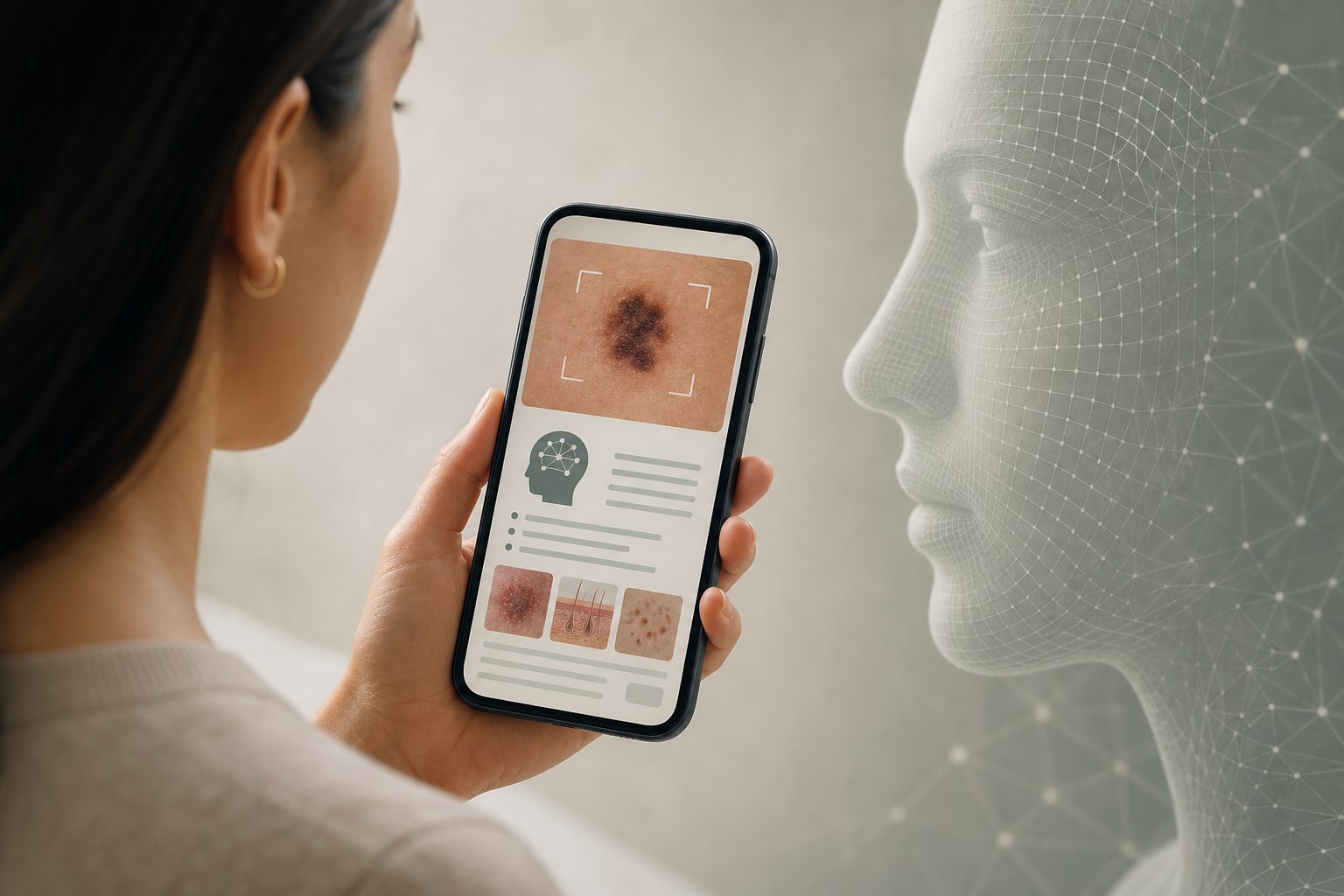
This study evaluates the effectiveness of an AI-powered application in enhancing consumer understanding of dermatological conditions. Participants reported their comprehension and management steps after interacting with deidentified case vignettes that included images and clinical metadata.

Background

Skin conditions affect approximately 2 billion people globally, with significant disparities in access to dermatological care. AI-based tools have the potential to improve access and diagnostic accuracy, particularly for underserved populations. This study explores how AI can assist consumers in understanding their skin concerns and making informed decisions about seeking care.

Data Highlights

The AI model demonstrated an accuracy ranging from 80.9% for the top 1 condition to 99.2% for the top 7 conditions based on an external validation set.

Key Findings

  • AI algorithms show performance comparable to trained specialists in dermatology.
  • Direct-to-consumer AI applications may enhance user confidence in identifying skin concerns.
  • Participants interacted with an AI application that provided matching conditions and supplemental information.
  • The study utilized deidentified datasets, waiving the need for further review and consent.
  • Variability in image quality and performance on darker skin tones raises concerns about equitable access.

Clinical Implications

The findings suggest that AI applications can serve as valuable tools for consumer education in dermatology. However, attention must be paid to the quality of input data and potential biases to ensure equitable access and accurate information.

Conclusion

The study highlights the potential of AI-enhanced resources in improving patient understanding of dermatological issues, while also identifying areas for further investigation regarding accuracy and equity.

Related Resources & Content

  1. American Academy of Dermatology, Teledermatology Standards, 2024 -- Guidance on AI in Dermatology
  2. World Health Organization, Ethics and governance of artificial intelligence for health, 2025 -- Guidance on AI Models
  3. Canadian Dermatology Association, AI Adoption in Dermatology Position Statement, 2026 -- Position on AI in Dermatology
  4. asco ai in oncology — How Well Do Patient-Facing Resources on AI and Cancer Measure Up?
  5. The ASCO Post — AI Avatar–Based Education Leads to Improved Patient Understanding of Radiation Treatment Plans
  6. The ASCO Post — Online Patient Resources About AI and Cancer Found Lacking
  7. npj Digital Medicine — Tailoring Prostate Cancer Education for Patients Through an EHR-Integrated Large Language Model Agent
  8. How Well Do Patient-Facing Resources on AI and Cancer Measure Up?
  9. AI Avatar–Based Education Leads to Improved Patient Understanding of Radiation Treatment Plans
  10. Online Patient Resources About AI and Cancer Found Lacking
  11. https://assets.ctfassets.net/1ny4yoiyrqia/595kopCF5lW6B72fXh06Bj/a3135982ce2160d358cb5334dec636e1/AAD-Teledermatology-Standards.pdf
  12. Ethics and governance of artificial intelligence for health: Guidance on large multi-modal models
  13. Artificial Intelligence Adoption in Dermatology
  14. (PDF) European Expert Consensus on Essential Variables for Teledermatological Assessment of Skin Tumours
  15. Evaluating General-Purpose LLMs for Patient-Facing Use: Dermatology-Centered Systematic Review and Meta-Analysis | medRxiv
  16. Assessment of the Utility of Artificial Intelligence-Based Chatbots in Patient Education: A Systematic Review and Meta-Analysis - Sameh Hany Emile, Nir Horesh, Zoe Garoufalia, Rachel Gefen, Marylise Boutros, Steven D. Wexner, 2026
  17. Diagnostic accuracy of ChatGPT in dermatology: A meta-analysis of textual versus visual prompts - ScienceDirect
  18. Artificial Intelligence in Patient Education for Androgenetic Alopecia: A Comparative Study of ChatGPT, Gemini, and Deepseek R1 | Dermatology Practical & Conceptual
  19. Are Multimodal LLMs Ready for Clinical Dermatology? A Real-World Evaluation in Dermatology
  20. Enhancing Patient Education in Cataract Surgery Using a Conversational Artificial Intelligence Chatbot: A Pilot Randomized Controlled Trial - PubMed
  21. The impact of a SmartPhone applicatiOn for skin cancer risk assessmenT on the healthcare system (SPOT-study): A randomized controlled trial | medRxiv
  22. AHRQ Health Literacy Universal Precautions Toolkit | Agency for Healthcare Research and Quality
  23. AHRQ Health Literacy Universal Precautions Toolkit Third Edition
  24. The CDC Clear Communication Index | The CDC Clear Communication Index | Centers for Disease Control and Prevention
  25. How to Use the Index | The CDC Clear Communication Index | Centers for Disease Control and Prevention
  26. A health literacy analysis of online patient-directed educational materials about mycobacterium avium complex - PMC
  27. Marketing Submission Recommendations for a Predetermined Change Control Plan for Artificial Intelligence-Enabled Device Software Functions | FDA
  28. Artificial Intelligence in Software as a Medical Device | FDA
  29. Final FDA guidance on PCCP includes clarification on version control | RAPS

Original Source(s)

Related Content