Potential association between IL-17A inhibition and blood pressure reduction in patients with axial spondyloarthritis - Report - MDSpire

Potential association between IL-17A inhibition and blood pressure reduction in patients with axial spondyloarthritis

  • By

  • Qianqian Wu

  • Yifan Wang

  • Ting Zhao

  • Jie Guo

  • Xiaomin Zhang

  • Yang Tu

  • Feng Wang

  • June 22, 2026

  • 0 min

Share

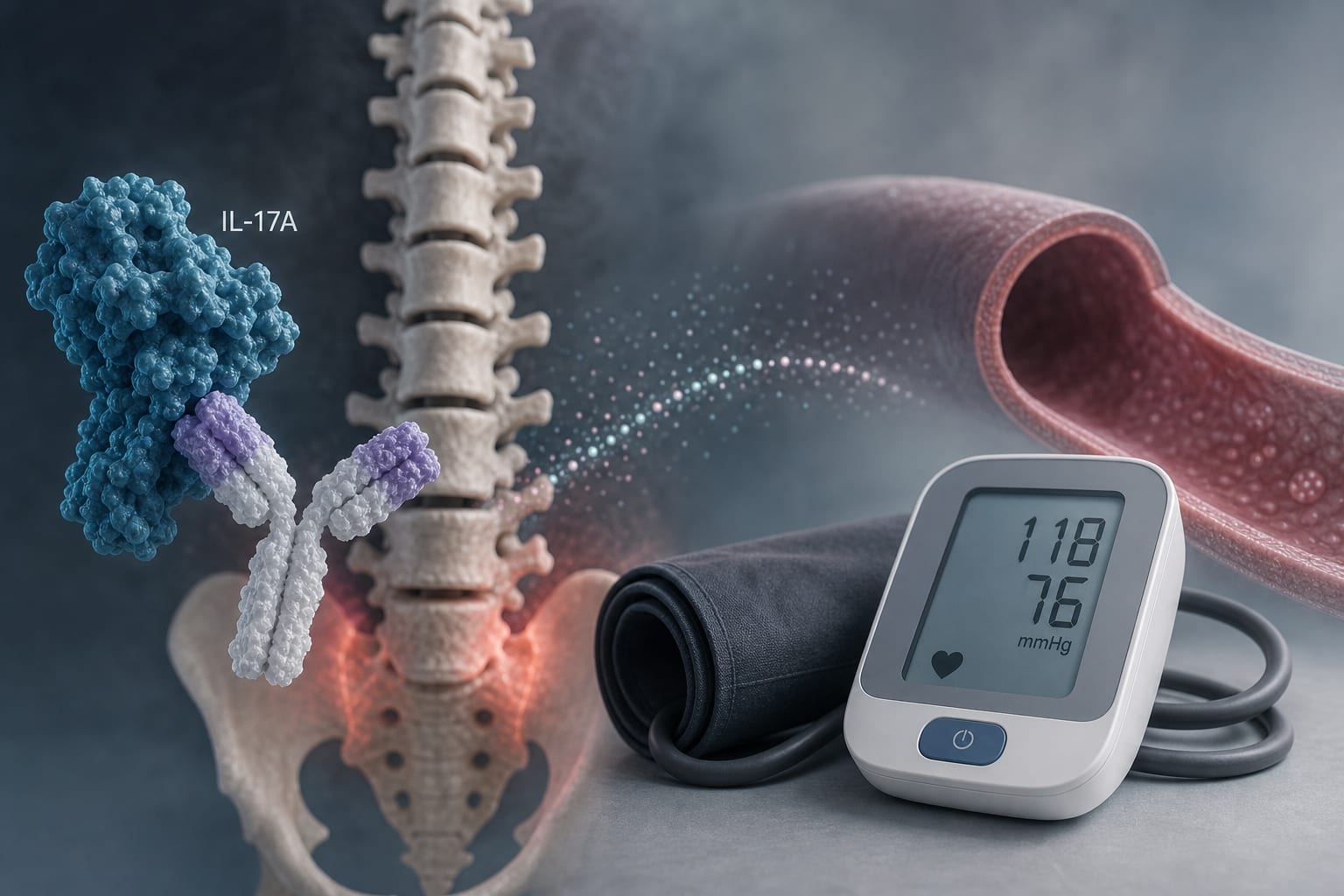
Clinical Report: Exploring the Link Between IL-17A Blockade and Blood Pressure Changes in Axial Spondyloarthritis Patients

Overview

This study investigates the effects of IL-17A inhibition on blood pressure in patients with axial spondyloarthritis (ax-SpA).

Background

Axial spondyloarthritis (ax-SpA) is a chronic inflammatory disease that can lead to increased cardiovascular risk, particularly hypertension. Managing blood pressure in this population is crucial.

Data Highlights

MeasureChange (mmHg)p-value
Systolic Blood Pressure (SBP)-4.800.071
Diastolic Blood Pressure (DBP)-5.100.016

Key Findings

  • IL-17A inhibition significantly improved disease activity and reduced inflammatory markers (p < 0.001).
  • Systolic blood pressure (SBP) decreased by 0.90 mmHg every 4 weeks (95% CI: -1.87 to 0.07, p = 0.071).
  • Diastolic blood pressure (DBP) decreased by 0.91 mmHg per month (95% CI: -1.64 to -0.17, p = 0.016).
  • Patients with baseline hypertension showed a more pronounced decline in DBP.
  • No significant side effects were observed in hematological, hepatic, or renal function tests (p < 0.01).

Clinical Implications

The findings suggest that IL-17A inhibitors may have a beneficial effect on blood pressure management in ax-SpA patients, particularly those with hypertension. Clinicians should consider monitoring blood pressure in patients receiving IL-17A inhibition.

Conclusion

This exploratory study provides preliminary evidence that IL-17A inhibition may reduce blood pressure in ax-SpA patients.
Related Resources & Content

  1. Clinical Rheumatology, 2020 -- Assessment of the effectiveness and safety of interleukin-17A inhibitors for treating ankylosing spondylitis: a systematic review and meta-analysis of randomized controlled trials
  2. Clinical Rheumatology, 2018 -- Age Influences Efficacy of Anti-TNFα Therapy in Ankylosing Spondylitis Patients and Correlates with CD8 Cell TNFα Production
  3. Clinical Rheumatology, 2022 -- Alterations in Th17, Treg, and helper innate lymphoid cell populations in the peripheral blood of individuals with rheumatoid arthritis
  4. ASAS-EULAR recommendations for the management of axial spondyloarthritis: 2022 update - PubMed
  5. Efficacy and safety of ixekizumab through 52 weeks in two phase 3, randomised, controlled clinical trials in patients with active radiographic axial spondyloarthritis (COAST-V and COAST-W) - PubMed
  6. Early-stage hypertension defined by the 2017 ACC/AHA blood pressure guideline carries excessive cardiovascular risk in axial spondyloarthritis patients
  7. Clinical Rheumatology — The Role of Serum APRIL, BAFF, and IL-10 Levels in Assessing Disease Activity and Flare Prediction in Systemic Lupus Erythematosus Is Limited
  8. ASAS-EULAR recommendations for the management of axial spondyloarthritis: 2022 update - PubMed
  9. Efficacy and safety of ixekizumab through 52 weeks in two phase 3, randomised, controlled clinical trials in patients with active radiographic axial spondyloarthritis (COAST-V and COAST-W) - PubMed
  10. Early-stage hypertension defined by the 2017 ACC/AHA blood pressure guideline carries excessive cardiovascular risk in axial spondyloarthritis patients

Original Source(s)

Related Content