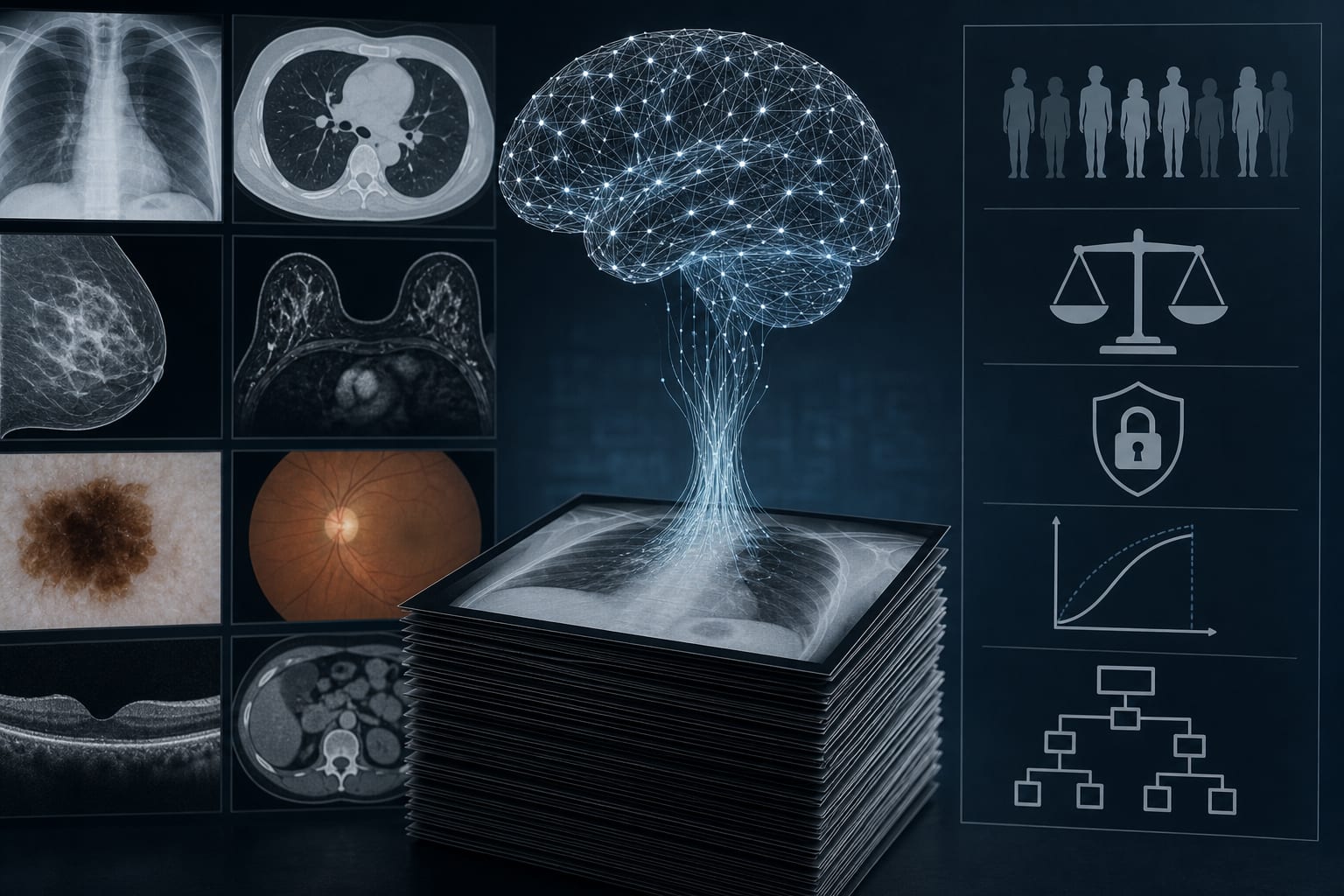
Clinical Report: Ethical Considerations of Artificial Intelligence in Medical Imaging
Overview
This systematic review evaluates 24 studies on AI in medical imaging, focusing on diagnostic accuracy, fairness, privacy, and explainability. Key findings indicate that while many studies report high accuracy, caution is advised due to methodological limitations.
Background
The integration of artificial intelligence in medical imaging has the potential to enhance diagnostic capabilities across various diseases. Ethical considerations such as fairness, privacy, and explainability are crucial for responsible deployment.
Data Highlights
No numerical data or trial data provided in the article.
Key Findings
Explainability methods like Grad-CAM and LIME are prevalent in AI studies but do not guarantee clinical validity.
High accuracy rates (>90%) reported in several studies may be misleading due to reliance on internal validation and curated datasets.
Fairness and privacy-preserving learning are underrepresented in the literature, highlighting a gap in responsible AI evaluation.
Bias in AI performance can occur across demographic factors, necessitating careful consideration in algorithm design.
Responsible AI evaluation should include external validation, privacy risk analysis, and post-deployment monitoring.
Clinical Implications
Healthcare professionals should be aware of the limitations of AI diagnostic tools, particularly regarding their accuracy and fairness across diverse patient populations.
Conclusion
The review emphasizes the need for transparency and ethical governance in the deployment of AI in medical imaging.
This internationally-recognized symposium is the premier global platform for showcasing the fast advancement of technology and the rapid integration of MRI into radiotherapy applications into the field of radiation oncology.