A federated digital twin reveals cytomegalovirus reactivation impairs CAR-T cell therapy via IL-15-mediated cytokine competition in B-Cell lymphoma - Report - MDSpire

A federated digital twin reveals cytomegalovirus reactivation impairs CAR-T cell therapy via IL-15-mediated cytokine competition in B-Cell lymphoma

  • By

  • Padmasri Sridharan

  • Mini Ghosh

  • June 12, 2026

  • 0 min

Share

Clinical Report: CMV Reactivation Impairs CAR-T Therapy via Cytokine Competition

Overview

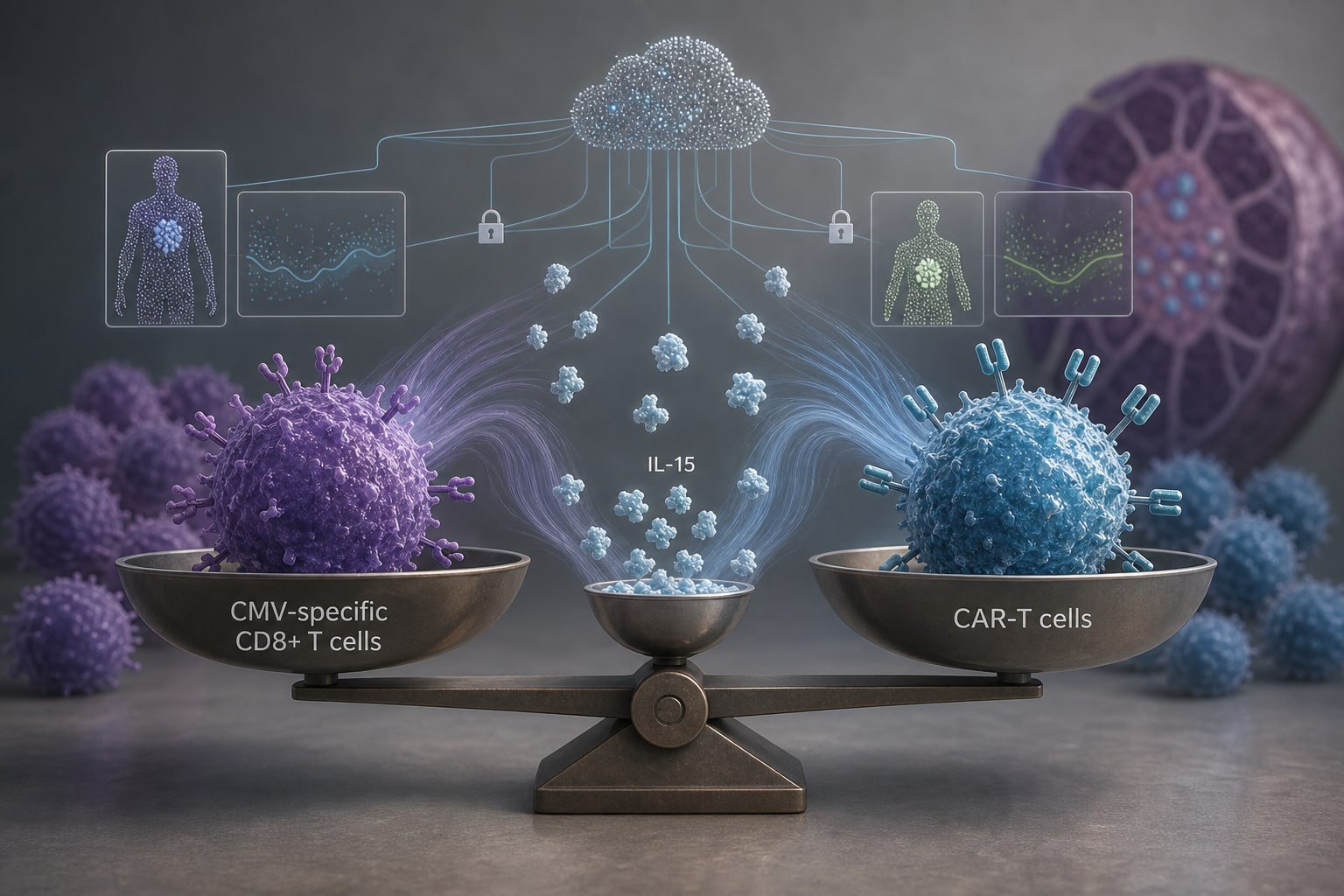
Cytomegalovirus (CMV) reactivation significantly hinders the effectiveness of CAR-T cell therapy in B-cell lymphoma patients through IL-15-driven cytokine competition. A novel digital twin model demonstrated that CMV-specific CD8+ T cells compete with CAR-T cells for essential homeostatic cytokines, leading to impaired CAR-T expansion and reduced progression-free survival.

Background

The advent of CAR-T therapy has revolutionized treatment for relapsed or refractory B-cell malignancies, yet challenges such as primary resistance and relapse persist. CMV reactivation in seropositive patients receiving CAR-T therapy is linked to poorer outcomes, necessitating a deeper understanding of the underlying immunological mechanisms. Identifying these mechanisms is crucial for improving patient management and therapy efficacy.

Data Highlights

OutcomeValue
AUROC for CMV reactivation predictionSignificantly outperforming existing clinical risk scores
Reduction in projected six-month progressionSignificant with digital-twin-guided antiviral prophylaxis
Hazard ratio for model-predicted kinetic impairmentIndependently predicted progression-free survival

Key Findings

  • CMV reactivation is associated with reduced peak CAR-T expansion.
  • The digital twin model predicts clinically significant CMV reactivation with high accuracy.
  • Resource competition for homeostatic cytokines is a key mechanism linking CMV reactivation to CAR-T therapy impairment.
  • Pre-infusion frequency of CMV-specific T-cell precursors is a primary driver of CAR-T expansion variance.
  • A risk-adapted antiviral prophylaxis strategy can reduce drug exposure while improving outcomes.

Clinical Implications

Healthcare providers should monitor CMV reactivation in seropositive patients undergoing CAR-T therapy, as it may significantly affect treatment outcomes. Implementing a digital twin-guided approach for antiviral prophylaxis could enhance patient management and improve progression-free survival rates.

Conclusion

The findings underscore the importance of addressing CMV reactivation in CAR-T therapy to optimize treatment efficacy. Further validation through randomized controlled trials is essential to establish the clinical utility of the digital twin model in guiding interventions.

Related Resources & Content

  1. Blood Cancer Journal, 2025 -- Development of chronic inflammatory demyelinating polyneuropathy (CIDP) following cilta-cel treatment
  2. Blood Cancer Journal, 2021 -- Enhancing CAR T-cell Therapy for Multiple Myeloma: Opportunities for Advancement
  3. The ASCO Post, 2025 -- Bicistronic CAR T-Cell Therapy Demonstrates Clinical Activity in Relapsed or Refractory B-Cell ALL KEY POINTS
  4. Blood Cancer Journal, 2021 -- Infections and Viral Reactivation During Extended Monitoring of Multiple Myeloma Patients Undergoing Anti-BCMA CAR Therapy
  5. Survival with Axicabtagene Ciloleucel in Large B-Cell Lymphoma | New England Journal of Medicine
  6. Recommendations from the 10th European Conference on Infections in Leukaemia for the management of cytomegalovirus in patients after allogeneic haematopoietic cell transplantation and other T-cell-engaging therapies
  7. Frontiers | The role of interleukin-15 in the development and treatment of hematological malignancies
  8. Where CAR-T sits today and why CMV matters
  9. Current guidance and consensus on CMV after CAR-T
  10. Frontiers | The role of interleukin-15 in the development and treatment of hematological malignancies

Original Source(s)

Related Content