Clinical Report: Predictive Scoring Model for Tracheostomy Decannulation
Overview
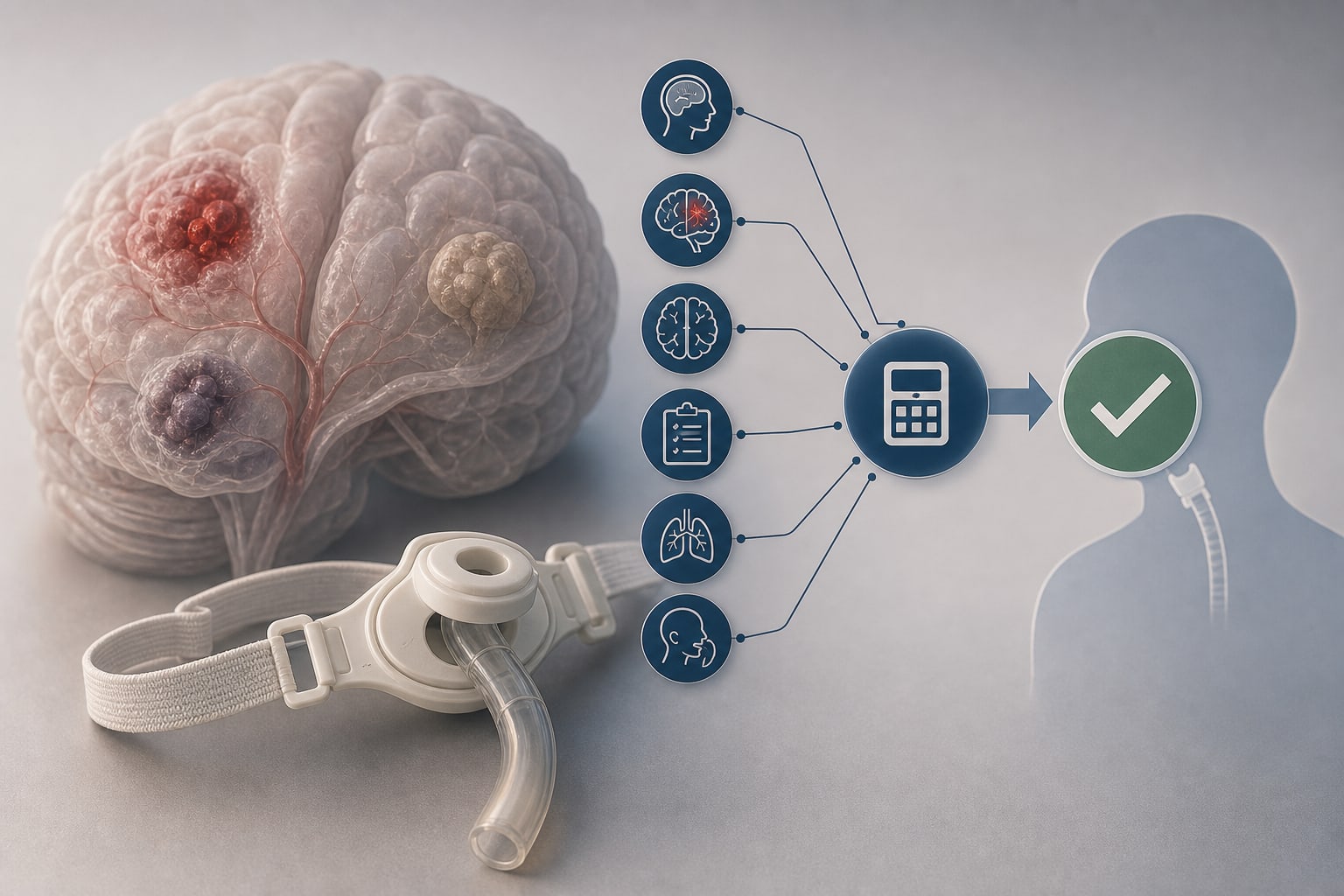
This study developed a predictive scoring system for successful tracheostomy decannulation in neurosurgical patients, achieving a decannulation success rate of 63.9%. The scoring model demonstrated high accuracy with an AUC of 0.933 in the training set and 0.930 in the validation set.
Background
Tracheostomy is often necessary for neurosurgical patients requiring prolonged artificial airway support due to various conditions. Successful decannulation is crucial for restoring spontaneous ventilation and improving patient quality of life. However, failure rates for decannulation can be high.
Data Highlights
Predictive Factor
Odds Ratio (OR)
95% Confidence Interval (CI)
Supratentorial lesion location
8.05
1.87–34.72
GCS >8 at decannulation
21.21
4.89–92.04
< 6 airway suctioning episodes/24 h
13.13
3.31–52.09
Capping trial ≥24 h
6.28
1.62–24.43
Serum albumin ≥35 g/L
4.71
1.43–15.51
Key Findings
The overall decannulation success rate was 63.9% among 216 patients.
Five independent predictive factors were identified for successful decannulation.
The scoring system ranged from 0 to 15 points, with a cut-off of ≥10 points.
The model achieved a sensitivity of 91.9% and specificity of 84.3% at the cut-off.
Temporal validation confirmed the model's performance in a later cohort.
Clinical Implications
The scoring system provides a tool for clinicians to assess the likelihood of successful decannulation in neurosurgical patients.
Conclusion
The developed predictive scoring system offers a method to support decannulation decisions in neurosurgical patients.