Integrated single-cell and bulk RNA sequencing analyses identify a myeloid state-related gene signature for molecular subtyping in stomach adenocarcinoma - Report - MDSpire

Integrated single-cell and bulk RNA sequencing analyses identify a myeloid state-related gene signature for molecular subtyping in stomach adenocarcinoma

  • By

  • Ruinan Li

  • Bohong Wei

  • Bin Sun

  • Mingji Li

  • Yingman Wang

  • Xiangyu Zhao

  • Yuntao Yao

  • Duowu Zou

  • Zirui He

  • July 16, 2026

Share

Clinical Report: Combined Single-Cell and Bulk RNA Sequencing Reveals a Gene Signature Related to Myeloid States for Molecular Classification in Gastric Adenocarcinoma

Overview

This study identifies a myeloid state-related prognostic gene signature in gastric adenocarcinoma (STAD) and establishes a molecular classification framework (STAD-MSC) that stratifies patients based on immune infiltration.

Background

Gastric adenocarcinoma (STAD) is a highly heterogeneous malignancy with a poor prognosis, particularly in advanced stages. The tumor microenvironment, particularly the role of myeloid cells, is crucial in modulating tumor behavior. Current classification methods based on histopathology are insufficient, necessitating novel approaches that consider the dynamic interactions within the tumor microenvironment.

Data Highlights

FindingDetails
MSRPGs Identified32 myeloid state-related prognostic genes across five distinct states
Patient SubtypesThree subtypes: low immune infiltration (LI-STAD), moderate immune infiltration (MI-STAD), high immune infiltration (HI-STAD)
Survival AnalysisHI-STAD subtype showed the poorest overall survival (global log-rank p = 0.018)
5-Gene Risk ModelEvaluated in a 355-patient validation cohort
Protein ClassifierThree-protein classifier (NNMT/AXL/COL1A1) stratified a 70-patient cohort with significant differences in OS and PFS
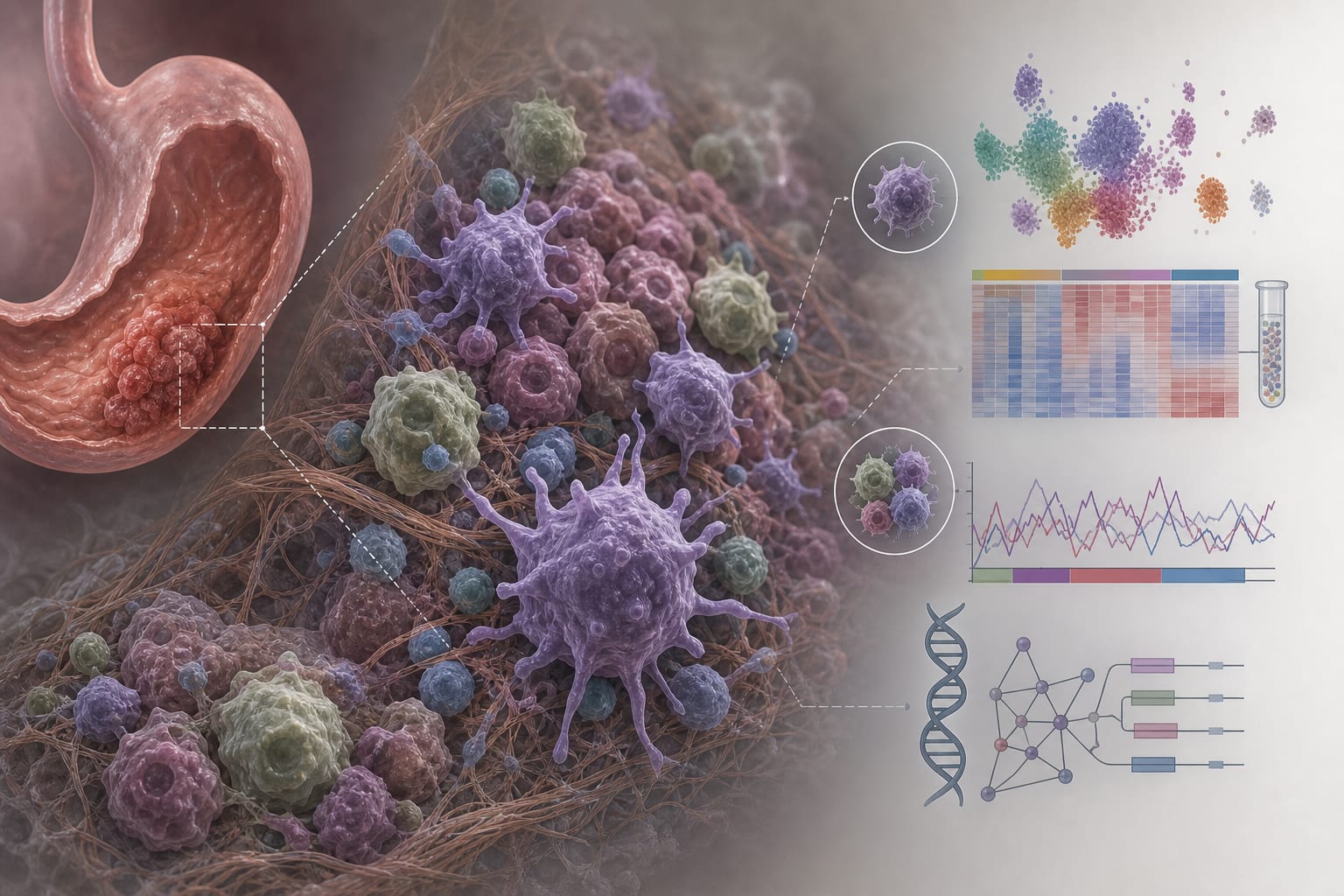
Key Findings

  • Identified 32 myeloid state-related prognostic genes (MSRPGs).
  • Patients were classified into three subtypes based on immune infiltration levels.
  • HI-STAD subtype exhibited the poorest overall survival outcomes.
  • A 5-gene prognostic signature was validated in a public cohort.
  • Exploratory pharmacogenomic analysis suggested potential subtype-specific therapeutic vulnerabilities.

Clinical Implications

The STAD-MSC framework provides a novel approach for stratifying gastric adenocarcinoma patients based on myeloid cell states.

Conclusion

The establishment of the STAD-MSC framework enhances the molecular classification of gastric adenocarcinoma.

Related Resources & Content

  1. Journal of Gastroenterology, 2013 -- A gene expression signature linked to immune suppression in the tumor microenvironment correlates with unfavorable outcomes in gastric adenocarcinoma
  2. Frontiers in Immunology, 2026 -- Tumor-intrinsic immune-genetic dynamics identify RNASE1 as an immune-evasion-associated biomarker and predictor of checkpoint blockade response in gastric adenocarcinoma
  3. Journal of Gastroenterology, 2015 -- Analysis of Long Non-Coding RNA Expression Patterns Linked to Varying Metastatic Capabilities in Gastric Cancer
  4. Gastric Cancer, 2019 -- Discovery of a molecular profile for prognostic subtypes in diffuse gastric carcinoma
  5. Immunotherapy and Targeted Therapy for Advanced Gastroesophageal Cancer: ASCO Guideline Update | Journal of Clinical Oncology
  6. Trastuzumab Deruxtecan or Ramucirumab plus Paclitaxel in Gastric Cancer | New England Journal of Medicine
  7. Immunotherapy and Targeted Therapy for Advanced Gastroesophageal Cancer: ASCO Guideline Update | Journal of Clinical Oncology
  8. Trastuzumab Deruxtecan or Ramucirumab plus Paclitaxel in Gastric Cancer | New England Journal of Medicine
  9. Neoadjuvant PD-1/PD-L1 inhibitors plus chemotherapy in locally advanced gastric cancer: A systematic review and meta-analysis - ScienceDirect

Original Source(s)

Related Content