Baroreflex sensitivity impairment in Long-COVID patients: a diagnostic tool for classifying the autonomic dysfunction spectrum - Report - MDSpire

Baroreflex sensitivity impairment in Long-COVID patients: a diagnostic tool for classifying the autonomic dysfunction spectrum

  • By

  • Alejandro Sáinz-Jiménez

  • Ignacio Romero Fragoso

  • Guadalupe Estrella Salazar Calderon

  • Santiago Martinez-Falcon

  • Hannah Molinari Luna

  • Jesus Portocarrero Nieto

  • Andrea Barajas-Aguilar

  • Antonio Barajas-Martínez

  • Isael Guillermo García Macedo

  • Felipe Gonzalez-Alvarez

  • Maria Silvia Lopez-Yañez

  • Brayans Becerra-Luna

  • Raul Martinez-Memije

  • Erwin Chiquete

  • Carlos Cantu

  • Karla Maria Tamez-Torres

  • Jose Sifuentes-Osornio

  • Claudia Lerma

  • Ruben Fossion

  • Tania Reyes-Cruz

  • Bruno Estañol

  • Jose de Jesus Aceves-Buendia

  • July 14, 2026

Share

Clinical Report: Impaired Baroreflex Sensitivity in Long-COVID Patients

Overview

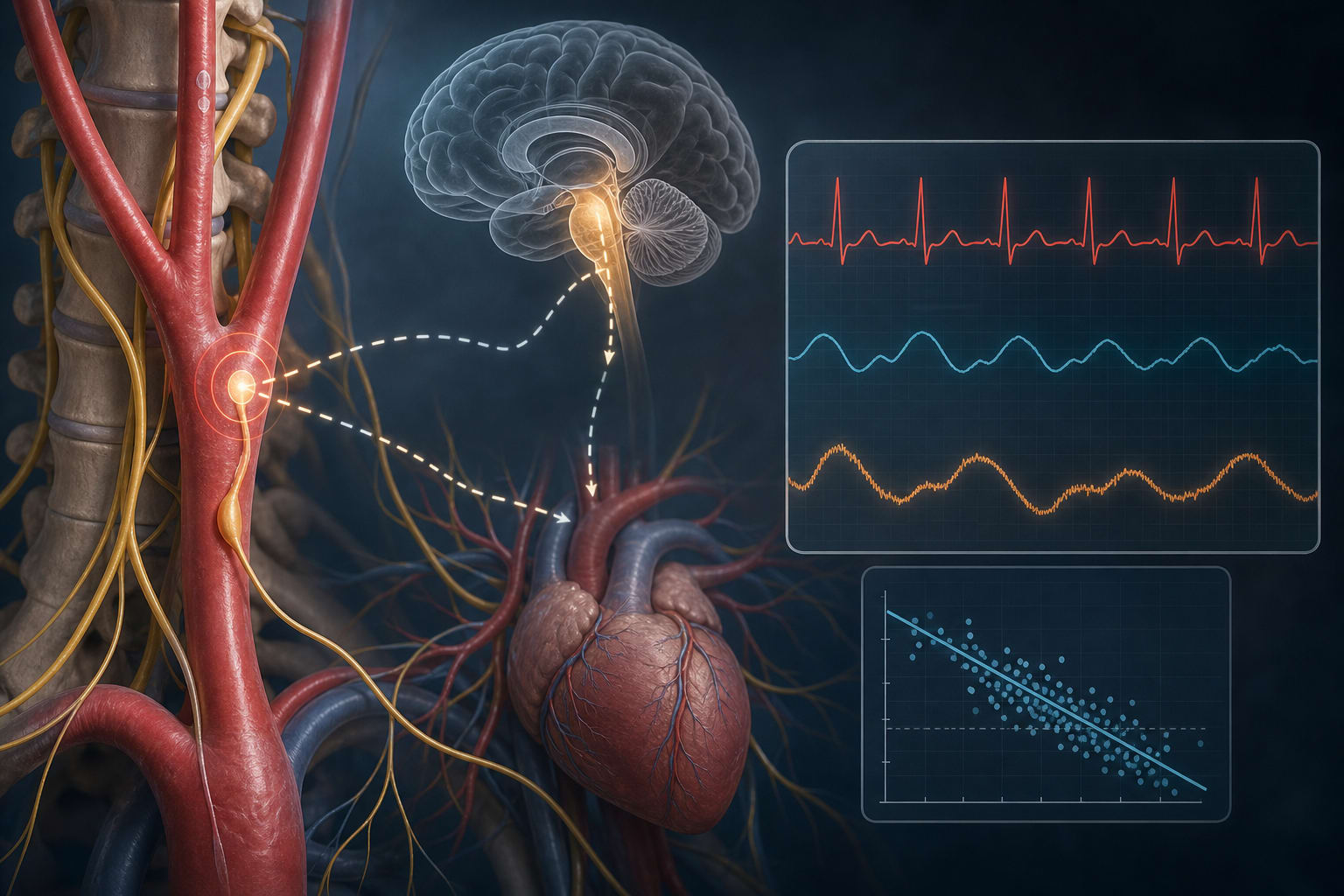
This study identifies impaired baroreflex sensitivity (BRS) as a potential diagnostic indicator for autonomic dysfunction in Long-COVID patients. The findings indicate that decreased BRS correlates with increased arterial blood pressure and heart rate.

Background

Long-COVID encompasses a range of symptoms persisting beyond three months post-COVID-19 infection, including cardiovascular issues like Postural Orthostatic Tachycardia Syndrome (POTS). The identification of autonomic dysfunction through baroreflex sensitivity measurements may aid in diagnosing and classifying these patients.

Data Highlights

ParameterLong-COVID PatientsHealthy Controls
Baroreflex Sensitivity (BRS)Significantly lowerNormal
Arterial Blood PressureHigherNormal
Heart RateHigherNormal
Heart Rate VariabilityLowerNormal

Key Findings

  • Long-COVID patients exhibited significantly lower baroreflex sensitivity compared to healthy controls.
  • Lower BRS was associated with higher arterial blood pressure and heart rate in patients.
  • Patients with decreased BRS showed overall lower heart rate variability.
  • The proposed method for assessing BRS allows for detailed characterization of cardiovascular dynamics.
  • This analysis can help reclassify patients within the spectrum of symptoms similar to POTS.

Clinical Implications

The findings indicate that measuring baroreflex sensitivity could serve as a diagnostic tool for identifying autonomic dysfunction in Long-COVID patients.

Conclusion

Impaired baroreflex sensitivity may provide a diagnostic indicator for autonomic dysfunction in Long-COVID patients.

Related Resources & Content

  1. Frontiers in Medicine, 2026 -- Long COVID as a network disorder: a mechanism-anchored framework for biological stratification and therapeutic targeting
  2. Frontiers in Immunology, 2026 -- Cardiovascular sequelae of Long COVID: immune dysregulation inflammation as central drivers
  3. Frontiers in Cardiovascular Medicine, 2026 -- Unraveling the cardiovascular burden of long COVID: symptom profiles, underlying mechanisms, and clinical management insights
  4. JAMA Network Open, 2026 -- Cognitive Rehabilitation and Functional Outcomes in Long COVID–Related Cognitive Impairment: A Randomized
  5. Long COVID Clinical Guidance | Long COVID | CDC, 2026
  6. Neurocardiac Autonomic Dysfunction in Patients With Post‐COVID‐19 Condition: A Systematic Review and Meta‐Analysis - PMC
  7. Long COVID Clinical Guidance | Long COVID | CDC
  8. Neurocardiac Autonomic Dysfunction in Patients With Post‐COVID‐19 Condition: A Systematic Review and Meta‐Analysis - PMC

Original Source(s)

Related Content