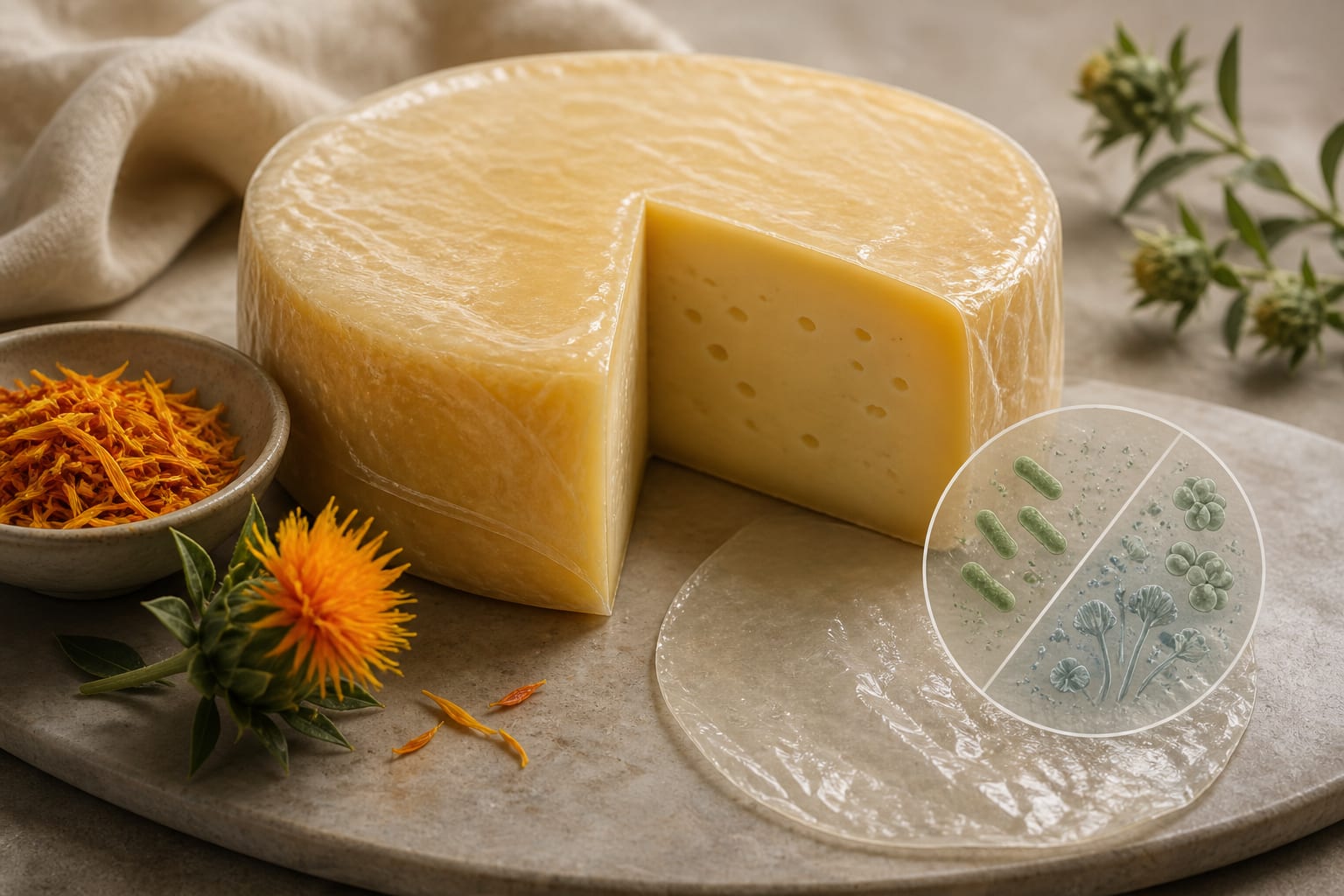
Novel Active Edible Coating Utilizing Safflower (Carthamus tinctorius L.) Extract for Microbial Control and Prolonged Shelf Life of Cheese
-
By
-
Elif Ayça Güler
-
Elif Özbey
-
August 15, 2026
Clinical Report: Novel Active Edible Coating Utilizing Safflower Extract for Cheese
Overview
This study investigates the use of an active edible coating made from safflower extract to enhance microbial control and extend the shelf life of cheese.
Background
Food packaging plays a vital role in maintaining food quality and safety, particularly for perishable items like cheese, which are prone to microbial spoilage. The transition to biodegradable and edible packaging solutions is essential to reduce environmental impact and food waste. Active edible coatings, such as those incorporating safflower extract, represent a promising advancement in food preservation technology.
Data Highlights
No numerical data provided in the source material.
Key Findings
- Active edible coatings can release bioactive compounds that manage microbial spoilage.
- Conventional packaging materials raise environmental concerns due to their non-biodegradability.
- Malatya cheese is particularly vulnerable to microbial spoilage during storage.
- Edible coatings can enhance food quality by acting as protective barriers against moisture loss and oxidative deterioration.
Clinical Implications
The use of active edible coatings may provide a novel strategy for enhancing the safety and shelf life of cheese, potentially reducing the risk of microbial contamination. This approach aligns with sustainability goals in food packaging.
Conclusion
The development of safflower extract-based edible coatings offers a solution for microbial control in cheese.
Related Resources & Content
- Dirpan et al., 2023 -- Edible Coatings and Their Role in Food Preservation
- Nastasi et al., 2022 -- Enhancing Food Quality with Edible Coatings
- Ali et al., 2025 -- Limitations of Non-Active Edible Coatings
- Yaashikaa et al., 2023 -- Advantages of Active Edible Coatings
- Galus and Kadzińska, 2015 -- Plasticizers in Edible Coatings
- the medicine maker — Some Like it Hot (Melted)
- the analytical scientist — Simple, Rapid Detection of Edible Oil Oxidation Using Direct MS
- the medicine maker — Edible Security
- CDC warns of Listeria outbreak linked to requesón/soft ricotta cheese
- How Listeria Spread: Soft Cheeses and Raw Milk
- Active and intelligent materials | EFSA
- Guidance for Industry: Preparation of Premarket Submissions for Food Contact Substances
- Legislation - Food Safety - European Commission
- 21 CFR Part 172[Docket No. 00F–0175]Food Additives Permitted for Direct Addition to Food for Human Consumption;
- GUIDELINES FOR THE CONTROL OF SHIGA TOXIN-PRODUCING E. COLI (STEC) IN RAW BEEF,
- Application of food-grade antimicrobial emulsions in active packaging coatings and films: A comprehensive review - PubMed
- Frontiers | Advances and Trends in the Use of Edible Coatings for Extending the Shelf Life of Foods: A Scoping Review
- Effect of natural biopolymers-based packaging materials on shelf life of dairy products - ScienceDirect
- A systematic review and meta-analysis of the use of plant essential oils and extracts in the development of antimicrobial edible films for dairy application - PMC
Based on findings from:
Innovative active edible coating with safflower (Carthamus tinctorius L.) extract for microbial inactivation and shelf life extension of cheese
Elif Ayça Güler, Elif Özbey. Food Safety And Risk, 2026.
https://link.springer.com/article/10.1186/s40550-026-00158-w
This content is an AI-generated, fully rewritten summary based on a published scholarly article. It does not reproduce the original text and is not a substitute for the original publication. Readers are encouraged to consult the source for full context, data, and methodology.