Desynchronization of Pacemaker Activity in the Sinoatrial Node Triggered by Stress
-
By
-
Dong-Gyun Han
-
June 23, 2026
Desynchronization of Pacemaker Activity in the Sinoatrial Node Triggered by Stress
Background
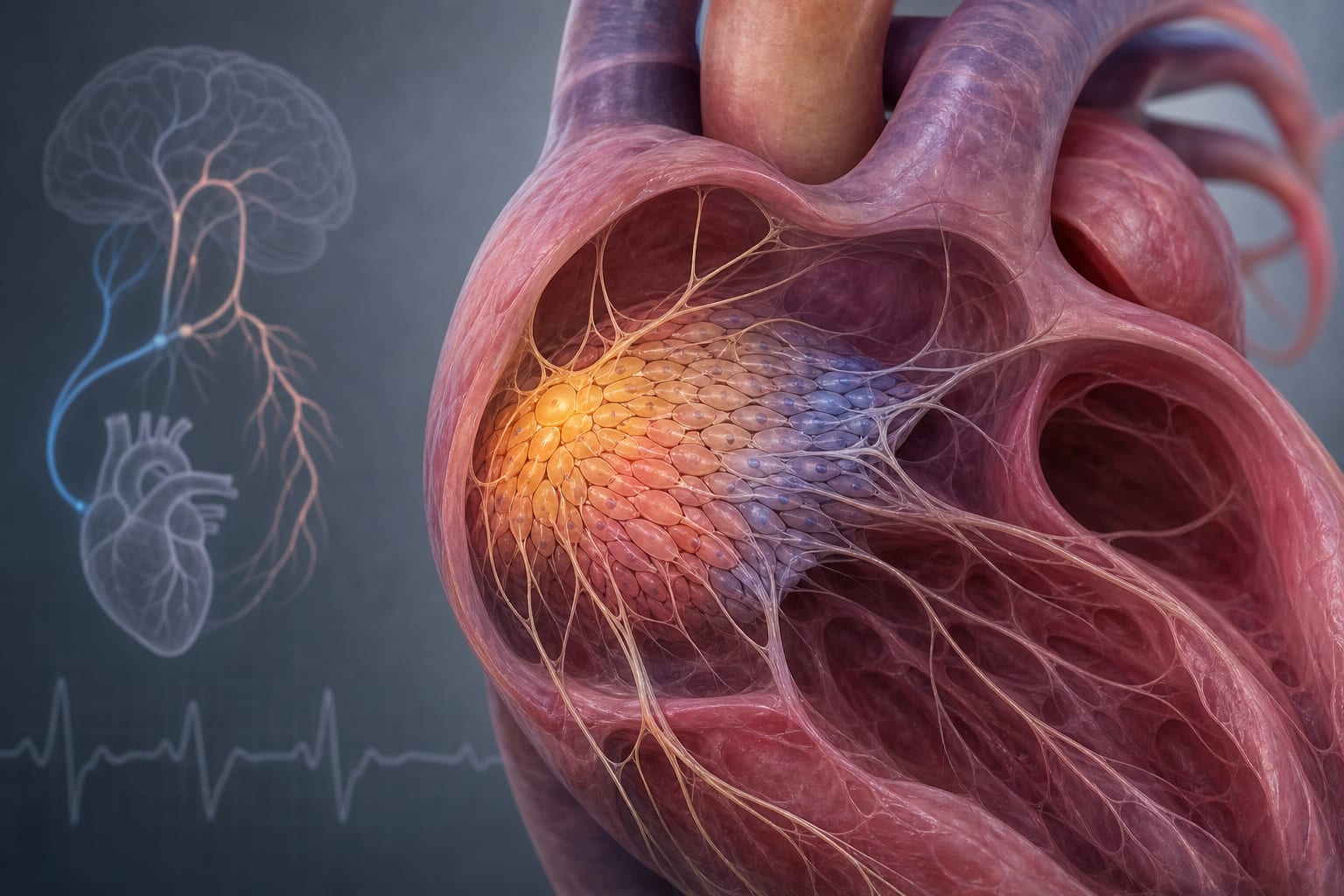
The sinoatrial node is crucial for maintaining heart rhythm, functioning as a network of pacemaker cells rather than a single oscillator. Understanding the mechanisms behind arrhythmias, particularly during stress, is vital. Stress-related changes in autonomic function can exacerbate arrhythmogenic risks.
Data Highlights
No numerical data or trial data were provided in the source material.
Key Findings
- The SAN operates as a heterogeneous population of pacemaker cells.
- Stress can lead to transient loss of synchronization within the SAN, increasing arrhythmogenic vulnerability.
- Physiological challenges such as autonomic stress and upright posture can amplify intrinsic-frequency dispersion.
- Arrhythmogenesis may result from disturbed coordination within the pacemaker system.
- Attention should be directed to synchronization reserve during physiological challenges.
Clinical Implications
Clinicians should consider the impact of stress and physiological transitions on SAN function when evaluating arrhythmia risk.
Conclusion
The SAN-centered hypothesis emphasizes synchronization among pacemaker cells in maintaining cardiac rhythm under stress.
Related Resources & Content
- Clinical Research in Cardiology, 2026 -- Real-time three-dimensional systolic dyssynchrony index predicts pacing-induced left ventricular dysfunction and cardiomyopathy
- European Journal of Preventive Cardiology, 2023 -- Chronotropic incompetency during stress echocardiography: a new paradigm for mortality and cardiac event prediction?
- European Journal of Preventive Cardiology, 2023 -- Chronotropic incompetence during exercise or pharmacological stress is associated with reduced survival in patients with chronic coronary syndromes
- Pediatric Cardiology — Regulation of Cardiac Electrophysiology Through Transcriptional and Epigenetic Mechanisms
- Sinoatrial Node Impulses Emerge From Unique Synchronization Processing Solutions of Partially Stochastic Local Calcium Signals
- Frontiers | Sinoatrial node heterogeneity and fibroblasts increase atrial driving capability in a two-dimensional human computational model
- 2018 ACC/AHA/HRS guideline on the evaluation and management of patients with bradycardia and cardiac conduction delay
- 2023 HRS/APHRS/LAHRS guideline on cardiac physiologic pacing for the avoidance and mitigation of heart failure - PubMed
- 2017 ACC/AHA/HRS Guideline for the Evaluation and Management of Patients With Syncope: A Report of the American College of Cardiology/American Heart Association Task Force on Clinical Practice Guidelines and the Heart Rhythm Society | JACC
- 2015 Heart Rhythm Society Expert Consensus Statement on the Diagnosis and Treatment of Postural Tachycardia Syndrome, Inappropriate Sinus Tachycardia, and Vasovagal Syncope - Heart Rhythm
- Ventricular Pacing or Dual-Chamber Pacing for Sinus-Node Dysfunction | New England Journal of Medicine
- Danish Multicenter Randomised Study on AAI Versus DDD Pacing in Sick Sinus Syndrome - American College of Cardiology
- Atrial pacing minimization in sinus node dysfunction and risk of incident atrial fibrillation: a randomized trial - PMC
- Atrial antitachycardia pacing and managed ventricular pacing in bradycardia patients with paroxysmal or persistent atrial tachyarrhythmias: the MINERVA randomized multicentre international trial - PMC
Based on findings from:
Stress-induced pacemaker desynchronization in the sinoatrial node
Dong-Gyun Han. Frontiers In Cardiovascular Medicine, 2026.
https://www.frontiersin.org/journals/cardiovascular-medicine/articles/10.3389/fcvm.2026.1852965/full
This content is an AI-generated, fully rewritten summary based on a published scholarly article. It does not reproduce the original text and is not a substitute for the original publication. Readers are encouraged to consult the source for full context, data, and methodology.