Systematic Review and Meta-Analysis of Prediction Models for Post-Induction Hypotension in Patients Undergoing General Anesthesia
-
By
-
Lu Meng
-
Kanru Zhao
-
Long Shen
-
Yuelai Yang
-
September 8, 2026
Clinical Report: Systematic Review and Meta-Analysis of Prediction Models for Post-Induction Hypotension
Overview
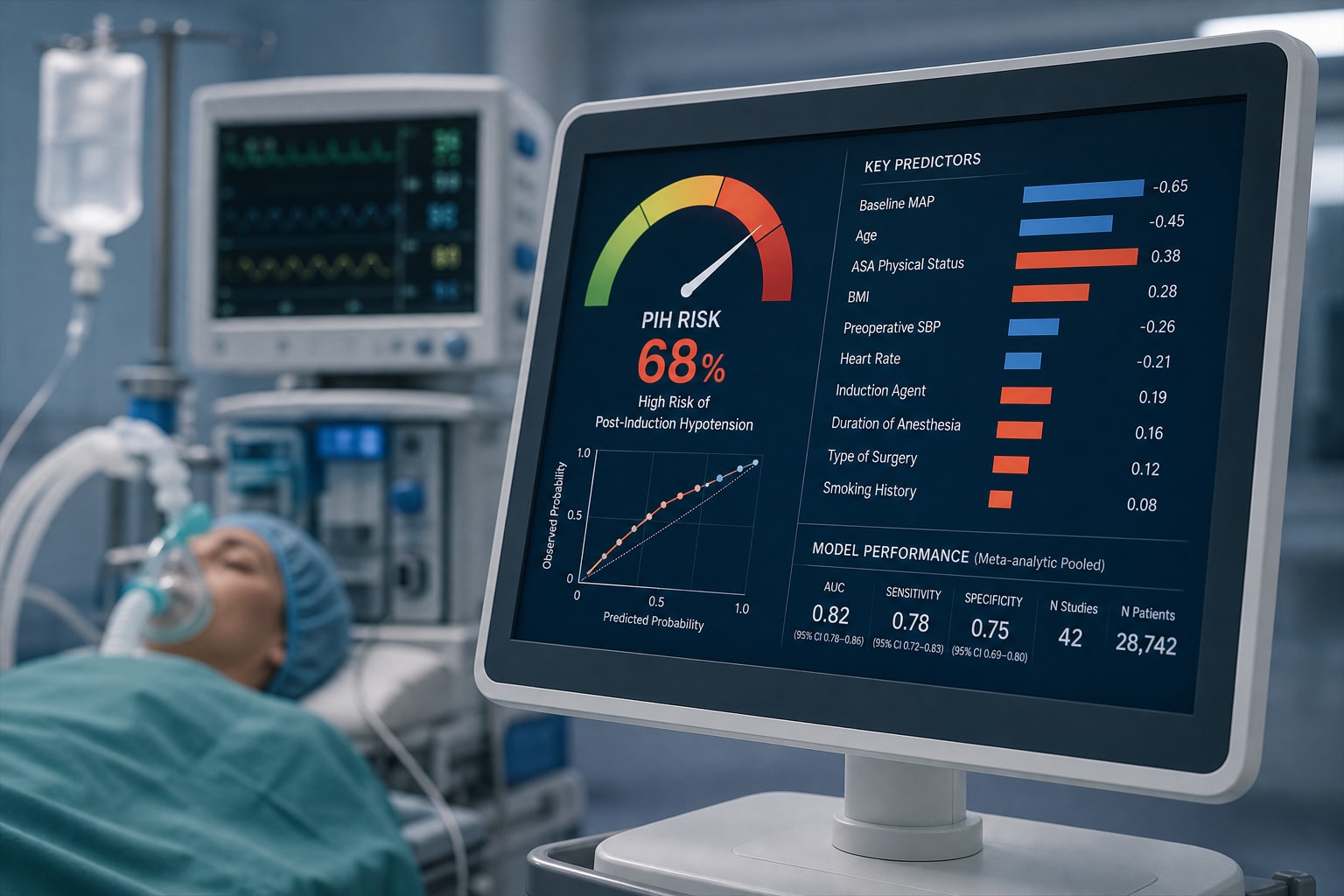
This systematic review evaluates the predictive performance and methodological quality of models for post-induction hypotension (PIH) in patients undergoing general anesthesia.
Background
Post-induction hypotension is a common occurrence during general anesthesia and is linked to adverse outcomes such as myocardial injury and acute kidney injury. Despite the development of prediction models using machine learning techniques, there has been insufficient systematic assessment of their quality and performance.
Data Highlights
| Study Characteristics | Findings |
|---|---|
| Number of Studies | 17 |
| Number of Prediction Models | 50 |
| Total Patients | 40,864 |
| Pooled AUC | 0.81 (95% CI 0.77–0.85) |
| Age OR | 1.031 (95% CI 1.016–1.046) |
| Propofol Dose OR | 1.357 (95% CI 1.046–1.667) |
Key Findings
- 15 studies (88.2%) were classified as high risk of bias.
- Discrimination estimates varied: modeling groups AUC 0.68 to 0.95; validation groups AUC 0.654 to 0.893.
- Only one model underwent external institutional validation with an AUC of 0.654.
- The pooled AUC for optimal models reached 0.81.
- Significant predictors of PIH included age and propofol dose.
Clinical Implications
The findings highlight the need for improved methodological rigor in developing PIH prediction models. Clinicians should be aware of the limitations of current models, particularly regarding their risk of bias and lack of external validation.
Conclusion
While existing PIH prediction models demonstrate good discrimination, their high risk of bias and absence of external validation are noted.
Related Resources & Content
- Frontiers in Anesthesiology, 2026 -- Impact of hypotension prediction index on mean arterial pressure and stroke volume index during pancreatic surgery: a retrospective pre-post observational pilot study
- Intensive Care Medicine, 2023 -- The Impact of Hypotension in Intensive Care on Patient Mortality and Morbidity: A Systematic Review and Meta-Analysis
- Langenbeck's Archives of Surgery, 2026 -- Comparing Personalized and Standard Intraoperative Blood Pressure Management on Serum Creatinine Levels and MicroRNA-21-5p Release in Hypertensive Elderly Patients Following Major Gastrointestinal Surgery: A Randomized Controlled Study
- 2024 AHA/ACC/ACS/ASNC/HRS/SCA/SCCT/SCMR/SVM Guideline for Perioperative Cardiovascular Management for Noncardiac Surgery, JACC
- Intra-operative haemodynamic monitoring and management of adults having noncardiac surgery: A statement from the European Society of Anaesthesiology and Intensive Care - PubMed
- aace endocrine ai — Machine learning model predicts post-op hypotension in T2DM
- Current guidelines on perioperative blood-pressure management
- Intra-operative haemodynamic monitoring and management of adults having noncardiac surgery: A statement from the European Society of Anaesthesiology and Intensive Care - PubMed
- Effect of Individualized vs Standard Blood Pressure Management Strategies on Postoperative Organ Dysfunction Among High-Risk Patients Undergoing Major Surgery: A Randomized Clinical Trial - PMC
- Continuous intra-arterial versus intermittent oscillometric arterial pressure monitoring and hypotension during induction of anaesthesia: the AWAKE randomised trial - ScienceDirect
- Frontiers | Prediction Models for Post-Induction Hypotension in Patients Undergoing General Anesthesia: A Systematic Review and Meta-Analysis
- Preoperative Ultrasound for the Prediction of Postinduction Hypotension: A Systematic Review and Meta-Analysis - PMC
Based on findings from:
Prediction models for post-induction hypotension in patients undergoing general anesthesia: a systematic review and meta-analysis
Lu Meng, Kanru Zhao, Long Shen, Yuelai Yang. Frontiers In Medicine, 2026.
https://www.frontiersin.org/journals/medicine/articles/10.3389/fmed.2026.1887058/full
This content is an AI-generated, fully rewritten summary based on a published scholarly article. It does not reproduce the original text and is not a substitute for the original publication. Readers are encouraged to consult the source for full context, data, and methodology.