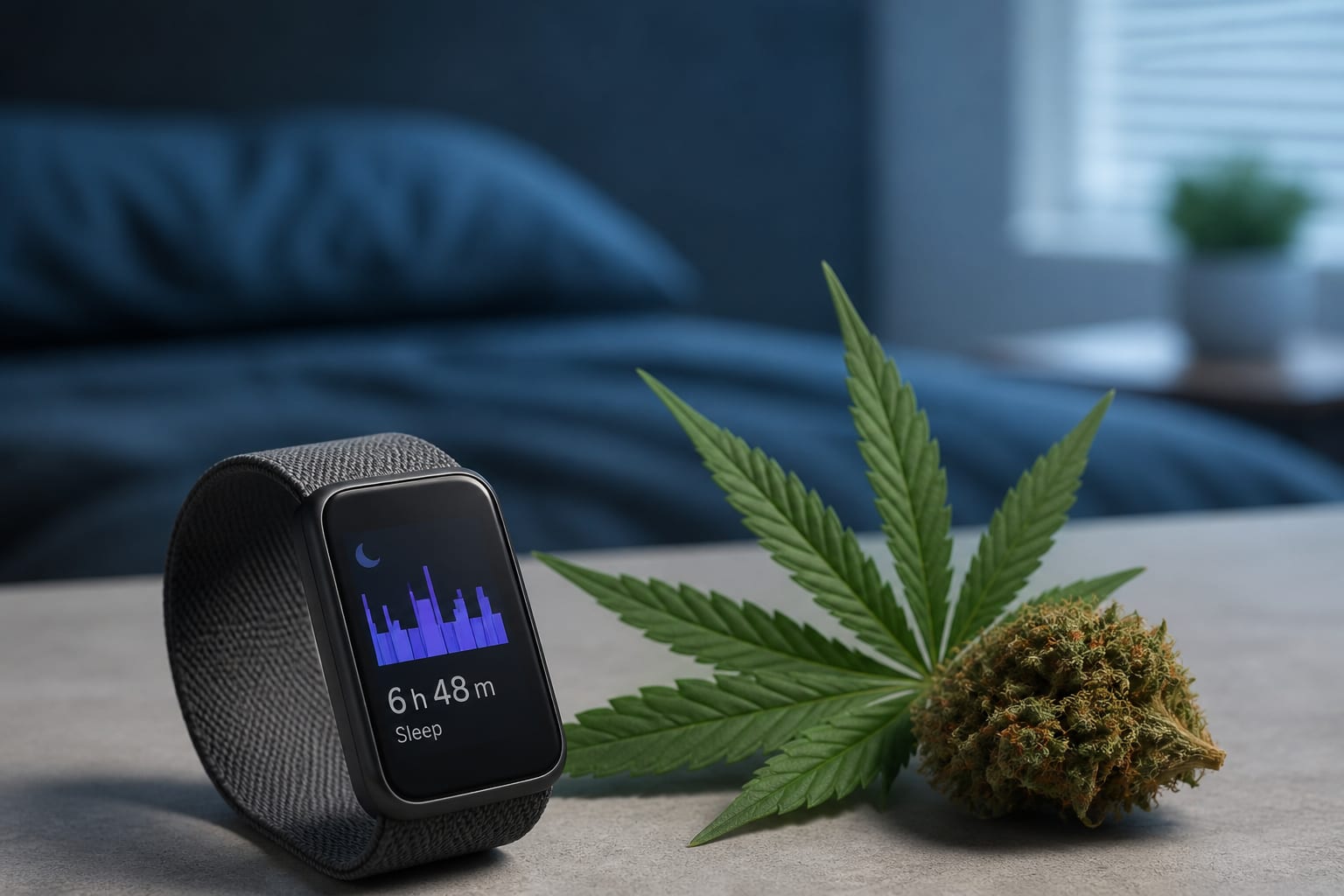
Recent and Long-Term Cannabis Use in Relation to Sleep Among Middle-Aged Adults
-
By
-
Thanh-Huyen T. Vu
-
Kristen L. Knutson
-
Reto Auer
-
Julian Jakob
-
Donald M. Lloyd-Jones
-
Mercedes R. Carnethon
-
October 9, 2026
Clinical Report: Recent and Long-Term Cannabis Use in Relation to Sleep
Overview
This CARDIA cohort study examined associations between cannabis use over 35 years and sleep outcomes measured in middle age. The supplied article context and related report describe greater cumulative and recent recreational cannabis use as associated with poorer objectively measured sleep quality; the provided material does not include the study’s detailed numerical results.
Background
Cannabis use, including use as a sleep aid, has increased in the United States, while sleep difficulties are common among adults. Sleep health includes duration, efficiency, and quality, and has been associated bidirectionally with substance use. Prior evidence on cannabis and sleep has been limited and inconsistent, with much of the research relying on short-term trials, cross-sectional designs, or self-reported sleep. Longitudinal evidence on recreational cannabis use and sleep outcomes has been scarce.
Data Highlights
| Study feature | Details reported in the supplied material |
|---|---|
| Study | Coronary Artery Risk Development in Young Adults (CARDIA), with follow-up through 2020–2022 |
| Original cohort | 5,115 Black and White adults aged 18–30 years at enrollment in 1985–1986, recruited at four US sites |
| Analytic cohort | 1,266 participants; objective-sleep analyses included 891 and subjective-sleep analyses included 1,128, with 753 in both |
| Cannabis exposure | Repeated self-reports of lifetime and recent nonmedical use; cumulative exposure expressed in cannabis-years |
| Sleep assessment | Sleep outcomes assessed at the year-35 examination; objective and subjective measures were collected |
| Reported association | The related article summary describes greater cumulative and recent recreational cannabis use as associated with poorer objectively measured sleep quality among middle-aged adults |
Key Findings
- The study used longitudinal CARDIA data spanning 35 years to examine cumulative and recent cannabis use in relation to sleep during middle age.
- The original cohort enrolled 5,115 Black and White adults aged 18 to 30 years at four US locations in 1985–1986.
- After exclusions, 1,266 participants were included; 891 contributed to objective-sleep analyses and 1,128 to subjective-sleep analyses.
- Cannabis exposure was assessed repeatedly through self-reported lifetime and past-30-day use, with cumulative exposure summarized in cannabis-years.
- The related article summary reports that greater cumulative and recent recreational cannabis use may be associated with poorer objectively measured sleep quality.
- The supplied study context states that prior evidence on cannabis and sleep has been limited and inconsistent, and that longitudinal evidence has been scarce.
Clinical Implications
The supplied study material describes an observational association and does not establish that cannabis use causes poorer sleep. For chronic insomnia, the American College of Physicians recommends cognitive behavioral therapy for insomnia as initial treatment, and the 2025 VA/DoD guideline suggests against cannabis or its derivatives for treatment of chronic insomnia disorder.
Conclusion
In this middle-aged CARDIA sample, greater cumulative and recent recreational cannabis use was reported as associated with poorer objectively measured sleep quality. The supplied material does not provide detailed effect estimates or establish causality.
Related Resources & Content
- JAMA Network Open, 2026 -- Recent and Cumulative Cannabis Use and Sleep in Middle-Aged Adults
- MDSpire News -- Cannabis use may be tied to worse sleep
- American College of Physicians, Annals of Internal Medicine, 2016 -- Management of Chronic Insomnia Disorder in Adults: A Clinical Practice Guideline From the American College of Physicians
- US Department of Veterans Affairs and Department of Defense, 2025 -- Clinical Practice Guideline for the Management of Chronic Insomnia Disorder and Obstructive Sleep Apnea
- JAMA Network Open — Edible Cannabis and Pain, Sleep, and Mental Health Management in Older Adults
- MDSpire News — Cannabis Conundrum: One in Six Patients Tokes for Relief
- MDSpire News — The Cannabis Talk That Doesn't Happen
- Recent and Cumulative Cannabis Use and Sleep in Middle-Aged Adults
- Management of Chronic Insomnia Disorder in Adults: A Clinical Practice Guideline From the American College of Physicians
- Clinical Practice Guideline for the Management of Chronic Insomnia Disorder and Obstructive Sleep Apnea
- Management of Chronic Insomnia Disorder in Adults: A Clinical Practice Guideline From the American College of Physicians | Annals of Internal Medicine
- Behavioral and psychological treatments for chronic insomnia disorder in adults: an American Academy of Sleep Medicine clinical practice guideline - PMC
- Effectiveness of cannabinoids on subjective sleep quality in people with and without insomnia or poor sleep: A systematic review and meta-analysis of randomised studies - ScienceDirect
- Cannabis and sleep architecture: A systematic review and meta-analysis - ScienceDirect
- Effects of a cannabidiol/terpene formulation on sleep in individuals with insomnia: a double-blind, placebo-controlled, randomized, crossover study - PMC
Based on findings from:
Recent and Cumulative Cannabis Use and Sleep in Middle-Aged Adults
Thanh-Huyen T. Vu, Kristen L. Knutson, Reto Auer, Julian Jakob, Donald M. Lloyd-Jones, Mercedes R. Carnethon. Jama Network Open, 2026.
https://jamanetwork.com/journals/jamanetworkopen/fullarticle/2855118
This content is an AI-generated, fully rewritten summary based on a published scholarly article. It does not reproduce the original text and is not a substitute for the original publication. Readers are encouraged to consult the source for full context, data, and methodology.