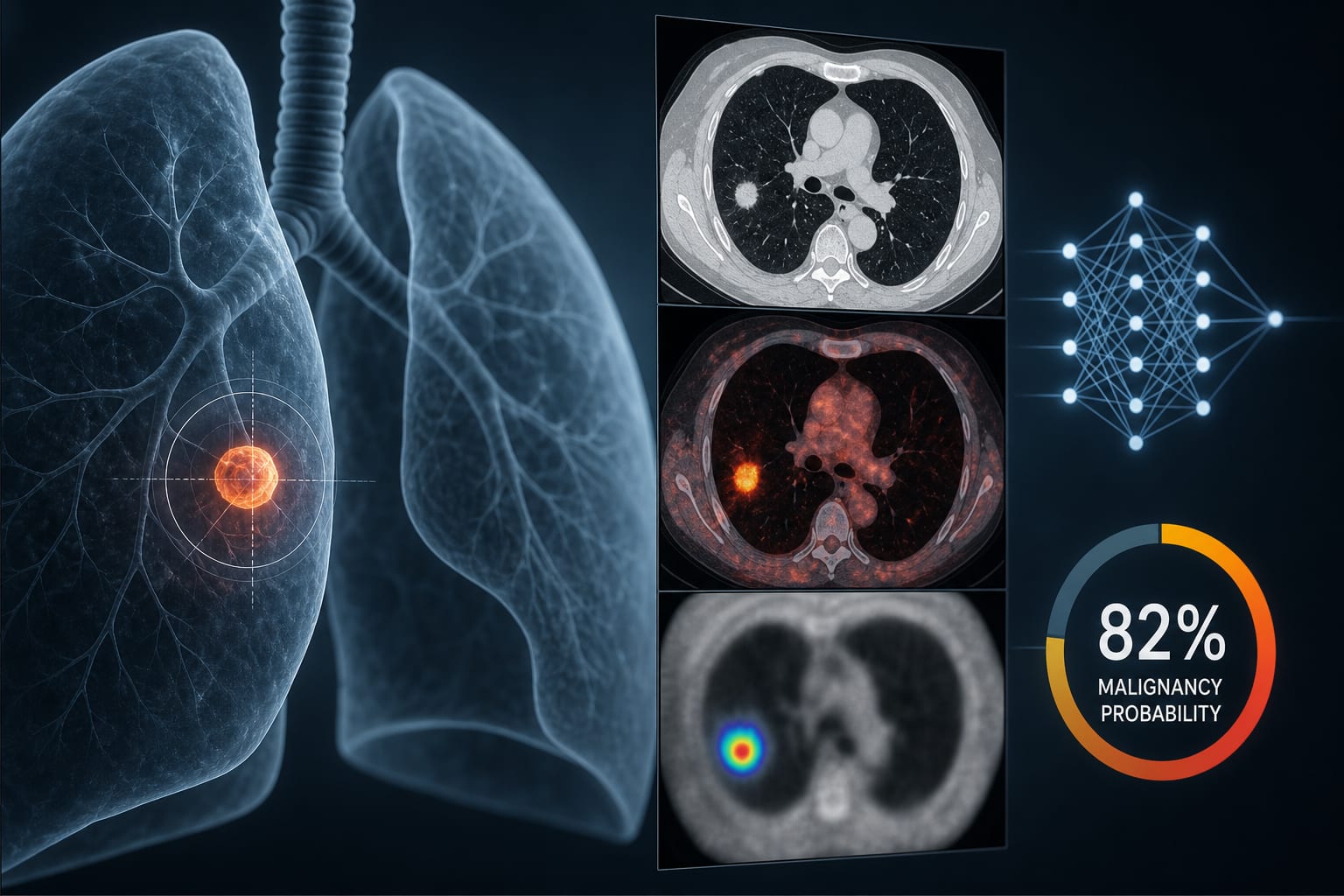
Clinical Report: Estimation of Malignancy Risk in Pulmonary Nodules Using Deep Learning Techniques on PET/CT Imaging
Overview
This study presents the development and evaluation of a deep learning model, AITO-PETCT-MP, designed to estimate malignancy probability in indeterminate pulmonary nodules using [18F]FDG-PET/CT imaging. The model's performance was compared against established clinical benchmarks.
Background
The early detection of lung cancer significantly reduces mortality, leading to increased identification of pulmonary nodules. Most detected nodules are benign, necessitating effective risk assessment strategies to minimize unnecessary interventions while ensuring early-stage cancer detection. Current guidelines recommend using models like the Brock and Herder models for risk assessment.
Data Highlights
No numerical data or trial results were provided in the source material.
Key Findings
The AITO-PETCT-MP model was developed to estimate malignancy probability in indeterminate pulmonary nodules.
It was evaluated against the Herder model and clinician assessments using histological confirmation and follow-up as reference standards.
The study included a balanced cohort of patients with indeterminate pulmonary nodules identified through multiple data collection methods.
Histological confirmation was used to establish the reference standard for malignancy, while benign nodules were classified based on two years of follow-up.
Deep learning models have been evaluated against traditional risk assessment models.
Clinical Implications
The AITO-PETCT-MP model may assist clinicians in assessing malignancy risk in pulmonary nodules.
Conclusion
The development of the AITO-PETCT-MP model represents an advancement in the assessment of malignancy risk in pulmonary nodules.
by Lars Leijten, Erik H. J. G. Aarntzen, Roel L. J. Verhoeven, Adrienne H. Brouwers, Bram Geurts, Johannes A. van der Heide, Klaas Pieter Koopmans, Walter Noordzij, Gilles N. Stormezand, Erik H. F. M. van der Heijden, Colin Jacobs
Pancreatic adenocarcinoma, the most common form of pancreatic cancer, accounts for roughly 90 to 95 percent of cases. It's notoriously difficult to catch early, because symptoms often don't appear until the disease has already spread