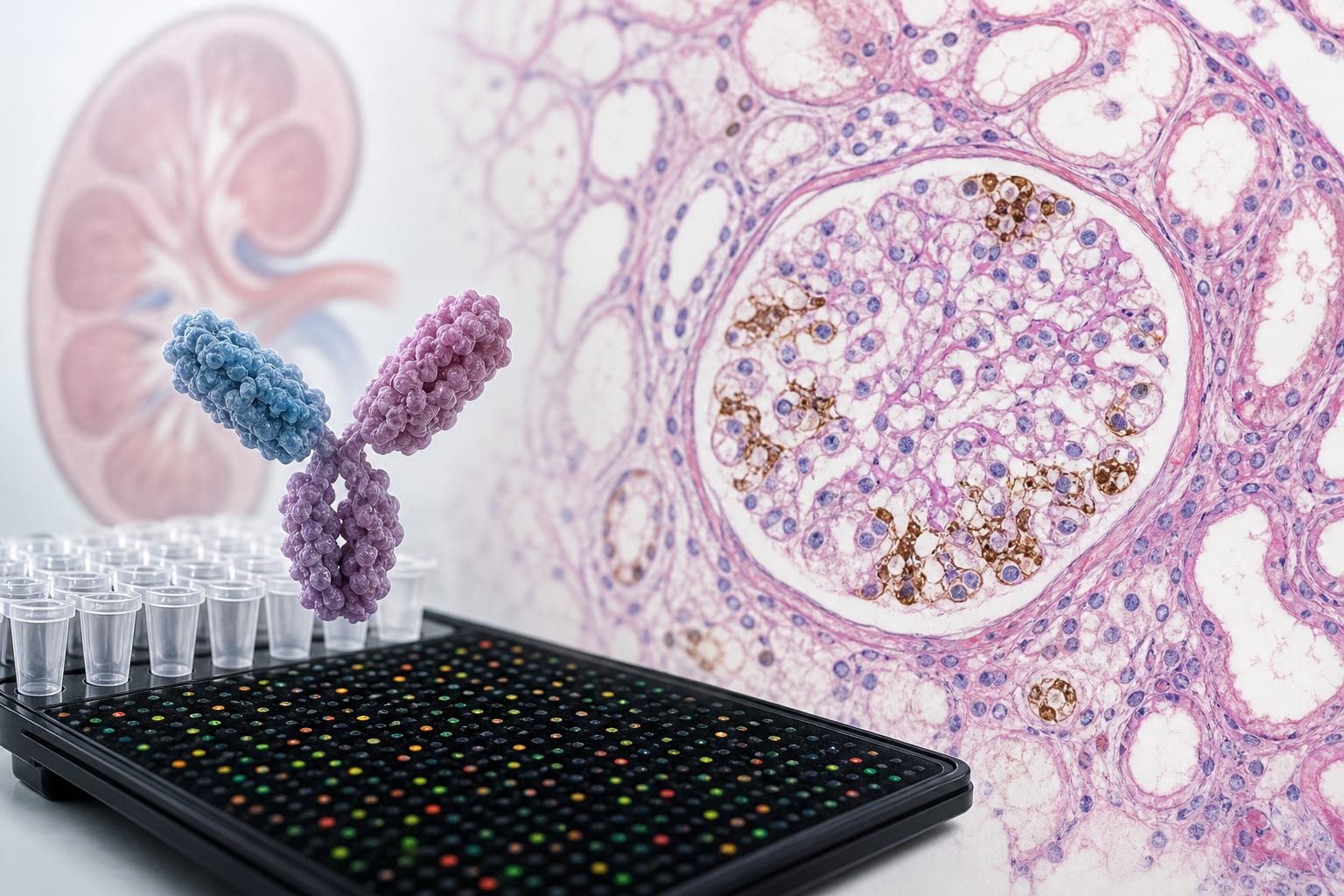
Intragraft donor-specific antibodies reflect histologic heterogeneity in kidney allografts with concurrent serum DSA - Report - MDSpire

Intragraft donor-specific antibodies reflect histologic heterogeneity in kidney allografts with concurrent serum DSA

  • By

  • Hyunjae Lee

  • Eun Youn Roh

  • Tae-Shin Kim

  • Yu Jung Choi

  • Inseong Oh

  • Hajeong Lee

  • Sang Il Min

  • Chang Wook Jeong

  • Hee Gyung Kang

  • Jongwon Ha

  • Kyung Chul Moon

  • Eun Young Song

  • June 23, 2026

  • 0 min

Share

Intragraft Donor-Specific Antibodies Correlate with Histological Variability

Overview

This study investigates the relationship between intragraft donor-specific antibodies (gDSA) and histological findings in kidney transplant recipients with concurrent serum donor-specific antibodies (sDSA).

Background

The presence of donor-specific antibodies (DSA) is a critical factor in the pathogenesis of antibody-mediated rejection (ABMR) in kidney transplantation. Understanding the relationship between circulating sDSA and intragraft gDSA can provide insights into the immunologic context of histological variability in kidney allografts.

Data Highlights

Histologic DiagnosisgDSA Positivity Rate
C4d-only lesions100.0%
aABMR90.9%
aABMR+TCMR83.3%
caABMR44.4%
No rejection22.7%
aTCMR14.3%

Key Findings

  • The prevalence of gDSA varied significantly across different histologic diagnoses (P = 3.3 × 10⁻⁴).
  • gDSA positivity was highest in C4d-only lesions (100.0%) and aABMR (90.9%).
  • The gDSA positive rate in aABMR was significantly higher than in the no-rejection group (P = 0.003; OR 34, 95% CI 3.5–334).
  • The MFI sum of gDSA was significantly higher in aABMR, aABMR+TCMR, and C4d-only lesions (P = 0.009, 0.035, and 0.007, respectively).
  • No significant difference was observed in the sum of sDSA MFI across histologic groups.

Clinical Implications

The findings indicate that assessing gDSA in kidney biopsies may provide information regarding the immunologic status of the graft in cases of aABMR.

Conclusion

Intragraft gDSA levels correlate with specific histological findings in kidney transplant recipients.

Related Resources & Content

  1. Bone Marrow Transplantation, 2023 -- Are Donor Specific Antibodies (DSA) the Sole Contributing Factor to Primary Graft Failure?
  2. Frontiers in Immunology, 2026 -- Timing matters: tacrolimus intra-patient variability within the initial seven months forecasts de novo DSA and subsequent rejection in a Chinese kidney transplant cohort
  3. Frontiers in Immunology, 2026 -- Association of PIRCHE scores and allograft injury in kidney transplant recipients
  4. The Banff 2024 Kidney Meeting Report: Rejection as a spectrum of phenotypes and focus on differential diagnostic reasoning, PubMed
  5. Frontiers Publishing Partnerships, 2023 -- The Clinical Utility of Post-Transplant Monitoring of Donor-Specific Antibodies in Stable Renal Transplant Recipients: A Consensus Report With Guideline Statements for Clinical Practice
  6. Suboptimal early graft performance negatively affects long-term results in living donor kidney transplants
  7. The Banff 2024 Kidney Meeting Report: Rejection as a spectrum of phenotypes and focus on differential diagnostic reasoning - PubMed
  8. Frontiers Publishing Partnerships | The Clinical Utility of Post-Transplant Monitoring of Donor-Specific Antibodies in Stable Renal Transplant Recipients: A Consensus Report With Guideline Statements for Clinical Practice
  9. Molecular diagnosis of kidney allograft rejection based on the Banff Human Organ Transplant gene panel: A multicenter international study - PubMed

Original Source(s)

Related Content