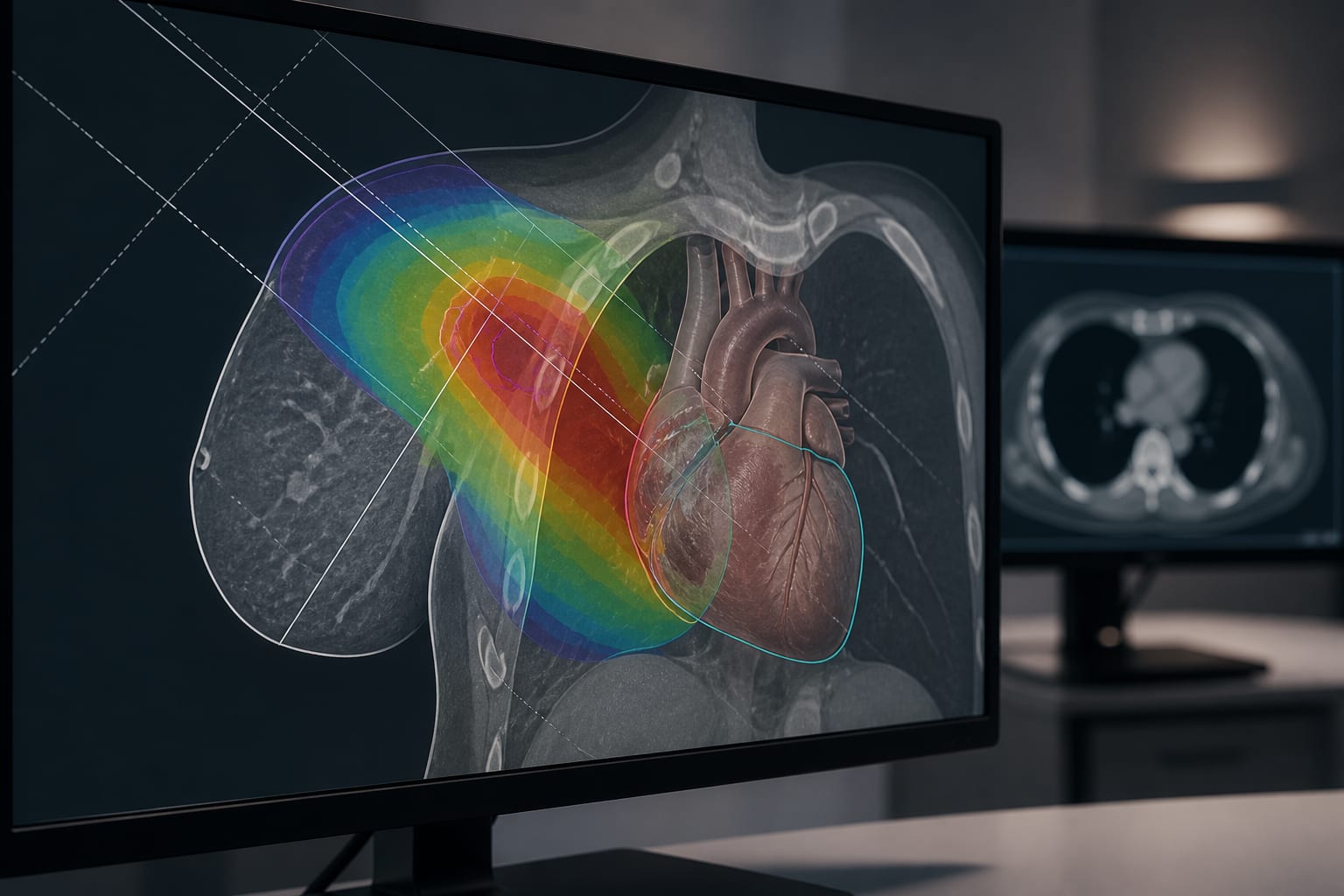
Advancing Precision Cardio-Oncology in Breast Cancer Radiotherapy
-
By
-
Avirup Guha
-
September 2, 2026
Clinical Report: Advancing Precision Cardio-Oncology in Breast Cancer Radiotherapy
Background
Radiotherapy is essential in breast cancer treatment, significantly reducing recurrence and mortality rates. However, as survival rates improve, cardiovascular disease has become a major concern for breast cancer survivors, as noted in recent studies. Understanding the relationship between radiotherapy and cardiovascular risk is crucial for optimizing patient outcomes.
Data Highlights
| Risk Factors | 8-Year Cumulative Incidence of IHD | Adjusted Hazard Ratio |
|---|---|---|
| Left-Sided Treatment | 20.3% | 1.37 |
| Right-Sided Treatment | 15.2% | Not reported |
Key Findings
- Left-sided radiotherapy is associated with a higher risk of IHD compared to right-sided treatment.
- The 8-year cumulative incidence of IHD is significantly higher in patients with 3 or more cardiovascular risk factors.
- Contemporary studies suggest that average cardiovascular harm from left-sided treatment has declined over time, but this requires further investigation.
- The study introduces a 6-item cardiovascular risk burden score to assess patient vulnerability.
Clinical Implications
Clinicians should assess cardiovascular risk factors in patients undergoing breast radiotherapy to tailor treatment plans effectively.
Conclusion
The findings emphasize the need for cardiovascular risk assessment in breast cancer radiotherapy planning.
Related Resources & Content
- Chung and Noh, JAMA Network Open, 2026 -- Laterality of Breast Radiotherapy and Ischemic Heart Disease by Cardiovascular Risk Burden
- American Heart Association, PubMed, 2026 -- Coronary Atherosclerosis in Patients With Cancer and Survivors: A Scientific Statement
- ASTRO, PubMed, 2026 -- Dose-Volume Histogram Compendium of Dose Constraints for Treatment Planning
- ASTRO-ASCO-SSO, PubMed, 2026 -- Postmastectomy Radiation Therapy: An ASTRO-ASCO-SSO Clinical Practice Guideline
- the asco post — Cardio-Oncology Is a Growing Subspecialty, but Where Are the Oncologists?
- the asco post — Accelerated Radiation Therapies Move Forward in Early Breast Cancer
- The ASCO Post — Reducing Incidental Cardiac Irradiation during Breast Radiotherapy
- The ASCO Post — Breast Cancer Radiotherapy Leads to Moderate Cardiac Function Decline Over Years
- Cardio-Oncology Is a Growing Subspecialty, but Where Are the Oncologists?
- Accelerated Radiation Therapies Move Forward in Early Breast Cancer
- Reducing Incidental Cardiac Irradiation during Breast Radiotherapy
- Coronary Atherosclerosis in Patients With Cancer and Survivors: A Scientific Statement From the American Heart Association - PubMed
- Dose-Volume Histogram Compendium of Dose Constraints for Treatment Planning: An ASTRO Consensus Paper - PubMed
- Postmastectomy Radiation Therapy: An ASTRO-ASCO-SSO Clinical Practice Guideline - PubMed
- Concurrent Versus Sequential Radiation Dose Escalation to the Surgical Cavity for Conservative Treatment of High-Risk Early Breast Cancer: NRG/RTOG 1005 Phase III Trial | Journal of Clinical Oncology
- Deep inspiration breath hold versus free breathing in postoperative radiotherapy strategy for patients with left-sided breast cancer treated with volumetric modulated arc therapy: A meta-analysis and systematic review - PubMed
- Laterality of Breast Radiotherapy and Ischemic Heart Disease by Cardiovascular Risk Burden | Oncology | JAMA Network Open | JAMA Network
Based on findings from:
Toward Precision Cardio-Oncology in Breast Radiotherapy
Avirup Guha. Jama Network Open, 2026.
https://jamanetwork.com/journals/jamanetworkopen/fullarticle/2853522
This content is an AI-generated, fully rewritten summary based on a published scholarly article. It does not reproduce the original text and is not a substitute for the original publication. Readers are encouraged to consult the source for full context, data, and methodology.