Endovascular thrombectomy in selected patients with active cancer and thrombocytopenia: outcomes under an institutional platelet transfusion practice - Report - MDSpire

Endovascular thrombectomy in selected patients with active cancer and thrombocytopenia: outcomes under an institutional platelet transfusion practice

  • By

  • Hyung Jun Kim

  • Tae-Jin Song

  • Jin-Soo Lee

  • Keon-Ha Kim

  • Woo-Keun Seo

  • Pyoung Jeon

  • Gyeong-Moon Kim

  • Jong-Won Chung

  • Oh Young Bang

  • June 23, 2026

  • 0 min

Share

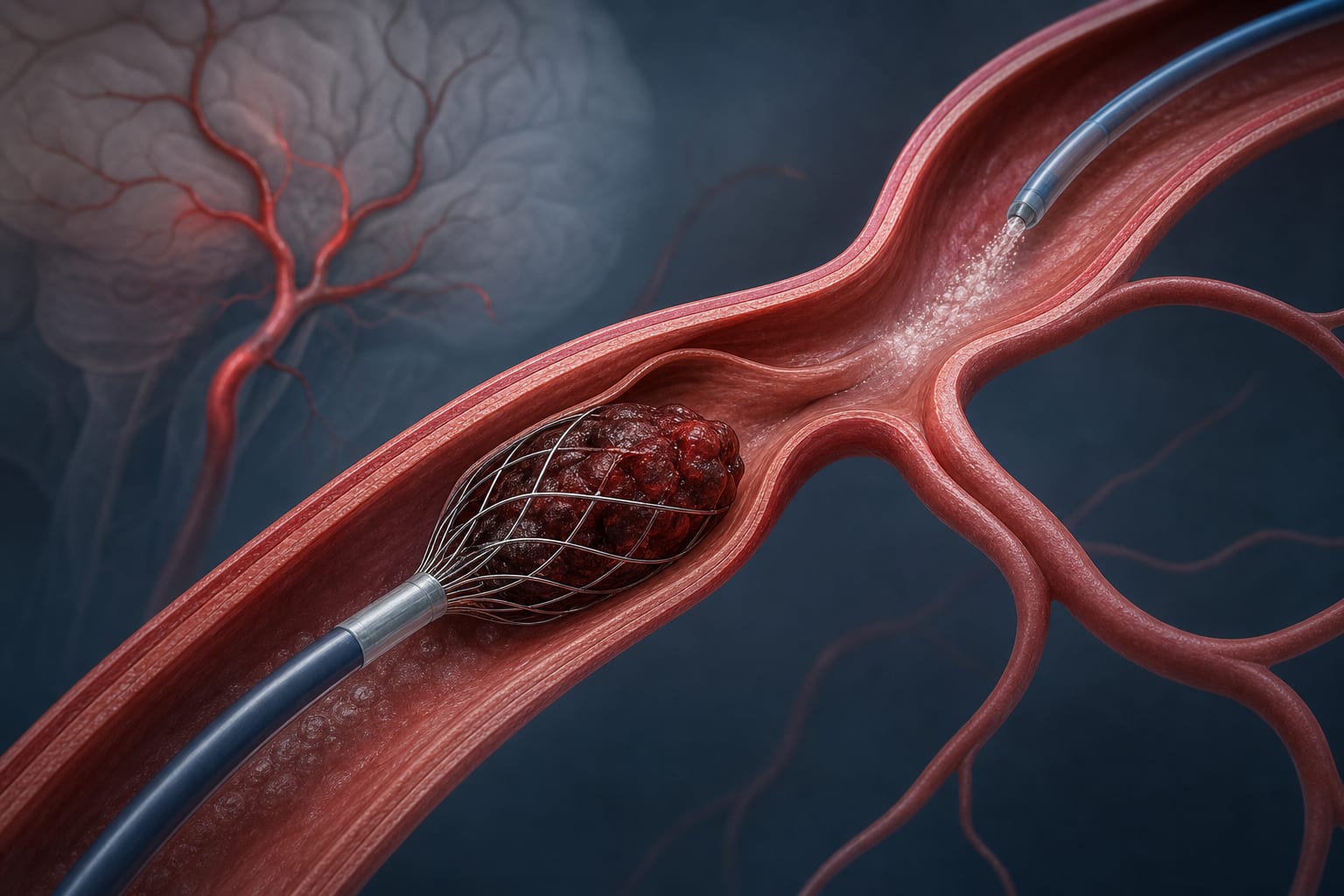
Outcomes of Endovascular Thrombectomy in Patients with Active Cancer and Thrombocytopenia

Overview

This study evaluates the safety and clinical outcomes of endovascular thrombectomy (EVT) in patients with active cancer and thrombocytopenia. The findings indicate that thrombocytopenia does not significantly increase the risk of hemorrhagic complications during EVT.

Background

Thrombocytopenia is prevalent among patients with active cancer and poses safety concerns during EVT for acute ischemic stroke. This population is often excluded from major clinical trials, leading to a lack of robust data on the safety and efficacy of EVT in these patients.

Data Highlights

GroupSymptomatic Intracranial Hemorrhage (sICH)Hemorrhagic Transformation (HT)Favorable Outcome (mRS 0-2)Mortality
Thrombocytopenia12.5%Not significant17.5%55%
No Thrombocytopenia10%Not significant37.5%37.5%

Key Findings

  • No statistically significant differences in rates of hemorrhagic complications between thrombocytopenia and non-thrombocytopenia groups (p > 0.99).
  • At 90 days, the thrombocytopenia group had a worse functional status (median mRS 6 vs. 3; p = 0.029).
  • Trends indicated fewer favorable outcomes in the thrombocytopenia group (mRS 0-2: 17.5% vs. 37.5%; p = 0.080).
  • Higher mortality was observed in the thrombocytopenia group (55% vs. 37.5%; p = 0.179).
  • Thrombocytopenia was not significantly associated with hemorrhagic complications in adjusted analyses.
  • Platelet transfusion prior to EVT was associated with lower 3-month mortality (adjusted OR, 0.153; p = 0.008).

Clinical Implications

Thrombocytopenia in patients with active cancer undergoing EVT does not appear to significantly increase the risk of hemorrhagic complications.

Conclusion

The study indicates that EVT can be performed in patients with active cancer and thrombocytopenia, although the associated outcomes may be less favorable.

Related Resources & Content

  1. Author(s)/Org, Source, Year -- Title
  2. Frontiers in Oncology — Predicting the efficacy of Recombinant Human Thrombopoietin in Treating Cancer Therapy-Related Thrombocytopenia:based on stacking ensemble methods
  3. The ASCO Post — For Hospitalized Cancer Patients, Thromboprophylaxis Often Prescribed Without Regard to Risk Factors
  4. Frontiers in Oncology — Commentary: Anticoagulant outcomes in managing tumor thrombus: a systematic review
  5. Thrombosis Associated with Colorectal Cancer
  6. Classification & Management of Ischemic Stroke in Patients with Active Cancer
  7. SNIS Thrombectomy in Special Populations Guideline
  8. AHA/ASA Guideline
  9. Endovascular thrombectomy in acute stroke with a large ischemic core: A systematic review and meta-analysis of randomized controlled trials
  10. Endovascular treatment in ischemic stroke with active cancer: retrospective analysis of university stroke center data | Neurological Research and Practice | Springer Nature Link

Original Source(s)

Related Content