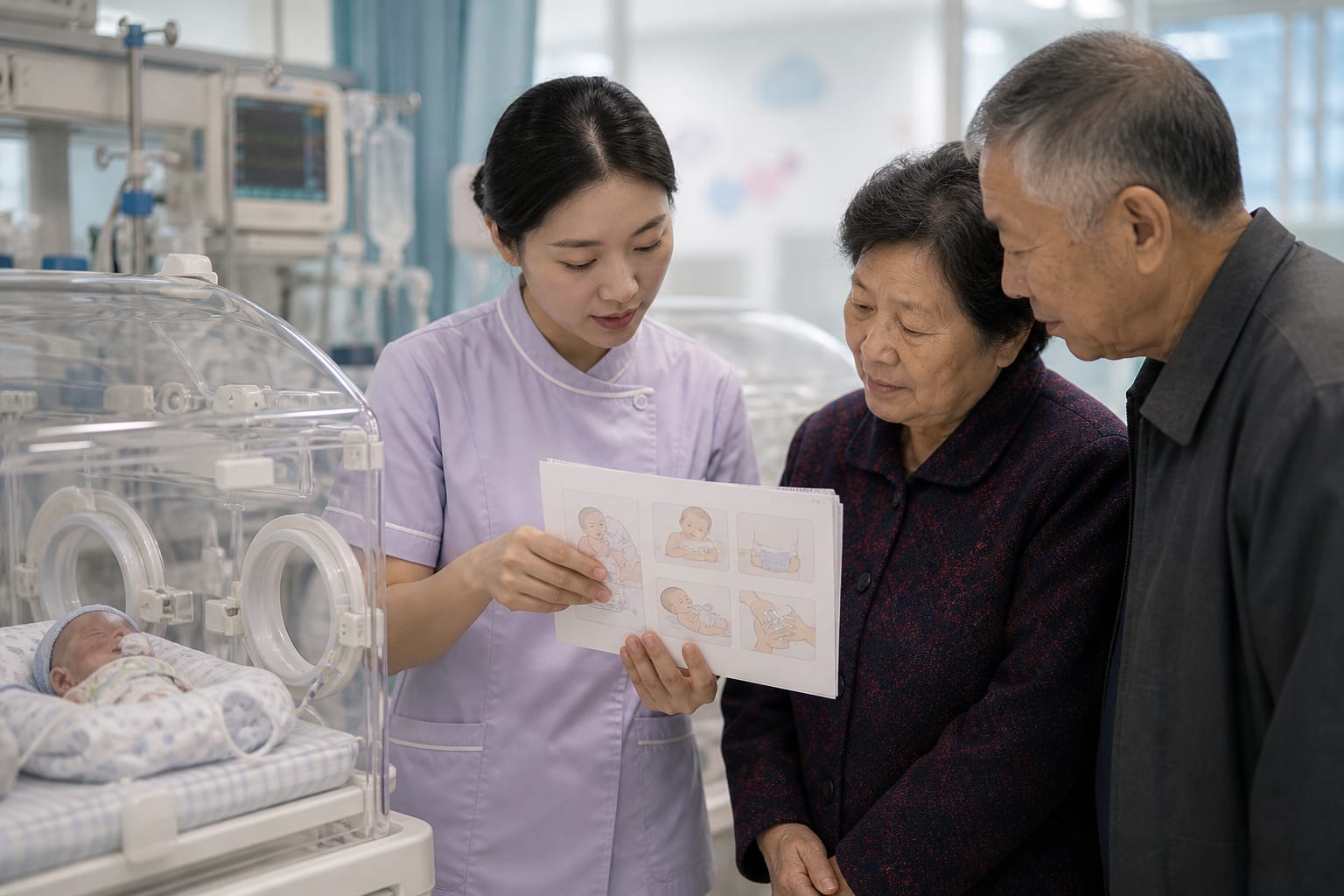
Experiences of Intergenerational Caregivers Preparing for Preterm Infants’ Discharge from NICUs in China: A Qualitative Study
-
By
-
Sijia Shen
-
Ling Jiang
-
Yuelan Ma
-
Jinyu Zhu
-
Yan Zhang
-
October 15, 2026
Clinical Report: Intergenerational Caregivers Preparing for Preterm Infant Discharge
Overview
In a qualitative study of 15 grandparent caregivers in a tertiary hospital NICU in Jiangsu Province, China, interviews identified emotional challenges, uncertainty about care practices, and a desire for support during discharge preparation. The authors conclude that discharge preparation should include psychological support, caregiving education and skills, and more comprehensive home-care guidance for intergenerational caregivers.
Background
Preterm infants may have ongoing health and developmental vulnerabilities after NICU discharge, and their care at home requires specialised skills. The article notes that inadequate caregiver preparation may contribute to readmission through problems such as improper feeding, insufficient infection prevention, or delayed recognition of illness. In China, grandparents commonly participate in family caregiving, yet discharge preparation is described as focusing mainly on parents. The study explored grandparents’ experiences and practical difficulties to inform discharge education.
Data Highlights
| Study feature | Details |
|---|---|
| Design | Qualitative study using semi-structured interviews and content analysis |
| Participants | 15 grandparent caregivers of preterm infants hospitalised in a tertiary-level NICU in Jiangsu Province, China |
| Recruitment and interviews | Purposive sampling; interviews conducted on the infants’ discharge day from March to May 2025 |
| Primary themes | Complex emotional spectrum; barriers to intergenerational care and dilemmas in reconstructing knowledge; desire for support from multiple sources |
| Context reported in the article | Approximately 15 million preterm births globally each year; the article reports an overall preterm birth rate of approximately 10% and a threefold to fourfold greater readmission risk for preterm than full-term infants |
Key Findings
- Grandparents described emotional deprivation and marginalisation from family involvement alongside happiness about bringing the infant home and concern about the infant’s long-term health.
- Participants perceived limitations in their previous caregiving experience and faced difficulty adapting that knowledge to the needs of preterm infants.
- Searching online for care information could feel overwhelming, and participants reported difficulty judging refined care practices for preterm infants.
- Generational differences were a concern, and grandparents expressed a wish for greater support from family members.
- Participants described shortages of community resources and a need for ongoing professional connections after discharge.
- The related study on discharge education quality recruited 409 parents of preterm infants in a cross-sectional investigation in Shandong Province; the supplied context states its objective was to examine the relationship between teaching quality and caregiving competence and test internal locus of control as a mediator, but provides no results.
Clinical Implications
The study authors state that healthcare institutions should provide psychological support, strengthen caregiving knowledge and skills education, and offer more comprehensive home-care guidance. The article also identifies formal inclusion of intergenerational caregivers in discharge-preparation education as a practice and policy consideration.
Conclusion
Grandparent caregivers in this study described intertwined emotional concerns, uncertainty about postdischarge care, and a need for support from family and professional sources. The authors call for discharge preparation that addresses these needs and includes intergenerational caregivers.
Related Resources & Content
- Authors not provided, Article source not provided, Year not provided — Experiences of Intergenerational Caregivers Preparing for Preterm Infants’ Discharge from NICUs in China: A Qualitative Study
- World Health Organization, WHO, 2022 — WHO recommendations for care of the preterm or low-birth-weight infant
- Authors not provided, Frontiers in Pediatrics, 2026 — Impact of Discharge Education Quality on Parental Caregiving Skills for Preterm Infants at NICU Release: The Mediating Effect of Internal Locus of Control
- Frontiers in Pediatrics — Engagement of Parents in Zero-Separation Care: Insights and Requirements from Parents of Late Preterm Infants
- Frontiers in Pediatrics — Classification and influencing factors of parent activation among parents of preterm infants at a NICU in China: a latent profile analysis
- Frontiers in Pediatrics — Optimizing discharge outcomes in very preterm infants by a novel integrated family and rehabilitation care model—a retrospective case-matched study
- WHO recommendations for care of the preterm or low-birth-weight infant
- Impact of Discharge Education Quality on Parental Caregiving Skills for Preterm Infants at NICU Release: The Mediating Effect of Internal Locus of Control
- Key Components of Parenting Education Interventions for Preterm Infant–Parent Dyads Admitted to the NICU: A Systematic Review - PMC
- Consensus Guidelines for the Care of the Growing Premature Infant: Roadmap to Discharge - UCSF Pediatrics
Based on findings from:
Discharge preparation experiences of intergenerational caregivers for premature infants in China’s NICU: a qualitative study
Sijia Shen, Ling Jiang, Yuelan Ma, Jinyu Zhu, Yan Zhang. Bmj Paediatrics Open, 2026.
https://bmjpaedsopen.bmj.com/content/10/1/e004695
This content is an AI-generated, fully rewritten summary based on a published scholarly article. It does not reproduce the original text and is not a substitute for the original publication. Readers are encouraged to consult the source for full context, data, and methodology.