Association between neutrophil percentage-to-albumin ratio and adverse clinical outcomes after successful percutaneous coronary intervention for chronic total occlusion: a cohort study - Report - MDSpire
Conexiant’s news site is now MDSpire News. Learn more
Advertisement
Relationship Between Neutrophil Percentage-to-Albumin Ratio and Long-Term Adverse Outcomes Following Successful Percutaneous Coronary Intervention for Chronic Total Occlusion: A Retrospective Cohort Analysis
Clinical Report: Relationship Between Neutrophil Percentage-to-Albumin Ratio and Long-Term Outcomes
Overview
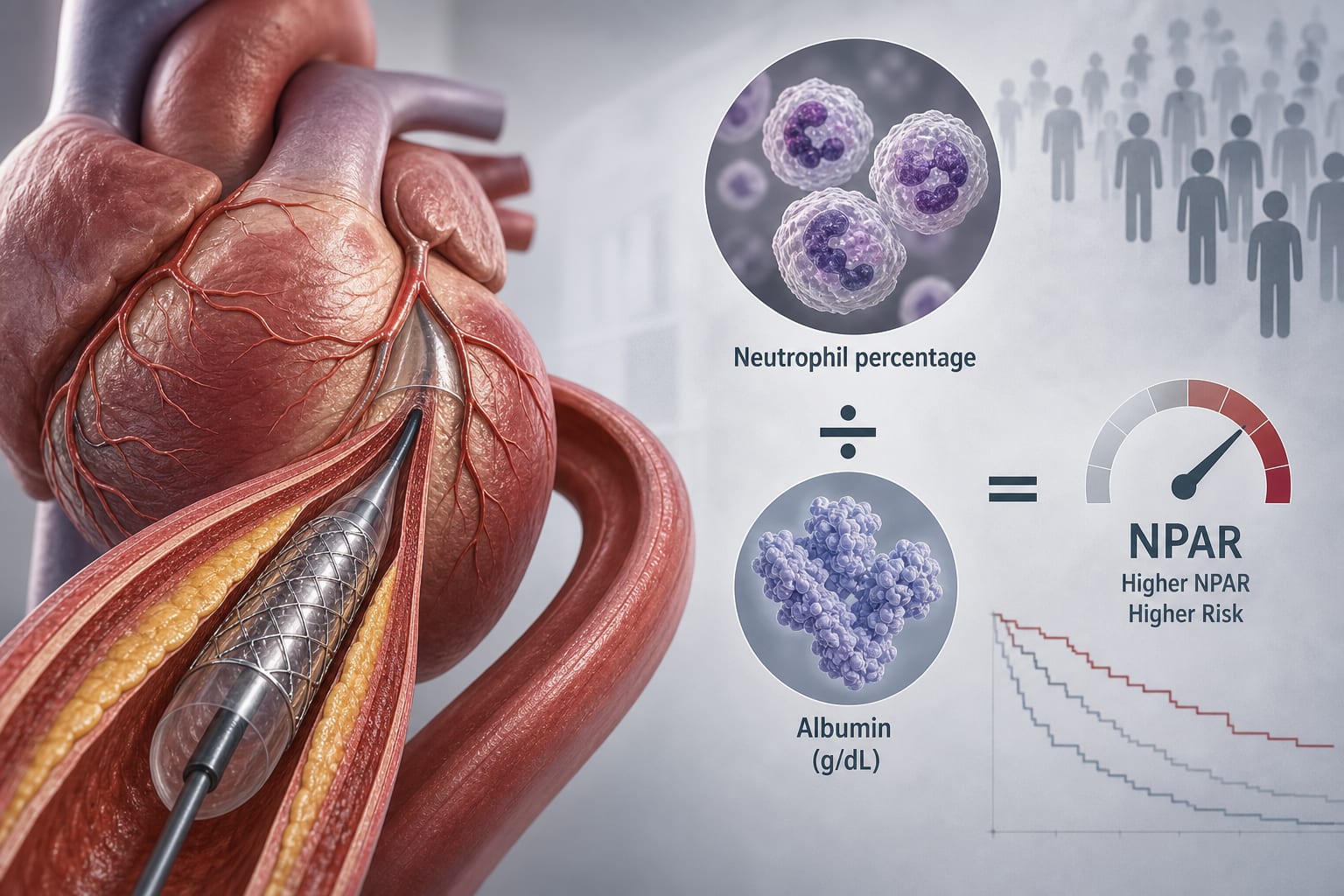
This study investigates the association between the neutrophil percentage-to-albumin ratio (NPAR) and long-term adverse outcomes in patients who underwent successful percutaneous coronary intervention (PCI) for chronic total occlusion (CTO). Elevated NPAR is associated with increased risks of all-cause mortality, cardiovascular mortality, and cardiovascular events.
Background
Chronic total occlusion (CTO) PCI has become a viable option for patients with coronary artery disease, yet residual cardiovascular risks remain significant. Identifying reliable biomarkers that can predict long-term outcomes post-PCI is crucial for improving patient management and risk stratification. The neutrophil percentage-to-albumin ratio (NPAR) integrates inflammation and nutritional status, serving as a prognostic tool in this context.
Data Highlights
Outcome
Event Count
Percentage
All-cause deaths
83
5.5%
Cardiovascular deaths
53
3.5%
Cardiovascular events
73
4.8%
Key Findings
Each 1-standard deviation increase in NPAR is associated with a 50% higher risk of all-cause mortality (HR 1.50, 95% CI 1.23–1.83, P<0.001).
NPAR is linked to a 59% higher risk of cardiovascular mortality (HR 1.59, 95% CI 1.23–2.05, P<0.001).
There is a 42% higher risk of cardiovascular events associated with NPAR (HR 1.42, 95% CI 1.13–1.79, P = 0.003).
Time-dependent ROC analyses show that adding NPAR improves discrimination for all-cause mortality at 1, 2, and 3 years (ΔAUC all P < 0.0001).
The optimal NPAR cut-off values were stable across three time points, with sensitivities of 71.8% to 72.6% and specificities of 73.2% to 75.7%.
Clinical Implications
The findings indicate that NPAR may serve as a biomarker for risk stratification in patients post-CTO PCI.
Conclusion
Elevated NPAR is associated with increased long-term mortality and cardiovascular events in patients undergoing successful CTO PCI.
As ASE convenes its 37th Scientific Sessions near Denver, the meeting will spotlight echocardiographic AI and big data, contrast-enhanced ultrasound, evolving guidelines, the Feigenbaum Lecture, and the future of the sonographer workforce.
A structured overview of recent FDA recalls, corrections, and alerts involving medications, ventilators, insulin delivery systems, cardiovascular devices, anesthesia products, and other equipment used in clinical practice.