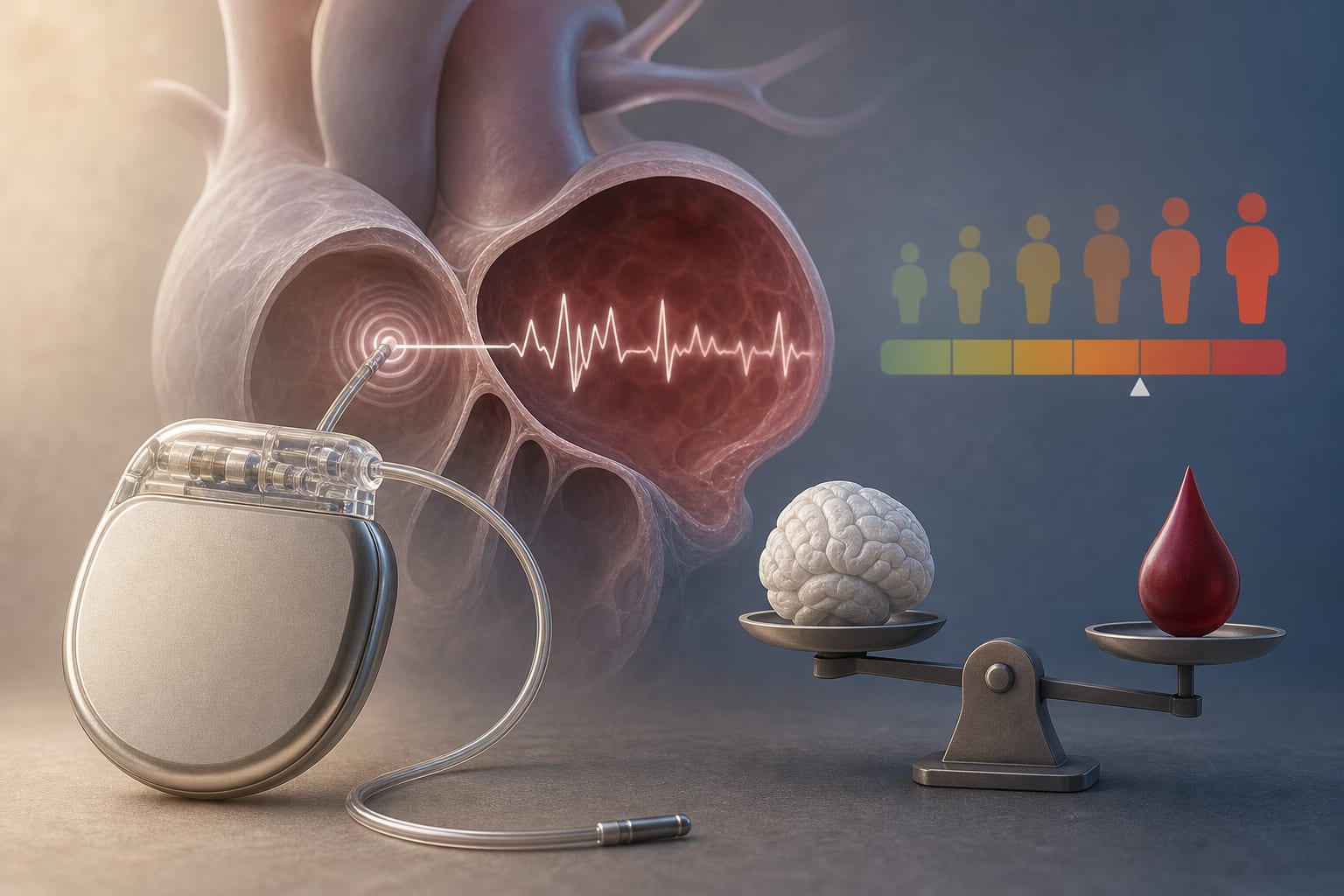
Anticoagulation Strategies for Device-Identified Atrial Fibrillation: Navigating Uncertainty and Variability in Clinical Value
-
By
-
Hanxuan Yu
-
Jinyi Zhu
-
June 8, 2026
Anticoagulation Strategies for Device-Identified Atrial Fibrillation
Overview
Recent trials indicate that anticoagulation in device-detected atrial fibrillation (AF) may reduce stroke risk but increases major bleeding. The economic evaluation suggests that routine anticoagulation may not represent high-value care, particularly in patients with lower stroke risk.
Background
Atrial fibrillation is a significant risk factor for stroke, yet management strategies for subclinical AF detected by devices remain uncertain. Recent randomized trials have begun to clarify the role of direct oral anticoagulants (DOACs) in these cases, highlighting the need for careful consideration of both benefits and risks. Understanding the economic implications of anticoagulation in device-detected AF is crucial for optimizing patient care.
Data Highlights
No numerical data available.
Key Findings
- Pooled results from ARTESiA and NOAH-AFNET 6 trials showed a 32% reduction in ischemic stroke risk with DOACs but increased major bleeding risk (risk ratio, 1.62).
- Subgroup analysis indicated that patients with a CHA2DS2-VASc score >4 may benefit more from DOACs, with a higher absolute reduction in stroke risk.
- The 2024 European Society of Cardiology guidelines recommend considering DOACs for selected patients with high stroke risk and no major bleeding risk factors.
- A cost-effectiveness analysis found that DOACs provided minimal QALY gains at high incremental costs for patients with lower CHA2DS2-VASc scores.
- For patients with CHA2DS2-VASc scores greater than 4, DOAC therapy showed a favorable ICER of €44,595/QALY, suggesting potential benefits may outweigh risks.
- Economic evaluations highlight the importance of baseline stroke risk and treatment costs in determining the value of anticoagulation for device-detected AF.
Clinical Implications
Clinicians should carefully assess stroke risk using the CHA2DS2-VASc score when considering anticoagulation for patients with device-detected AF. The economic implications of treatment decisions should also be taken into account, particularly in patients with lower stroke risk.
Conclusion
The management of device-detected AF requires a nuanced approach that balances the benefits of anticoagulation against the risks and costs involved. Further research is needed to refine treatment strategies in this population.
Related Resources & Content
- Clinical Research in Cardiology, 2023 -- Comparison of therapeutic strategies in patients presenting with left atrial thrombus despite oral anticoagulation
- Clinical Research in Cardiology, 2020 -- Antithrombotic Approaches for Atrial Fibrillation Patients Undergoing Percutaneous Coronary Intervention
- Clinical Research in Cardiology, 2022 -- Managing Patients with Subclinical Atrial Fibrillation and Atrial High-Rate Episodes: Evidence and Clinical Significance
- 2023 ACC/AHA/ACCP/HRS Guideline for the Diagnosis and Management of Atrial Fibrillation
- Non-vitamin K antagonist Oral anticoagulants in patients with Atrial High rate episodes - American College of Cardiology
- DOACs for Stroke Prevention in Device-Detected AF - American College of Cardiology
- conexiant — Switching Anticoagulants After Breakthrough Stroke May Not Improve Outcomes
- 2023 ACC/AHA/ACCP/HRS Guideline for the Diagnosis and Management of Atrial Fibrillation
- Non-vitamin K antagonist Oral anticoagulants in patients with Atrial High rate episodes - American College of Cardiology
- DOACs for Stroke Prevention in Device-Detected AF - American College of Cardiology
Based on findings from:
Anticoagulation in Device-Detected Atrial Fibrillation—Uncertainty and Heterogeneity in Value
Hanxuan Yu, Jinyi Zhu. Jama Network Open, 2026.
https://jamanetwork.com/journals/jamanetworkopen/fullarticle/2849963
This content is an AI-generated, fully rewritten summary based on a published scholarly article. It does not reproduce the original text and is not a substitute for the original publication. Readers are encouraged to consult the source for full context, data, and methodology.