Using a Pareto Efficiency Frontier to Guide Value-Based Pricing of Gaucher Disease Therapies in Brazil
-
By
-
Marcus Carvalho Borin
-
Ludmila Peres Gargano
-
Francisco de Assis Acurcio
-
Juliana Álvares-Teodoro
-
Augusto Afonso Guerra
-
October 9, 2026
Clinical Report: Pareto Frontier for Gaucher Therapy Pricing in Brazil
Overview
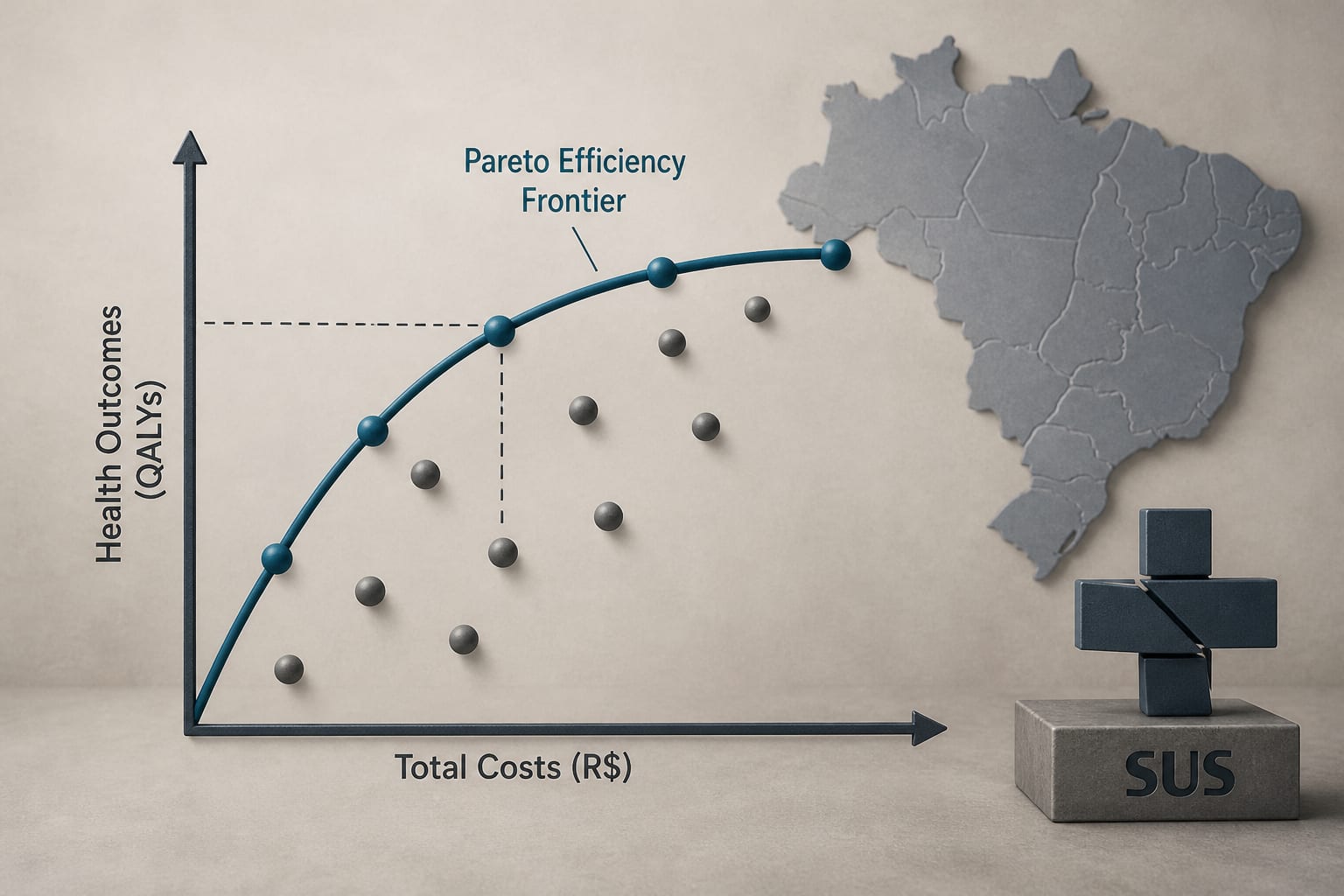
This exploratory analysis examines a Pareto-based price–benefit frontier for Gaucher disease therapies available in Brazil, relating annual drug acquisition costs to selected hematologic outcomes from the SUS perspective. The approach retains directly non-dominated therapies as a descriptive benchmark; it is not a full economic evaluation or a conventional cost-effectiveness optimization rule.
Background
Gaucher disease is an inherited lysosomal storage disorder that can cause hepatosplenomegaly, anemia, thrombocytopenia, and bone complications, with neurological manifestations in some disease types. Enzyme replacement therapy is used mainly for systemic manifestations, while substrate-reduction therapy is another treatment strategy. In Brazil, treatment eligibility and follow-up are governed by national clinical protocols, and hematologic normalization, particularly of hemoglobin and platelet counts, is identified as a therapeutic objective. The high costs of treatment motivate economic analyses relevant to pricing and reimbursement decisions.
Data Highlights
| Analysis element | Source-reported description |
|---|---|
| Perspective | Brazilian Unified Health System (SUS) |
| Approach | Exploratory Pareto-based price–value analysis |
| Costs assessed | Annual drug acquisition costs |
| Benefits assessed | Selected hematologic outcomes |
| Therapies identified in the article context | Imiglucerase, velaglucerase alfa, and taliglucerase alfa; miglustat is indicated in Brazil for selected adults with Type 1 disease when ERT is unsuitable |
| Excluded from the analysis | Utilities, QALYs, long-term survival modeling, budget impact analysis, and probabilistic uncertainty analysis |
Key Findings
- The analysis applies a Pareto-based adaptation to describe the relationship between annual acquisition costs and selected hematologic benefits among Gaucher therapies available in Brazil.
- The proposed frontier preserves therapies that are directly non-dominated and is presented as a descriptive price–benefit benchmark, not as a conventional convex cost-effectiveness frontier or an optimization rule.
- The evaluation is explicitly exploratory and is not a full economic evaluation; it excludes utilities, QALYs, long-term survival modeling, budget impact analysis, and probabilistic uncertainty analysis.
- The article identifies hemoglobin and platelet normalization as principal therapeutic objectives in the Brazilian clinical protocol context.
- The article distinguishes ERTs—imiglucerase, velaglucerase alfa, and taliglucerase alfa—from SRT; it notes that miglustat is used for selected adults with Type 1 Gaucher disease when ERT is unsuitable.
- The source states that any future use of this approach as a regulatory pricing instrument would require comparative efficacy evidence, formal uncertainty analysis, and assessment of clinical value dimensions beyond the hematologic outcomes evaluated.
Clinical Implications
The analysis offers a descriptive framework for examining hematologic price–benefit relationships in the Brazilian SUS context, but it does not establish treatment rankings or an optimal price. The source states that regulatory application would require comparative efficacy evidence, formal uncertainty analysis, and evaluation of broader clinical value dimensions.
Conclusion
A Pareto-based frontier is presented as an exploratory descriptive approach to value-based pricing analysis for Gaucher disease therapies in Brazil. The supplied material does not provide numerical results or support conclusions about comparative value or specific prices.
Related Resources & Content
- Article context supplied by user, publication details not provided -- Using a Pareto Efficiency Frontier to Guide Value-Based Pricing of Gaucher Disease Therapies in Brazil
- Brazilian Ministry of Health, Clinical Protocol and Therapeutic Guidelines for Gaucher Disease, 2025
- French national diagnosis and care protocol, Orphanet Journal of Rare Diseases, 2025 -- Gaucher disease
- ASCO Publications — Cost Evaluation Analysis of Genetic Testing and Tailored Adjuvant Imatinib in Patients With Resected High-Risk GI Stromal Tumors: The Brazilian Perspective
- ASCO Publications — Cost-effectiveness analysis of Oncotype DX from a Brazilian private medicine perspective: A GBECAM multicenter retrospective study.
- Frontiers in Hematology — Commentary: "Connecting Innovation with Equity: The Changing Access to CAR T-cell Therapy in Brazil" Insights from the Pediatric Experience in Uruguay
- the medicine maker — Advanced Therapies: The Price is Right?
- Brazilian Clinical Protocol and Therapeutic Guidelines for Gaucher Disease
- French national diagnosis and care protocol (PNDS): Gaucher disease
- European Working Group on Gaucher Disease statement on home therapy
- Checking your browser - reCAPTCHA
- MASSIVE DISEASE BURDEN IN INFANTS WITH GAUCHER DISEASE TYPE 1 AND TYPE 3: LONG-TERM OUTCOMES OF EARLY IMIGLUCERASE THERAPY - ScienceDirect
- Checking your browser - reCAPTCHA
Based on findings from:
Applying a Pareto-Based Efficiency Frontier to Inform Value-Based Pricing for Gaucher Disease Therapies in Brazil
Marcus Carvalho Borin, Ludmila Peres Gargano, Francisco de Assis Acurcio, Juliana Álvares-Teodoro, Augusto Afonso Guerra. Pharmacoepidemiology And Drug Safety, 2026.
https://onlinelibrary.wiley.com/doi/10.1002/pds.70497
This content is an AI-generated, fully rewritten summary based on a published scholarly article. It does not reproduce the original text and is not a substitute for the original publication. Readers are encouraged to consult the source for full context, data, and methodology.