Clinical Report: Assessment of a Two-Gene Blood Test for Diagnosing Kawasaki Disease
Overview
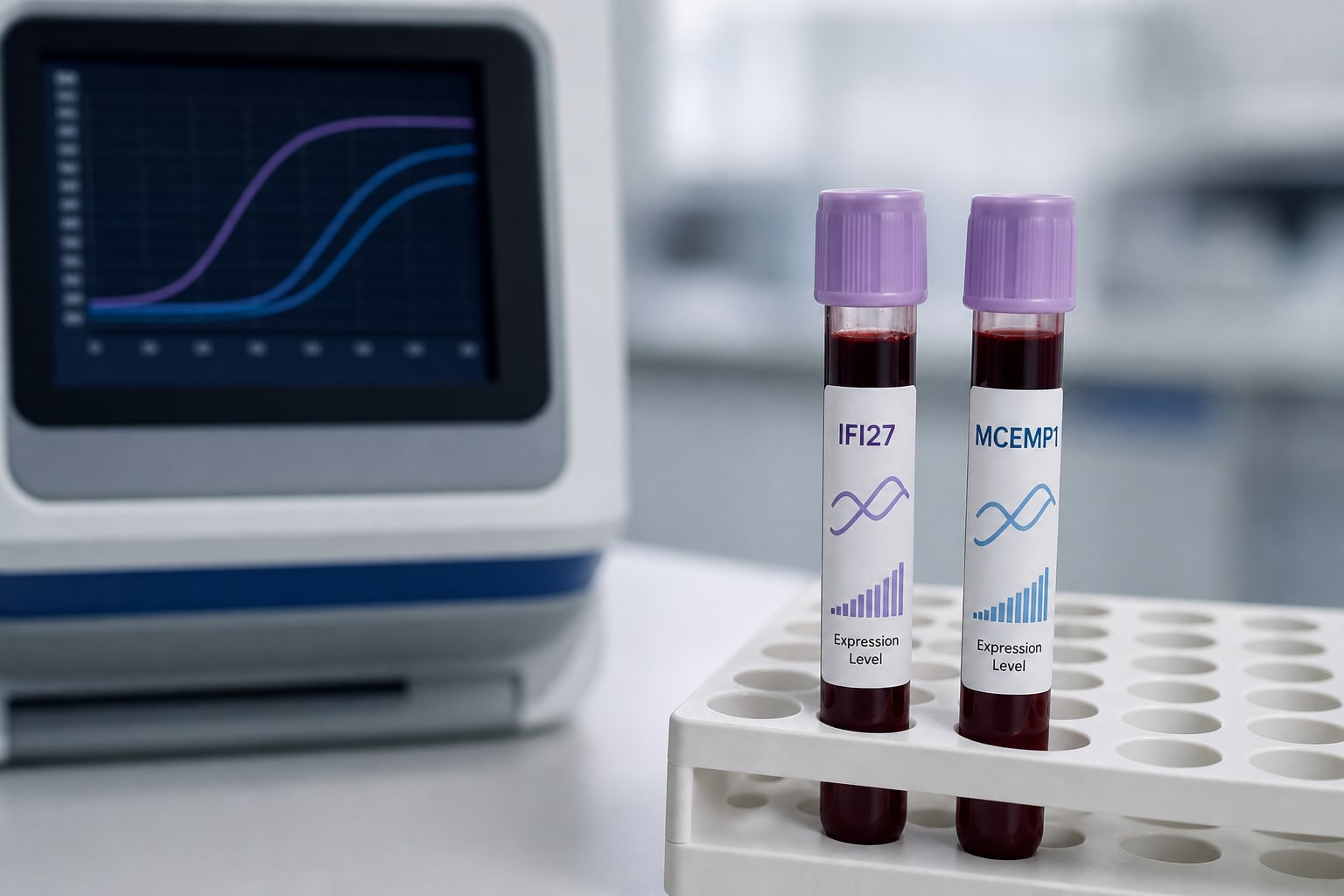
This study evaluates a two-gene blood test for Kawasaki disease (KD) diagnosis, demonstrating its potential to improve diagnostic accuracy. The test, based on IFI27 and MCEMP1 gene expression, was assessed in a cohort of 541 children, showing promising results in distinguishing KD from other febrile illnesses.
Background
Kawasaki disease is a significant cause of acquired heart disease in children, with timely diagnosis and treatment being crucial to prevent complications. Traditional diagnostic methods are often subjective and can lead to delays, particularly in cases with incomplete clinical features. The development of molecular biomarkers, such as the two-gene signature evaluated in this study, could enhance diagnostic precision and facilitate earlier intervention.
Data Highlights
Specify the total number of febrile controls and clarify 'indeterminate results'.
Key Findings
The two-gene signature (IFI27 and MCEMP1) was tested in a cohort of 541 children with fever.
Out of 445 determinate classifications, 209 KD cases were correctly identified.
The assay demonstrated a misclassification of 8 KD cases and 42 febrile controls.
96 participants fell into the indeterminate range, indicating biological overlap.
The study adhered to the STARD reporting guidelines, ensuring robust methodological standards.
Clinical Implications
The two-gene blood test could serve as a valuable tool for clinicians in diagnosing Kawasaki disease, particularly in cases with incomplete clinical features. Early and accurate diagnosis may lead to timely treatment, potentially reducing the risk of coronary complications in affected children.
Conclusion
The evaluation of the two-gene blood test highlights its potential to enhance the diagnostic process for Kawasaki disease, warranting further validation in clinical practice. This advancement may significantly impact the management of febrile children presenting with symptoms suggestive of KD.
by Ho-Chang Kuo, Xing Xue, Fang Liu, Richard D. Mortensen, C. James Chou, Bo Jin, Juan Wei, Qiong Luo, Ken-Pen Weng, Mindy Ming-Huey Guo, Kuender D. Yang, Kuo-Jung Su, Shih-Ting Kang, Sun Kim, Weiwei Li, James Schilling, Zhi Han, Naoto Ozawa, Takumi Ichikawa, Henry Chubb, Scott R. Ceresnak, Gary L. Darmstadt, Doff McElhinney, Harvey J. Cohen, Xuefeng B. Ling