Fractionated stereotactic radiotherapy (fSRT) for symptomatic WHO grade 1 cavernous sinus meningiomas: long-term local control, clinical response, and toxicity outcomes - Report - MDSpire

Fractionated stereotactic radiotherapy (fSRT) for symptomatic WHO grade 1 cavernous sinus meningiomas: long-term local control, clinical response, and toxicity outcomes

  • By

  • Ryan Shah

  • Shray Jain

  • Nilanjan Haldar

  • Lauren A. Holt

  • Robert L. Walker

  • Christopher J. Farrell

  • Debanjan Haldar

  • James J. Evans

  • Gregory S. Alexander

  • Wenyin Shi

  • June 30, 2026

  • 0 min

Share

Long-term Outcomes of Fractionated Stereotactic Radiotherapy for Symptomatic WHO Grade 1 Cavernous Sinus Meningiomas

Overview

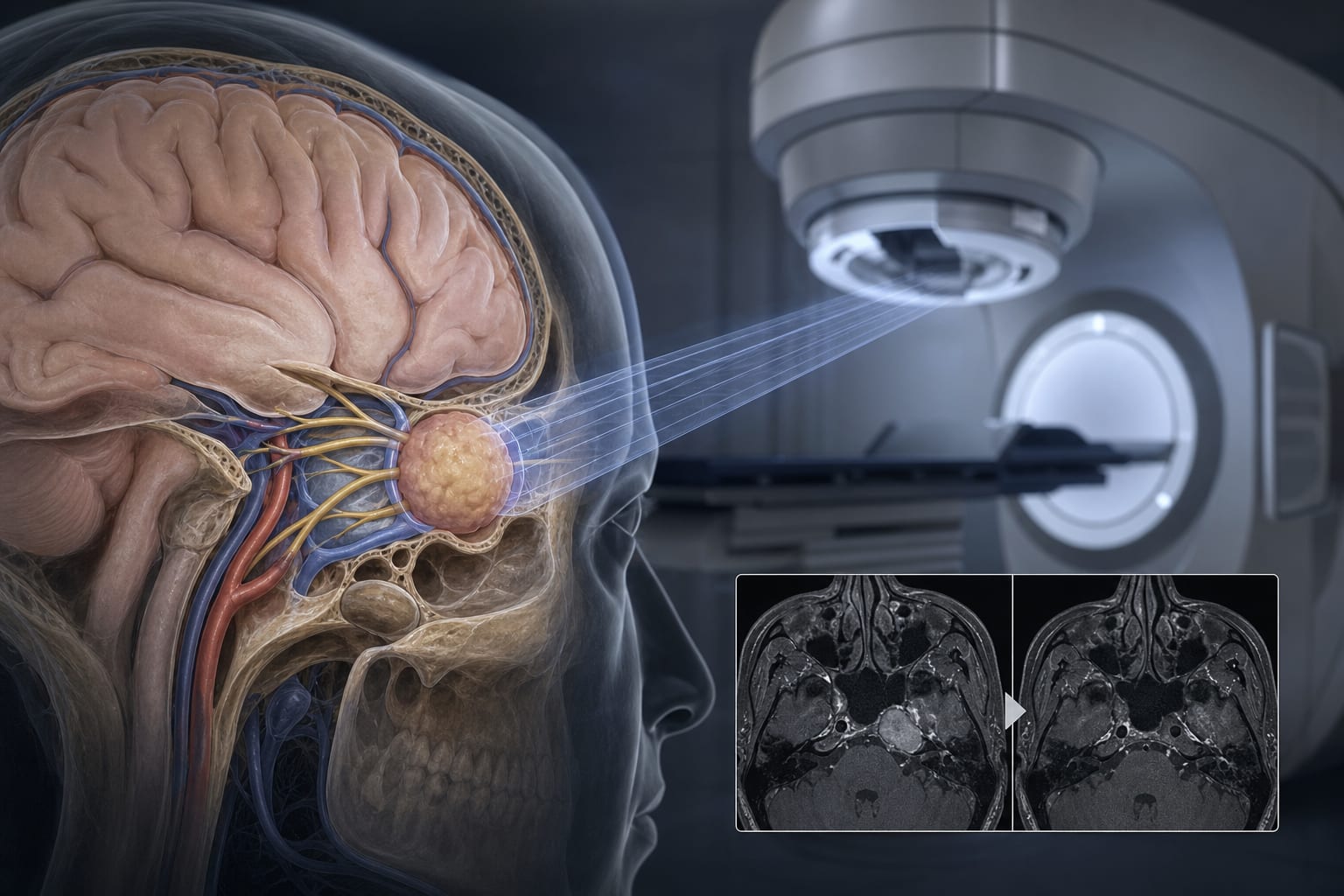
This study evaluates the long-term outcomes of fractionated stereotactic radiotherapy (fSRT) for symptomatic WHO Grade 1 cavernous sinus meningiomas, focusing on local control, clinical response, and toxicity.

Background

Meningiomas are the most common primary intracranial tumors, with a significant incidence in older adults. Cavernous sinus meningiomas can lead to severe morbidity due to their location and the potential for cranial nerve compression.

Data Highlights

No numerical data provided in the source material.

Key Findings

  • fSRT for symptomatic WHO Grade 1 cavernous sinus meningiomas was performed on patients between January 2006 and December 2017.
  • Local control rates with fSRT at 5 and 10 years are reported to exceed 85%.
  • fSRT is associated with a complication profile that may differ from stereotactic radiosurgery (SRS).
  • Maximal safe surgical resection is often preferred, but fSRT may be considered for larger tumors.
  • Reported rates of gross total resection (GTR) for cavernous sinus meningiomas vary widely from 12% to 80%.

Clinical Implications

Clinicians should consider the long-term local control rates and toxicity profile when discussing treatment options with patients.

Conclusion

Fractionated stereotactic radiotherapy is evaluated for its long-term outcomes in patients with symptomatic WHO Grade 1 cavernous sinus meningiomas.

Related Resources & Content

  1. Journal of Neuro-Oncology, 2024 -- Outcomes of Cranial Nerve Neuropathy Recovery Following LINAC-Based Stereotactic Radiosurgery for Benign Cavernous Sinus Meningoma
  2. Journal of Neuro-Oncology, 2025 -- Repeated Stereotactic Radiosurgery for High-Grade Meningiomas
  3. Journal of Neuro-Oncology, 2025 -- Sustained Tumor Control in Cystic and Solid Vestibular Schwannomas Following LINAC-Based Stereotactic Radiosurgery: A Retrospective Study
  4. Journal of Neuro-Oncology, 2025 -- Long-term Efficacy and Adverse Effects of Radiotherapy in Patients with WHO Grade II and III Meningiomas: A Retrospective Study of 98 Cases
  5. EANO guideline on the diagnosis and management of meningiomas
  6. Management of cavernous sinus meningiomas: Consensus statement on behalf of the EANS skull base section
  7. Efficacy and Safety of Radiosurgery in Cavernous Sinus Meningioma: A Systematic Review and Single Meta-Analysis
  8. https://virtualtrials.org/pdf2025/cns.pdf
  9. Radiosurgery and fractionated radiotherapy for cavernous sinus meningioma: a systematic review and meta-analysis - PubMed
  10. Single session versus hypofractionated stereotactic radiosurgery for large meningiomas (> 8 cc): a systematic review and meta analysis - PubMed
  11. Impact of Fractionation Regimen on Local Control Following Frameless Linear Accelerator-Based Image-Guided Stereotactic Radiosurgery and Radiotherapy for Intracranial Meningioma - PubMed
  12. https://www.brainlife.org/fulltext/2024/Lesueur_P241230_BMCCancer.pdf

Original Source(s)

Related Content