Current status and challenges in lumbar proprioception measurement: a narrative review - Report - MDSpire

Current status and challenges in lumbar proprioception measurement: a narrative review

  • By

  • Xiansheng Zhao

  • Maoqing Fu

  • Lihe Li

  • Chaoliang Lv

  • June 29, 2026

  • 0 min

Share

Clinical Report: Overview of the Current Challenges and Developments in Measuring Lumbar Proprioception

Overview

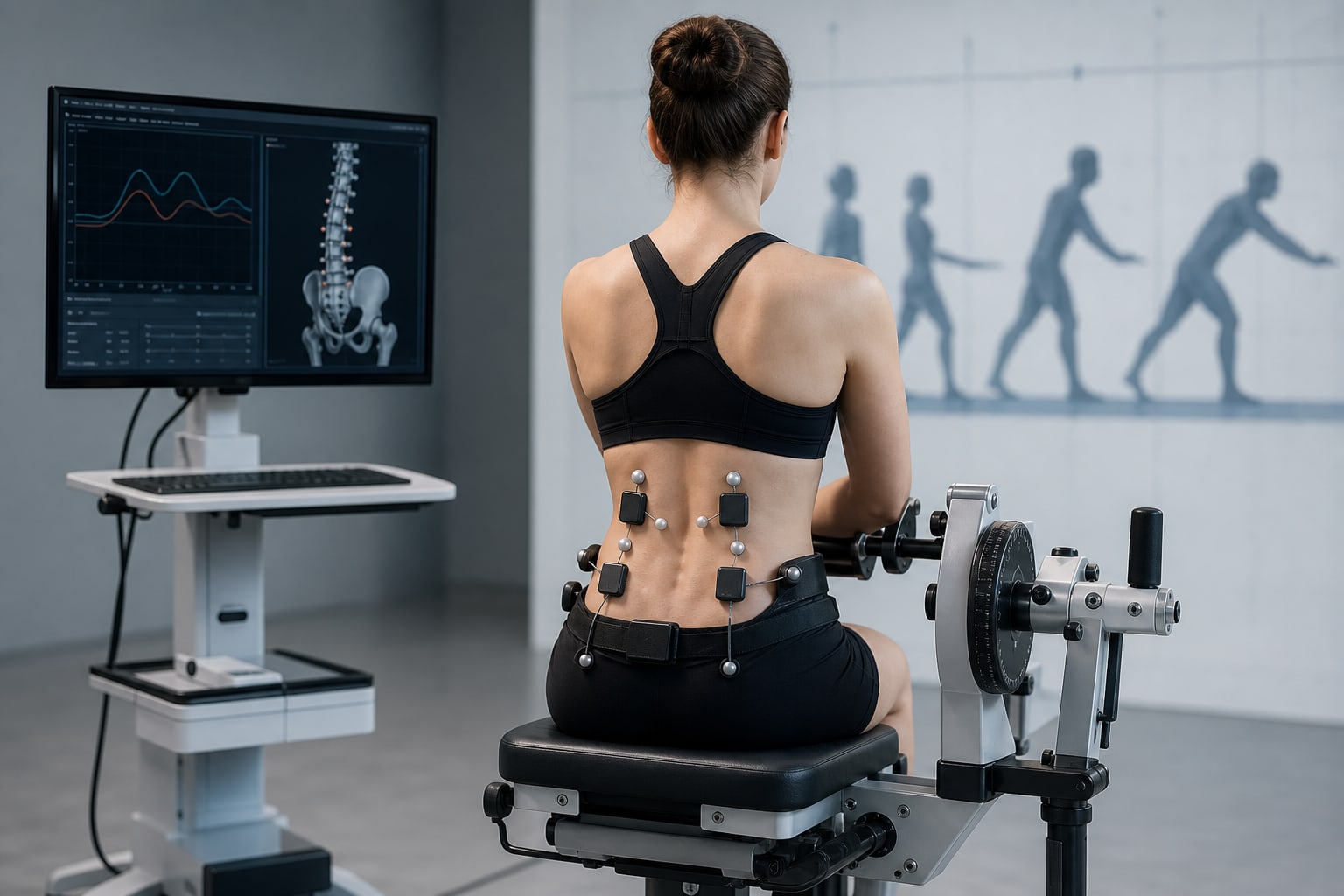
This narrative review evaluates various measurement tools for lumbar proprioception, noting significant methodological controversies and the absence of a gold standard for objective quantification.

Background

Lumbar proprioception is critical for maintaining spinal stability and postural control. Deficits in proprioception are linked to chronic low back pain and degenerative lumbar diseases. Current evaluation methods face challenges in reliability and validity.

Data Highlights

No numerical data or trial data provided in the article.

Key Findings

  • Lumbar proprioception is essential for dynamic spinal stability and sensorimotor regulation.
  • Proprioceptive deficits are associated with chronic non-specific low back pain and degenerative lumbar diseases.
  • Position sense via inclinometer-based active joint repositioning is the most widely applied metric.
  • Common clinical tools like dual inclinometry and tape measurement show weak concurrent validity and low test-retest reliability.
  • There is a lack of significant inter-modal correlation among distinct direct metrics of proprioception.
  • A universally accepted gold standard for proprioception measurement is absent.

Clinical Implications

Clinicians should be aware of the limitations of current measurement tools.

Conclusion

Ongoing research is essential to develop a universally accepted standard for proprioception assessment.

Related Resources & Content

  1. WHO, WHO, 2023 -- Guideline for non-surgical management of chronic primary low back pain
  2. VA/DoD, VA/DoD, 2022 -- Clinical Practice Guidelines for Low Back Pain
  3. Springer Nature, 2025 -- Active and passive physical therapy in patients with chronic low-back pain: a level I Bayesian network meta-analysis
  4. Frontiers in Pain Research — Toward function-oriented, neuroscience-based spine care in older adults: a structured narrative review and translational synthesis
  5. Brain — Non-invasive closed-loop spinal stimulation enables individuals with paraplegia to regain control of leg movement
  6. European Radiology — Can Paraspinal Muscle Morphometry Serve as a Predictor for Functional Outcomes and Reoperation Rates Following Lumbar Spine Surgery? A Systematic Review and Meta-Analysis
  7. Evaluation of Sensorimotor and Functional Variations in Patients with Surgically Managed Partially Incongruent Lisfranc Injuries Compared to Healthy Individuals: A Cross-Sectional Analysis
  8. WHO guideline for non-surgical management of chronic primary low back pain
  9. VA/DoD Clinical Practice Guidelines
  10. Active and passive physical therapy in patients with chronic low-back pain: a level I Bayesian network meta-analysis | Journal of Orthopaedics and Traumatology | Springer Nature Link
  11. The World Health Organization guideline for non-surgical management of chronic primary low back pain in adults: implications for equitable care and strengthening health systems globally
  12. The impact of spinal manipulation on lumbar proprioception and its link to pain relief: a randomized controlled trial | Scientific Reports
  13. Sensorimotor Stabilization Exercises With and Without Behavioral Treatment in Low Back Pain: Feasibility and Effects of a Multicenter Randomized Controlled Trial - ScienceDirect
  14. Lower limb proprioception and postural control strategies in people with non-specific low back pain: A systematic review and meta-analysis - PubMed
  15. Development of head-trunk coordination measures for assessing sensorimotor function in laboratory and natural settings using wearable sensors | Scientific Reports
  16. Full article: Reliability and validity of lower extremity and trunk kinematics measured with markerless motion capture during sports-related and functional tasks: A systematic review
  17. Validation of proprioception measures of the lumbar spine - ScienceDirect

Original Source(s)

Related Content