Free water–mediated associations among choroid plexus enlargement, white matter lesions, and cognitive performance in type 2 diabetes mellitus - Report - MDSpire

Free water–mediated associations among choroid plexus enlargement, white matter lesions, and cognitive performance in type 2 diabetes mellitus

  • By

  • Ling Li

  • Peichun Pan

  • Jing Li

  • Min Tang

  • Dongsheng Zhang

  • Xiaoyan Lei

  • Xiaoling Zhang

  • Jie Gao

  • June 18, 2026

  • 0 min

Share

Clinical Report: Associations of Choroid Plexus Enlargement and Cognitive Function in T2DM

Overview

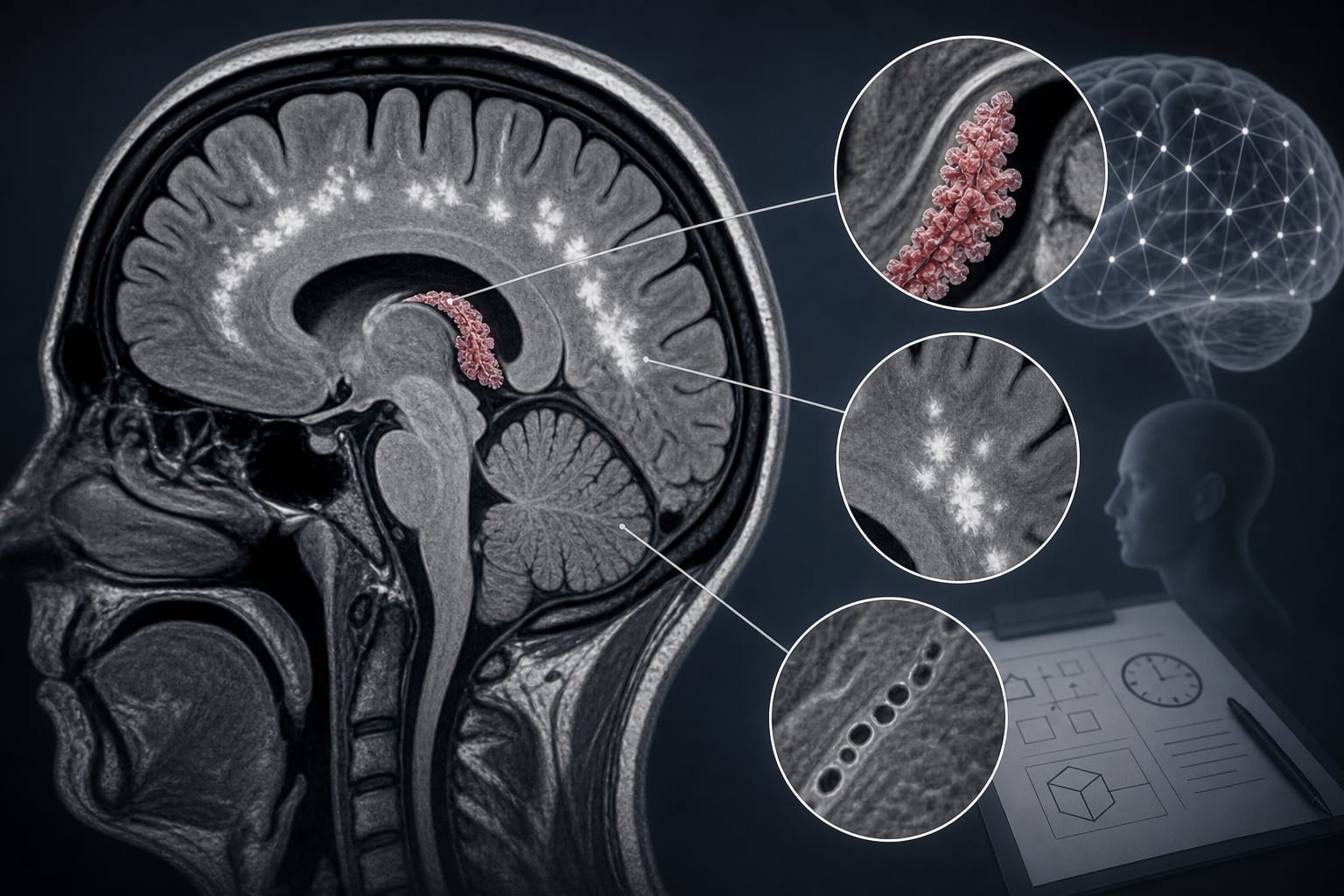
This study investigates the relationships between choroid plexus enlargement, white matter hyperintensities, and cognitive function in individuals with type 2 diabetes mellitus (T2DM).

Background

Type 2 diabetes mellitus (T2DM) is a prevalent metabolic disorder linked to various neurological complications, including cognitive decline. Understanding the relationship between brain structural changes, such as white matter hyperintensities, and cognitive function is crucial for managing T2DM-related cognitive impairments.

Data Highlights

MeasureT2DM PatientsHealthy Controls
CP VolumeLargerSmaller
FW FractionHigherLower
PVS VolumeLargerSmaller
PWMH VolumeLargerSmaller
SDMT ScoresLowerHigher

Key Findings

  • T2DM patients had larger choroid plexus volume and higher free water fraction compared to controls.
  • Lower cognitive performance was observed in T2DM patients, as indicated by Symbol Digit Modalities Test (SDMT) scores.
  • CP volume and FW fraction were independently associated with periventricular white matter hyperintensity (PWMH) volume.
  • FW fraction and PWMH were independently linked to cognitive performance measured by SDMT.
  • Mediation analyses indicated significant indirect effects of FW on the relationships between CP and PWMH, and between FW and SDMT.

Clinical Implications

Clinicians should consider factors related to choroid plexus volume and free water dynamics when assessing cognitive function in this population.

Conclusion

The study establishes a connection between glymphatic-related brain fluid alterations and cognitive performance in T2DM.
Related Resources & Content

  1. Frontiers in Endocrinology, 2026 -- Influence of Glucose Levels and Metabolic Disorders on White Matter Hyperintensity Volume in Healthy Adults
  2. The Journal of Clinical Endocrinology & Metabolism, 2026 -- Alterations in Regional Brain Structures Observed in Diabetes, Excluding Prediabetes
  3. The Journal of Clinical Endocrinology & Metabolism, 2026 -- Link Between Fluctuations in Glucose Levels Over Time and Brain Structure and Cognitive Abilities in Individuals with Type 2 Diabetes
  4. Frontiers in Endocrinology — Sentinel factors for mild cognitive impairment in type 2 diabetes mellitus and their interaction mechanisms: a narrative review with network analysis perspective
  5. Comprehensive Medical Evaluation and Assessment of Comorbidities: Standards of Care in Diabetes—2026
  6. Vascular Contributions to Cognitive Impairment and Brain Health - Professional Heart Daily
  7. STRIVE-2_Manuscript
  8. Choroid plexus enlargement contributes to CSVD progression and white matter microstructural deterioration via brain-fluid dysregulation - PMC
  9. Choroid plexus enlargement is associated with poor functional status in cerebral small vessel disease via reduced DTI-ALPS index: a 5T MRI study - PubMed
  10. Papez circuit remodeling in type 2 diabetes: Enlarged choroid plexus volume partially mediates functional impairments linked to insulin resistance - ScienceDirect
  11. Association of Glymphatic Dysfunction with Cognitive Performance in Type 2 Diabetes Mellitus and Prediabetes - PubMed
  12. Structural and functional brain abnormal alteration in patients with type 2 diabetes mellitus: A coordinate-based meta-analysis | Translational Psychiatry
  13. Impact of glucose fluctuations on white matter hyperintensity in type 2 diabetic patients - PubMed

Original Source(s)

Related Content