Development and validation of an m6A and autophagy related lncRNAs signature for predicting survival and modulating the immune microenvironment in esophageal squamous cell carcinoma - Report - MDSpire

Development and validation of an m6A and autophagy related lncRNAs signature for predicting survival and modulating the immune microenvironment in esophageal squamous cell carcinoma

  • By

  • Mingyi Yang

  • Honghao Ren

  • Jing Hu

  • Pengfei Wen

  • Jiale Xie

  • Xianjie Wan

  • Lin Liu

  • Zhi Yang

  • Ming Zhang

  • Xiaodong Ren

  • Yani Su

  • May 28, 2026

  • 0 min

Share

Clinical Report: m6A and Autophagy-Associated lncRNAs in ESCC Prognosis

Overview

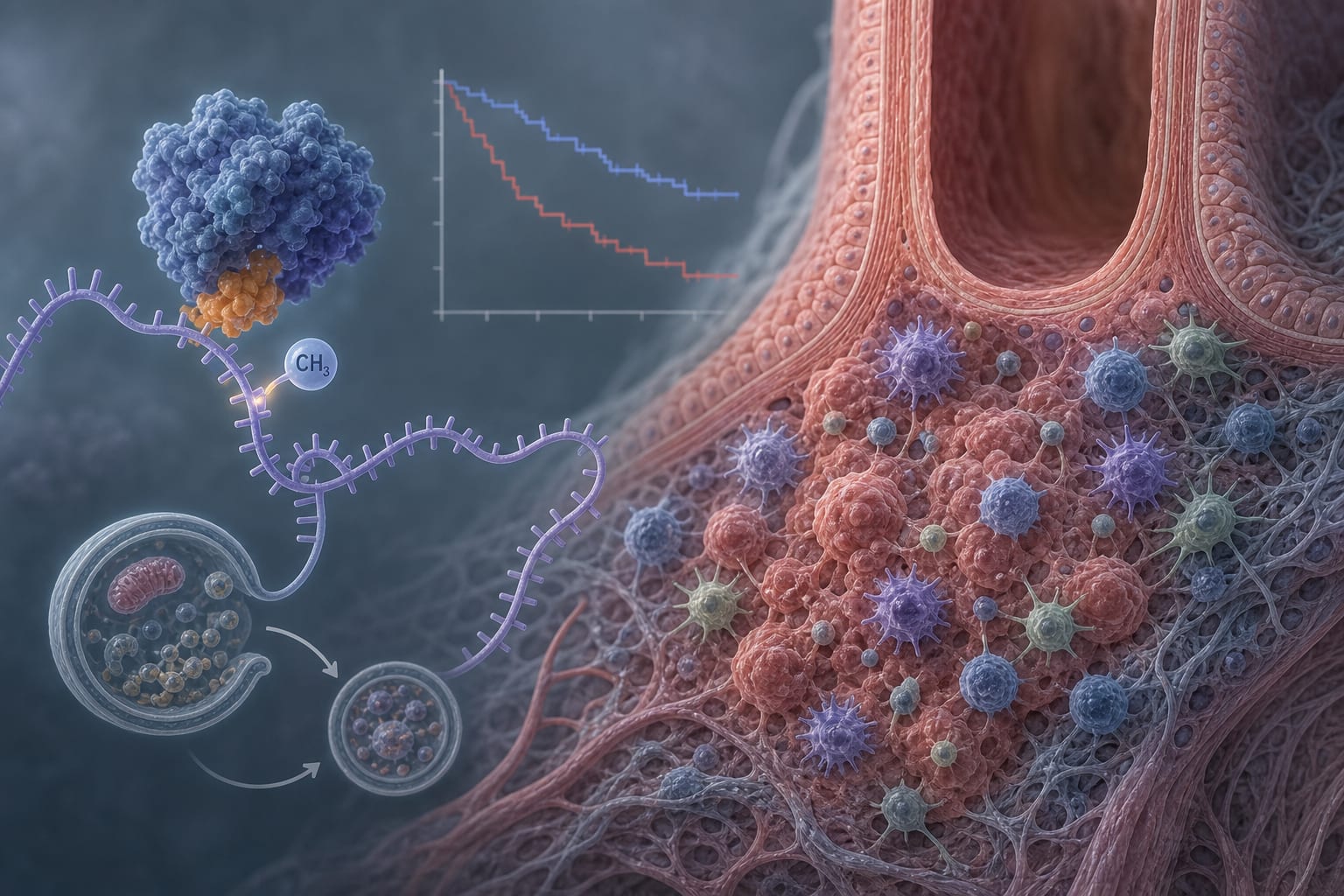
This study establishes a prognostic model based on m6A- and autophagy-related lncRNAs for predicting survival in esophageal squamous cell carcinoma (ESCC). It also explores the model's impact on the tumor immune microenvironment, highlighting its potential for guiding therapeutic strategies.

Background

Esophageal squamous cell carcinoma (ESCC) is a highly aggressive malignancy with poor prognosis, often diagnosed at advanced stages. The need for effective prognostic tools is critical to improve patient outcomes and tailor treatment strategies. Understanding the molecular mechanisms underlying ESCC can facilitate the development of targeted therapies and enhance survival prediction.

Data Highlights

m6A-Related lncRNAsPrognostic Value
LINC00847Significant
UBL7-AS1Significant
LINC01554Significant
LINC00601Significant
FAM222A-AS1Significant

Key Findings

  • A prognostic model was developed using five m6A- and autophagy-related lncRNAs.
  • The model effectively predicts overall survival in ESCC patients.
  • Immune profiling revealed a unique immune phenotype associated with the prognostic model.
  • Correlation of immune checkpoint molecules TNFRSF18 and LAIR1 with risk stratification was observed.
  • Nine compounds showed differential sensitivity based on risk stratification.

Clinical Implications

The established prognostic model can aid clinicians in stratifying ESCC patients based on survival outcomes, potentially guiding treatment decisions. The insights into the immune landscape may also inform the use of immunotherapies in managing ESCC.

Conclusion

This research provides a novel prognostic framework that enhances survival prediction in ESCC and offers insights into the tumor immune microenvironment, paving the way for targeted therapeutic interventions.

Related Resources & Content

  1. Frontiers in Oncology, 2026 -- ATG16L1 and OPTN as a novel prognostic gene expression signature in acute myeloid leukemia survival
  2. Discovery of ASMTL-AS1 and LINC02604 Long Non-Coding RNAs as Potential Diagnostic Biomarkers for Colorectal Cancer
  3. Gastric Cancer, 2023 -- Identification of LncRNA Expression Patterns Through Genome-Wide Transcriptomic Analysis for Predicting Lymph Node Metastasis in Stage T1 and T2 Gastric Cancer Patients
  4. The ASCO Post, 2026 -- Deep-Learning CT Biomarker Predicts Survival Better Than Traditional Measures in Immunotherapy-Treated Advanced NSCLC
  5. Ten-Year Outcome of Neoadjuvant Chemoradiotherapy Plus Surgery for Esophageal Cancer: The Randomized Controlled CROSS Trial - PubMed
  6. Pembrolizumab plus chemotherapy versus chemotherapy for advanced esophageal cancer: 5-year extended follow-up for the randomized phase III KEYNOTE-590 study - PMC
  7. m6A methylation: a process reshaping the tumour immune microenvironment and regulating immune evasion | Molecular Cancer | Full Text
  8. Ten-Year Outcome of Neoadjuvant Chemoradiotherapy Plus Surgery for Esophageal Cancer: The Randomized Controlled CROSS Trial - PubMed
  9. Pembrolizumab plus chemotherapy versus chemotherapy for advanced esophageal cancer: 5-year extended follow-up for the randomized phase III KEYNOTE-590 study - PMC
  10. m6A methylation: a process reshaping the tumour immune microenvironment and regulating immune evasion | Molecular Cancer | Full Text

Original Source(s)

Related Content