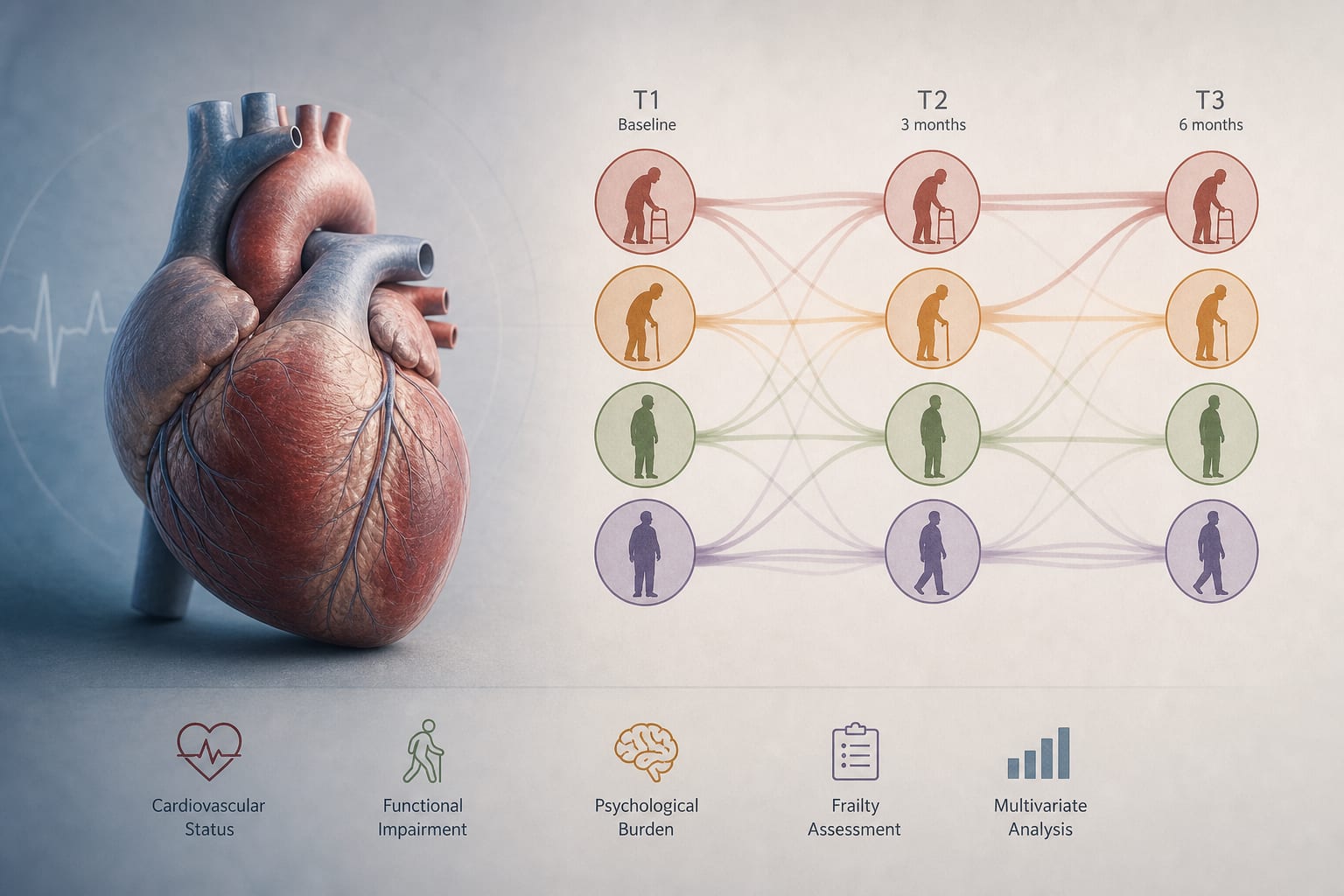
Identification of frailty heterogeneity and its transition trajectories in patients with chronic heart failure: a latent transition analysis - Report - MDSpire
Advertisement
Identification of frailty heterogeneity and its transition trajectories in patients with chronic heart failure: a latent transition analysis
Clinical Report: Characterization of Frailty Variability in CHF Patients
Overview
This study identifies three frailty subtypes in chronic heart failure (CHF) patients and examines their transition patterns over time.
Background
Chronic heart failure (CHF) is a leading cause of morbidity and mortality, particularly among the elderly. Frailty, a multidimensional syndrome, significantly impacts clinical outcomes in CHF patients.
Data Highlights
Frailty Subtype
Characteristics
Transition Rate (T1→T2)
Transition Rate (T2→T3)
Healthy Type
Low Frailty
N/A
N/A
Social-Dominant Type
Moderate Frailty, Insufficient Social Support
24.4%
34.0%
Psychological-Dominant Type
High Frailty, Severe Psychological Burden
N/A
N/A
Key Findings
Three frailty subtypes identified: healthy, social-dominant, and psychological-dominant.
Moderate frailty subtype showed the lowest stability and highest transition to high frailty.
Transition rates from moderate to high frailty increased from 24.4% to 34.0% over six months.
Age, medical insurance status, and psychological factors significantly influenced frailty transitions.
Frailty in CHF patients is dynamic and heterogeneous, requiring stratified management approaches.
Clinical Implications
Healthcare providers should recognize the dynamic nature of frailty in CHF patients and consider individual frailty subtypes.
Conclusion
The findings highlight the importance of understanding frailty transitions in CHF patients.