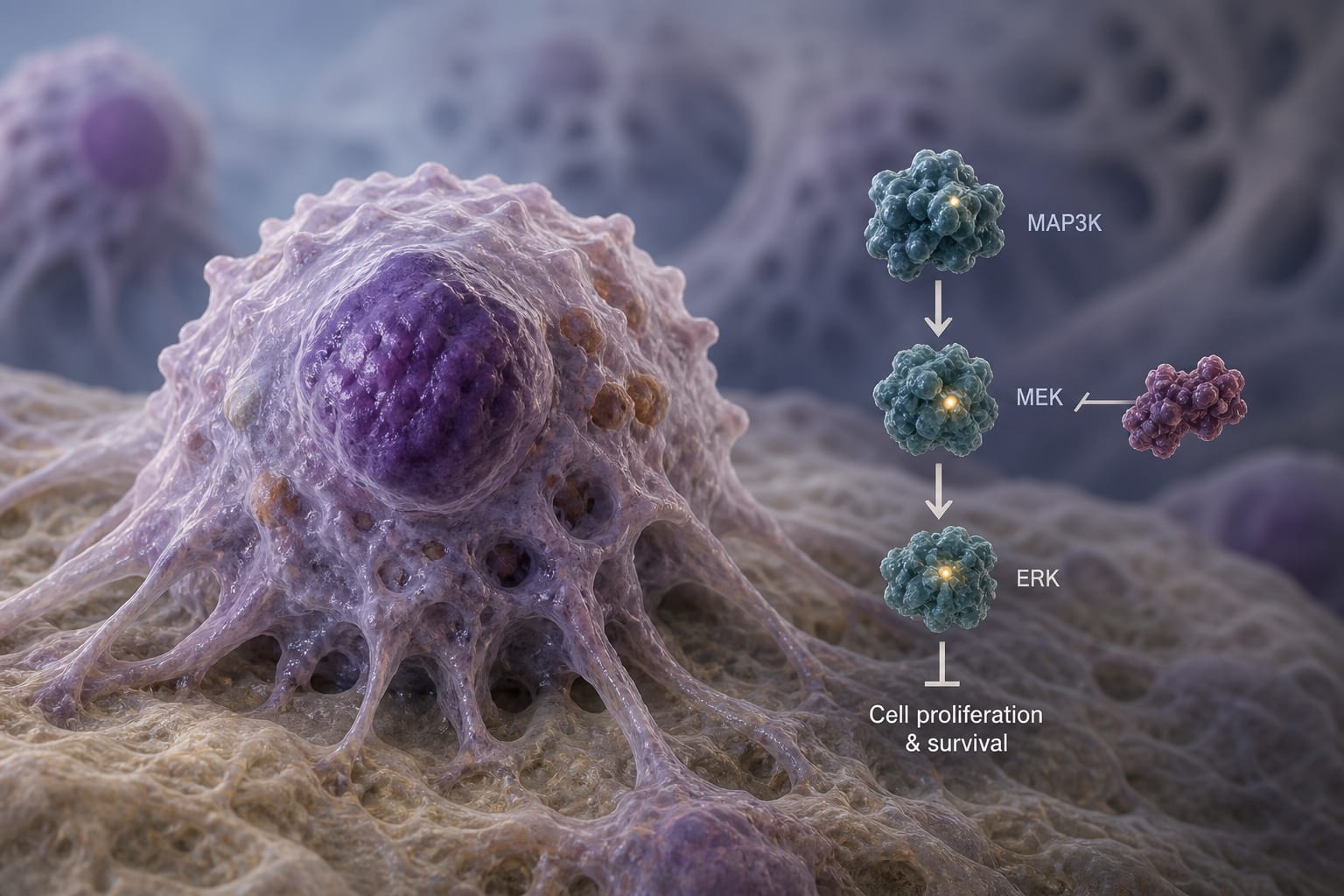
Clinical Report: MEK Inhibitors in Erdheim–Chester Disease
Overview
This international study evaluated long-term efficacy and tolerability of MEK inhibitor (MEKi) monotherapy in patients with Erdheim–Chester disease (ECD), including whether baseline features were associated with response. The supplied article excerpt describes the study design and response criteria but does not provide cohort results, so response rates, durability, toxicity frequencies, and predictors cannot be reported from this material.
Background
ECD is a rare histiocytic neoplasm associated with activating somatic mutations in the MAPK pathway and can cause heterogeneous, life-threatening disease. MAPK inhibitors, including BRAF and MEK inhibitors, have produced high metabolic response rates and are first-choice treatments in some high-income countries. The source notes that long-term efficacy and tolerability remain less well established, particularly for MEKi monotherapy. The study was designed to assess these outcomes and identify baseline features associated with MEKi response.
Data Highlights
The provided excerpt reports study eligibility and assessment methods but contains no numerical cohort outcomes. Patients were required to have at least 6 months of follow-up; response assessment included patients treated for at least 3 months and used a composite of clinical, radiologic, and metabolic criteria.
Key Findings
The study screened patients with biopsy-proven ECD or mixed histiocytosis across eight countries; eligible patients received MEKi monotherapy at any treatment line and had available treatment and outcome data.
Prespecified outcomes included response, time to best response, treatment retention, toxicity, event-free survival, and overall survival.
Complete response required complete regression across clinical, radiologic, and metabolic assessments.
Partial response could be defined by symptom resolution with stable imaging or metabolic studies, at least a 30% decrease in target-lesion diameter without new lesions, or complete or partial metabolic response despite persistent clinical or radiologic involvement.
Progressive disease criteria included new ECD-related manifestations, specified increases or new lesions on radiologic studies, or specified increases or new lesions on PET.
The supplied excerpt does not include the study’s results; therefore, it does not establish response rates, long-term tolerability, or predictors of MEKi efficacy.
Clinical Implications
The source describes MEKi monotherapy as a treatment approach under evaluation for ECD and identifies long-term efficacy, tolerability, and response predictors as unresolved questions. It does not provide outcome data in the supplied excerpt to support specific treatment recommendations or estimates of benefit and risk.
Conclusion
The article excerpt establishes the rationale and methods for an international assessment of MEKi monotherapy in ECD, but omits the results needed to characterize efficacy, durability, safety, or response predictors.
Related Resources & Content
Article excerpt supplied by user, publication details not provided -- MEK Inhibitors Produce Strong, Sustained Responses in Erdheim–Chester Disease