Clinical Report: Current Indications and Results of Open Surgical Treatment for Cerebral Aneurysms
Overview
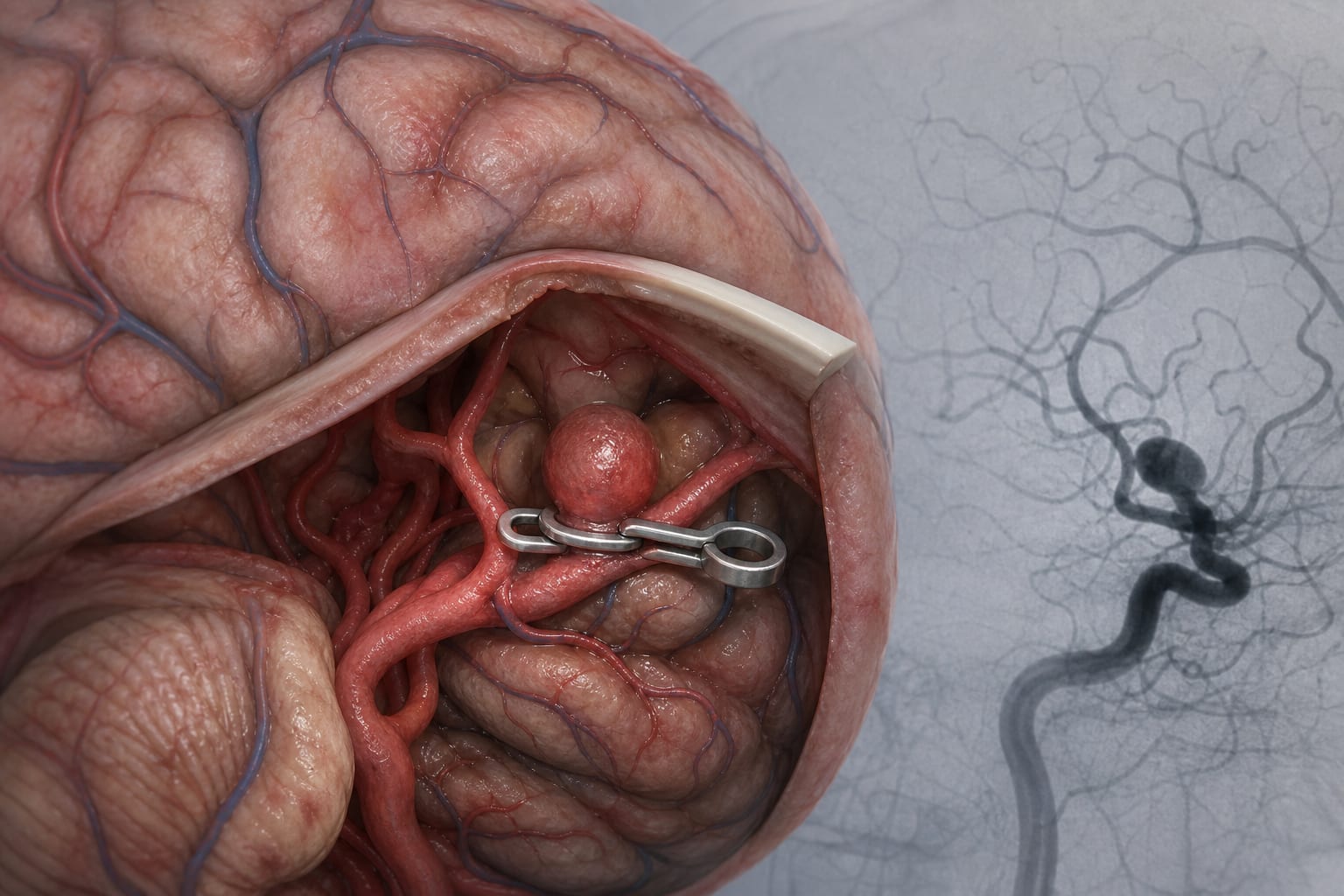
This study analyzes the contemporary indications and outcomes of open surgical treatment for intracranial aneurysms (IA) in an era dominated by endovascular techniques. It highlights the high rates of complete aneurysm occlusion achieved through microsurgery, even in complex cases.
Background
The management of intracranial aneurysms has shifted significantly towards endovascular techniques over the past two decades. However, certain aneurysms still require open surgical intervention due to their anatomical characteristics. Understanding the current indications for surgery is crucial.
Data Highlights
Parameter
Value
Total Aneurysms Analyzed
432
Open Surgery Cases
39.1%
Subarachnoid Hemorrhage Cases
41.4%
Complete Aneurysm Occlusion Rate
93.3%
Major Complication Rate
3.6%
Minor Complication Rate
7.9%
Key Findings
39.1% of aneurysms were treated with open surgery, while 60.9% received endovascular therapies.
41.4% of surgical cases presented with subarachnoid hemorrhage.
Wide-necked aneurysms were the most common reason for selecting open surgery (27%).
93.3% of cases achieved complete aneurysm occlusion.
Major and minor complication rates were 3.6% and 7.9%, respectively.
Adjunctive techniques were necessary in 9.3% of cases, and cerebral bypass and trapping were required in 5.7% of cases.
Clinical Implications
The findings suggest that open surgical treatment is necessary for certain intracranial aneurysms that are unsuitable for endovascular approaches.
Conclusion
This study outlines the indications for open surgical treatment for intracranial aneurysms in the endovascular era, achieving high rates of occlusion with manageable complication rates.
by Jonathan Rychen, Christian Ferreira, Marcio Y. Ferreira, Zoey Croft, Valentin F. Weiger, Griffin Thomas, Christian Rajkovic, Katherine Stark, Yafell Serulle, Jason A. Ellis, David J. Langer