Case report: Central retinal artery occlusion following scleral buckling surgery with secondary angle closure and recurrent acute ocular hypertension - Report - MDSpire

Case report: Central retinal artery occlusion following scleral buckling surgery with secondary angle closure and recurrent acute ocular hypertension

  • By

  • Jing Chen

  • Ling Zhang

  • July 2, 2026

  • 0 min

Share

Central Retinal Artery Occlusion After Scleral Buckling Surgery

Background

CRAO is a rare but serious complication that can occur after retinal detachment surgery, potentially leading to irreversible vision loss. Understanding the mechanisms and risk factors associated with CRAO is crucial for timely intervention and management.

Data Highlights

No numerical data or trial data provided in the article.

Key Findings

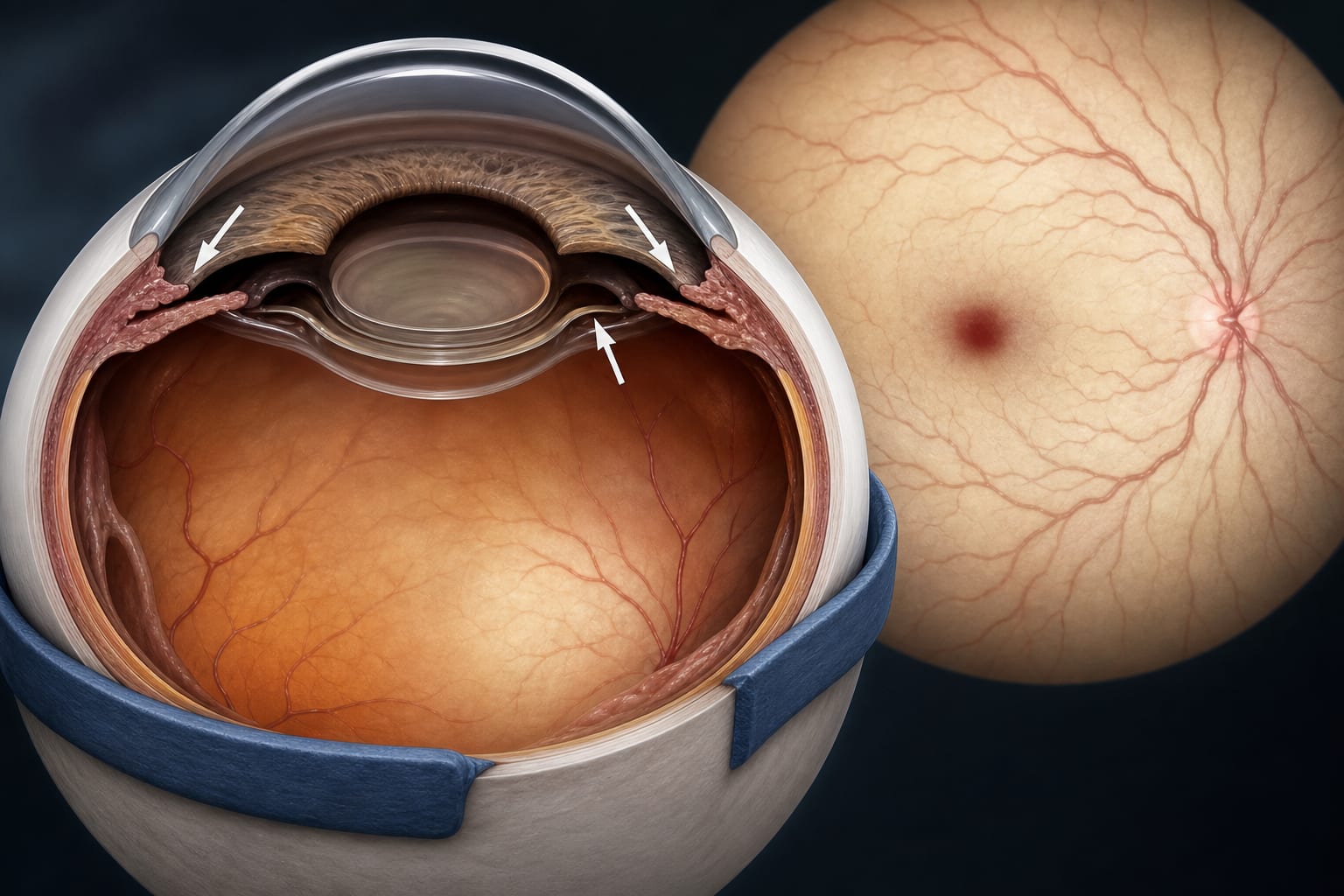
  • A man in his late 60s developed CRAO after combined phacoemulsification and scleral buckling.
  • Post-operative symptoms included recurrent ocular pain, anterior chamber shallowing, and iris bombe.
  • Fundus examination revealed diffuse retinal whitening and a cherry-red spot, indicative of CRAO.
  • Fluorescein angiography showed delayed retinal arterial filling and focal choroidal hypoperfusion.
  • Management included anterior chamber paracentesis and IOP-lowering therapies.
  • Visual recovery was limited to hand motion vision despite normalization of IOP.

Clinical Implications

Healthcare professionals should be aware of signs of recurrent ocular pain and shallow anterior chambers following scleral buckling surgery.

Conclusion

This case highlights the occurrence of CRAO after scleral buckling surgery.

Related Resources & Content

  1. American Academy of Ophthalmology, Ophthalmology, 2024 -- Retinal and Ophthalmic Artery Occlusions Preferred Practice Pattern®
  2. New England Journal of Medicine, 2026 -- A Randomized Trial of Tenecteplase in Acute Central Retinal Artery Occlusion
  3. Optometric Management — CLINICAL: POSTERIOR
  4. New Retinal Physician — Minimizing the Risk of Angle Closure Due to Dilation
  5. glaucoma physician — Management of the Primary Angle-closure Suspect
  6. Retinal Physician — Traumatic and Chronic Retinal Detachments
  7. Minimizing the Risk of Angle Closure Due to Dilation
  8. Management of the Primary Angle-closure Suspect
  9. Retinal and Ophthalmic Artery Occlusions Preferred Practice Pattern® - Ophthalmology
  10. A Randomized Trial of Tenecteplase in Acute Central Retinal Artery Occlusion | New England Journal of Medicine
  11. Secondary glaucoma following vitreo-retinal surgeries - PMC

Original Source(s)

Related Content