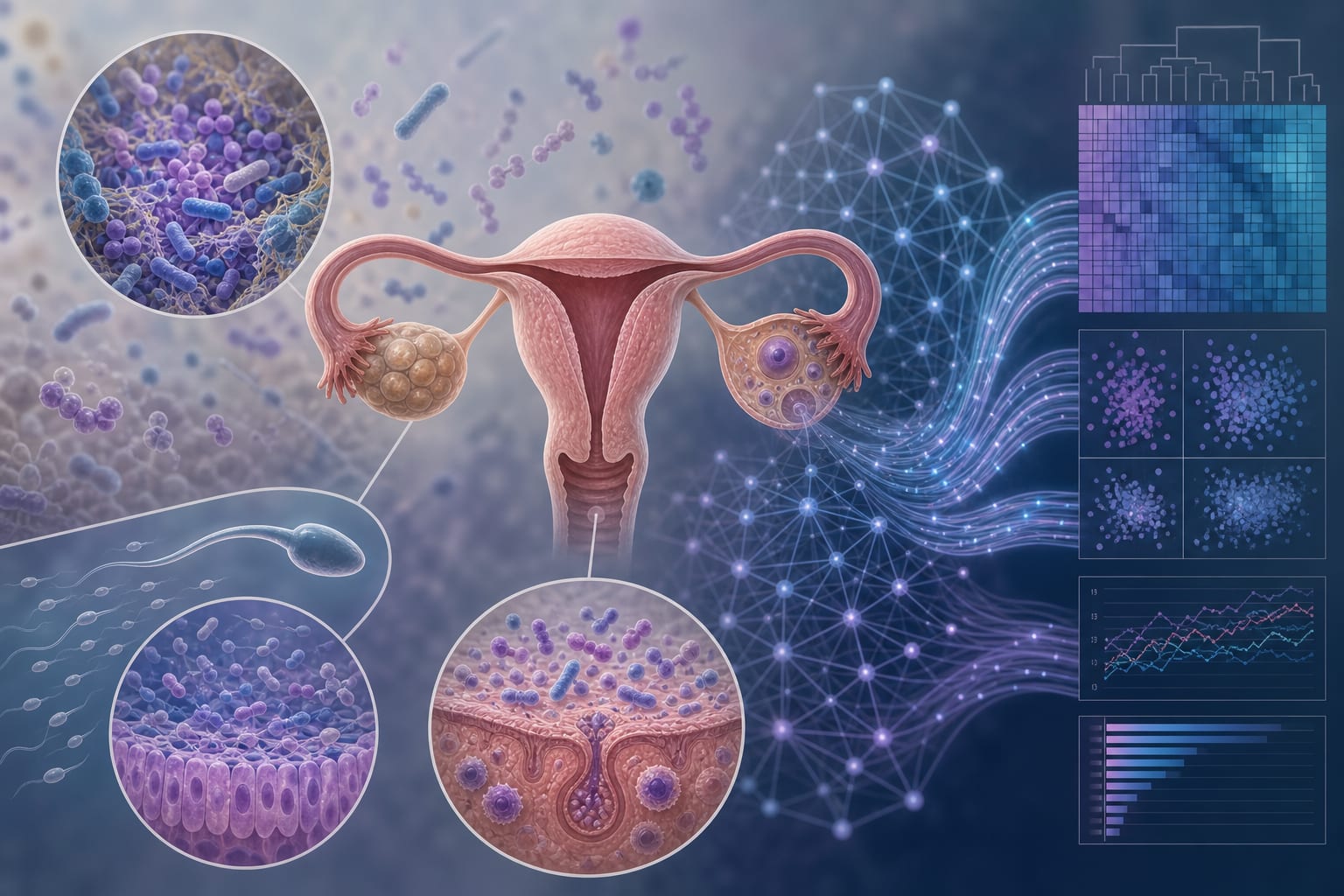
Clinical Report: Unraveling the Reproductive Microbiome with AI Techniques
Overview
This review highlights the integration of machine learning (ML) and deep learning (DL) in understanding the reproductive microbiome's role in reproductive health. It emphasizes the need for robust computational frameworks to transition from descriptive to predictive insights in reproductive medicine.
Background
The reproductive microbiome significantly influences reproductive health, affecting sperm quality, ovarian function, and pregnancy outcomes. Despite its importance, current research is limited by small cohort sizes and a descriptive approach. Advanced computational methods like ML and DL are essential for analyzing complex microbiome data and enhancing clinical applications.
Data Highlights
No specific numerical or trial data provided in the article.
Key Findings
Machine learning can identify non-linear patterns in microbiome data to predict reproductive outcomes.
Deep learning models can capture subtle microbial interactions, although they require large datasets.
Integration of independent datasets can help overcome challenges posed by small cohort sizes.
Feature selection and synthetic data generation are crucial for developing predictive models.
Explainable AI is necessary to ensure biological interpretability in clinical decision-making.
Clinical Implications
Healthcare professionals should consider the potential of ML and DL in enhancing the understanding of the reproductive microbiome. Standardizing analytical workflows and prioritizing interpretability will be essential for translating these findings into clinical practice.
Conclusion
The integration of advanced computational techniques is vital for advancing reproductive microbiome research from descriptive to predictive models, paving the way for personalized reproductive care.
by Ignacio Garach Vélez, Irene Leonés-Baños, Bárbara A. Folch, Laura Antequera, Ignacio Rojas, Francisco Ortuño, María José Sáez Lara, Signe Altmäe, Luis Javier Herrera