Immunotherapeutic potential of PD-1 blockade in chronic Leishmania mexicana infection through the enhancement of progenitor-like CXCR5+ and intermediate CXCR5+TIM-3+ exhausted T cells - Report - MDSpire

Immunotherapeutic potential of PD-1 blockade in chronic Leishmania mexicana infection through the enhancement of progenitor-like CXCR5+ and intermediate CXCR5+TIM-3+ exhausted T cells

  • By

  • Mariana Diupotex

  • Julián A. Gajón

  • Laura C. Bonifaz

  • Jaime Zamora-Chimal

  • Ingeborg Becker

  • June 29, 2026

  • 0 min

Share

Clinical Report: Therapeutic Efficacy of PD-1 Inhibition in Chronic Leishmania mexicana Infection

Overview

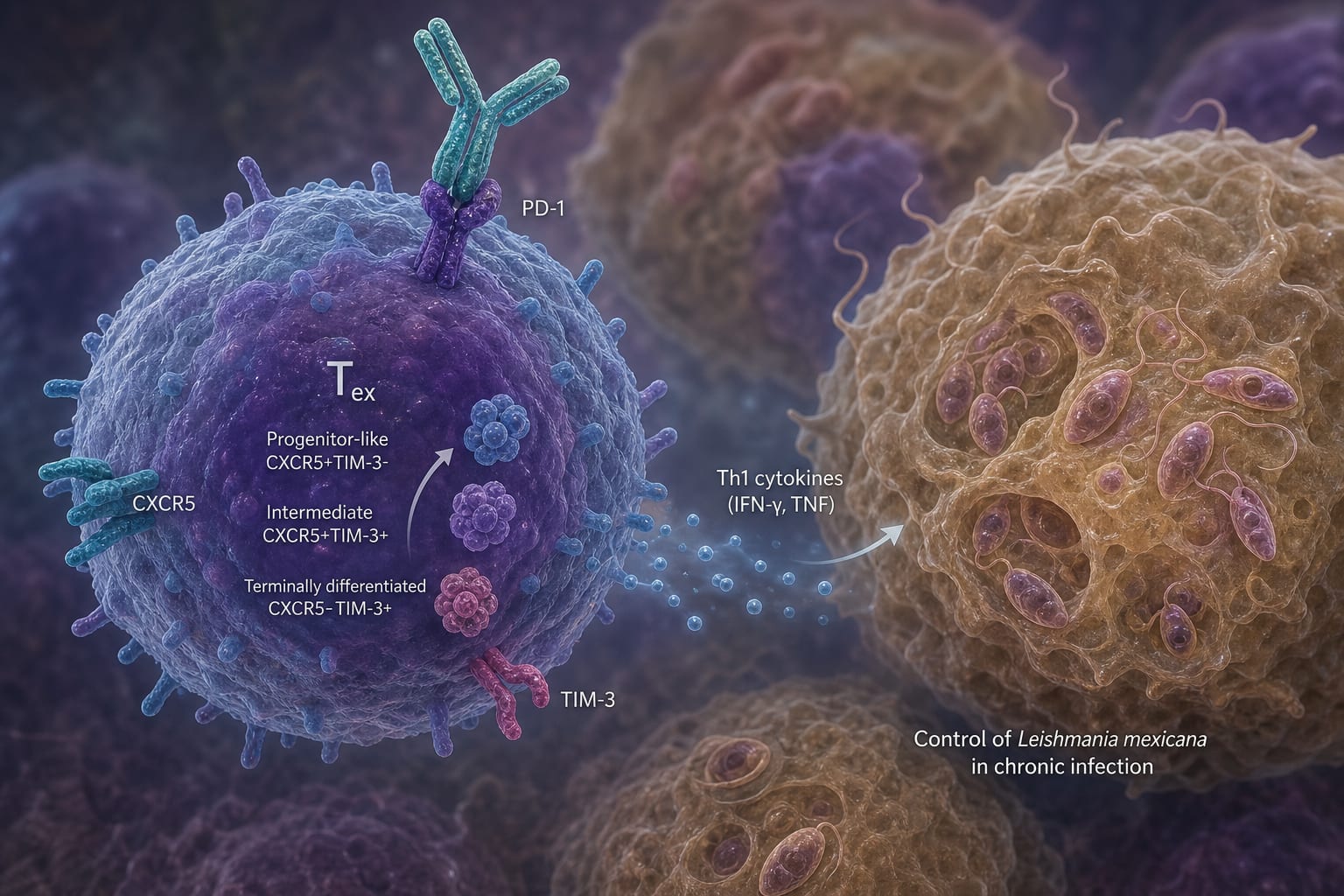
This study demonstrates that anti-PD-1 immunotherapy effectively limits lesion progression and reduces parasite burden in chronic Leishmania mexicana infection. The treatment enhances Th1 immune responses and remodels exhausted T-cell populations.

Background

Diffuse cutaneous leishmaniasis (DCL) caused by Leishmania mexicana is a chronic and treatment-refractory form of leishmaniasis, leading to significant morbidity. Current treatment options are limited and often ineffective, highlighting the need for novel therapeutic strategies.

Data Highlights

ParameterEffect of Anti-PD-1 Therapy
Lesion ProgressionLimited
Parasite BurdenReduced
Th1 Immune ResponseEnhanced
CD8+ T Cell FunctionReinvigorated
Progenitor-like Tex CellsExpanded

Key Findings

  • Anti-PD-1 therapy limited lesion progression in chronically infected mice.
  • Reduced parasite burden was observed following treatment.
  • Enhanced antigen-specific Th1 immune response was noted.
  • Functional reinvigoration of CD8+ and CD4+ T cells occurred in draining lymph nodes.
  • Increased expression of CD69, Ki-67, IFN-γ, and GrzmB was documented.
  • Expansion of progenitor-like CXCR5+TIM-3- and intermediate CXCR5+TIM-3+ Tex cells was observed.

Clinical Implications

The findings indicate that PD-1 blockade may have implications for managing diffuse cutaneous leishmaniasis.

Conclusion

This study provides evidence for the efficacy of anti-PD-1 therapy in chronic L. mexicana infection.

Related Resources & Content

  1. Blood Cancer Journal, 2014 -- The stimulation of PD-L1-specific cytotoxic T lymphocytes can both directly and indirectly enhance antileukemic immunity
  2. The Journal of Infectious Diseases, 2023 -- Immunological Indicators of Treatment Response in Human Cutaneous Leishmaniasis: The Role of Circulating Soluble Factors and T-Cell Subpopulations
  3. Frontiers in Immunology, 2026 -- Immunomodulation by platelet-derived DKK1: potential for controlling disease and pathology in leishmaniasis and implications for other infectious diseases
  4. Guideline for the Treatment of Leishmaniasis in the Americas. Second Edition - PAHO/WHO
  5. The ASCO Post — Chemotherapy-Induced Immunosuppressive Myeloid Cells Inhibit Tumor Control via PD-1–PD-L1 Axis
  6. Guideline for the Treatment of Leishmaniasis in the Americas. Second Edition - PAHO/WHO | Pan American Health Organization
  7. Efficacy and safety of different drugs for the treatment of leishmaniasis: a systematic review and network meta-analysis
  8. Frontiers | CXCR5 and TIM-3 expressions define distinct exhausted T cell subsets in experimental cutaneous infection with Leishmania mexicana

Original Source(s)

Related Content