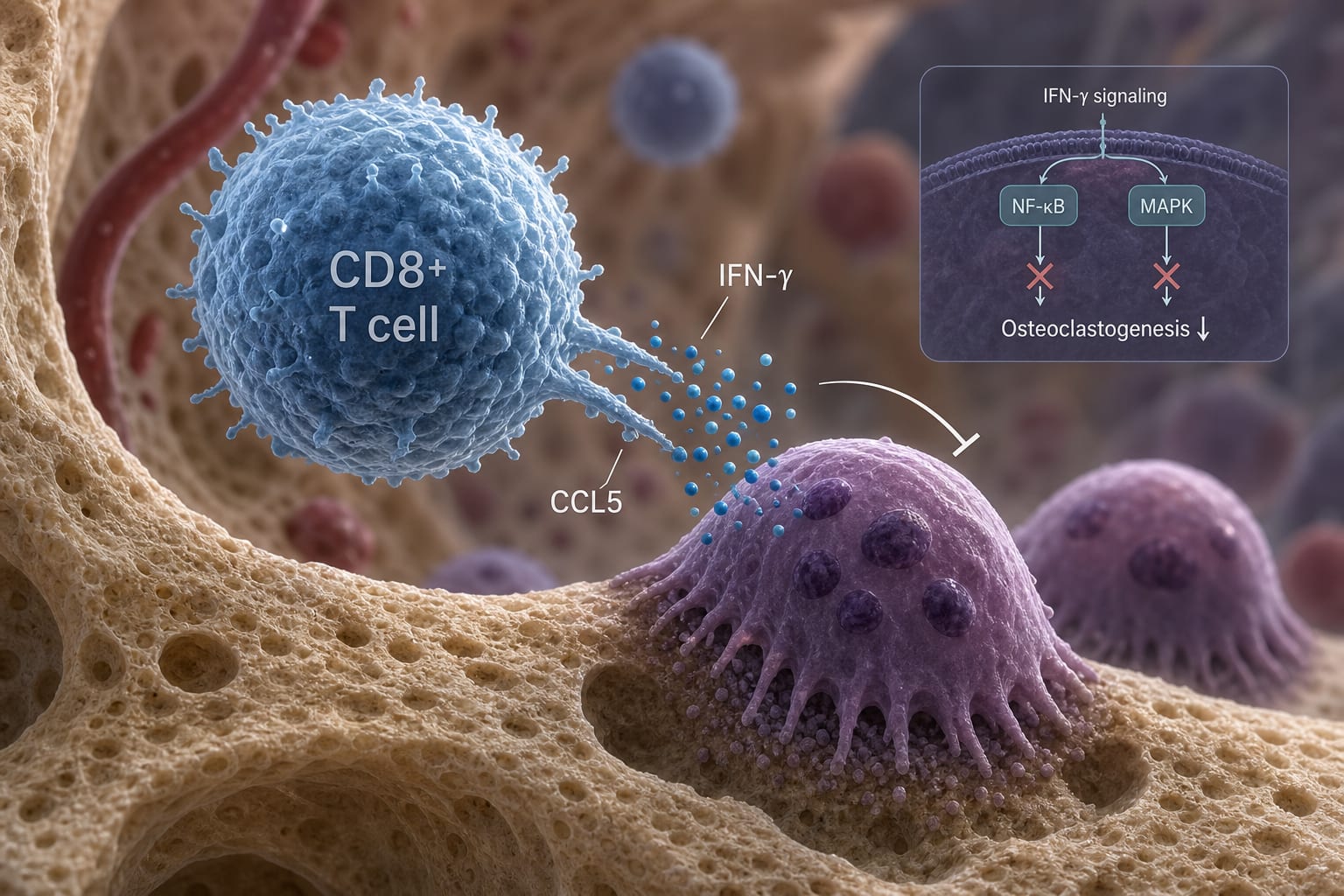
Clinical Report: The Function of CD8+ T Cells in Osteoporosis Immunoregulation
Overview
Revise to emphasize the complexity of local signals affecting CD8+ T cell function.
Background
Osteoporosis is a significant public health concern characterized by reduced bone density and increased fracture risk, particularly in postmenopausal women and the elderly. Recent research underscores the importance of immune regulation in bone metabolism, particularly the role of CD8+ T cells in maintaining or disrupting bone homeostasis. Understanding these mechanisms is crucial for developing targeted therapies to manage osteoporosis.
Data Highlights
No numerical data presented in the article.
Key Findings
Activated CD8+ T cells secrete interferon-γ, inhibiting osteoclast formation and maintaining bone mass under healthy conditions.
Estrogen deficiency leads to increased CCL5 release from CD8+ T cells, promoting osteoclast activation and bone loss.
Aging results in the accumulation of senescent CD28- CD8+ T cells, which exhibit a senescence-associated secretory phenotype that suppresses osteoblast function.
CD8+ T cells can induce apoptosis in osteoblasts and osteocytes through pathways involving TNF-α, IFN-γ, and glucocorticoids.
Granzyme K from CD8+ T cells protects against bone loss, while CCL5 promotes it, indicating potential therapeutic targets.
Clinical Implications
Clinicians should consider the dual role of CD8+ T cells in osteoporosis when developing treatment strategies. Targeting specific pathways, such as the IL-33/CCL5 axis, may provide new avenues for restoring bone health in patients with osteoporosis.
Conclusion
Strengthen the conclusion by summarizing the clinical relevance of the findings.
Researchers urge caution in interpreting joint replacement predictors, noting that surgery reflects access and decision-making as well as disease biology.