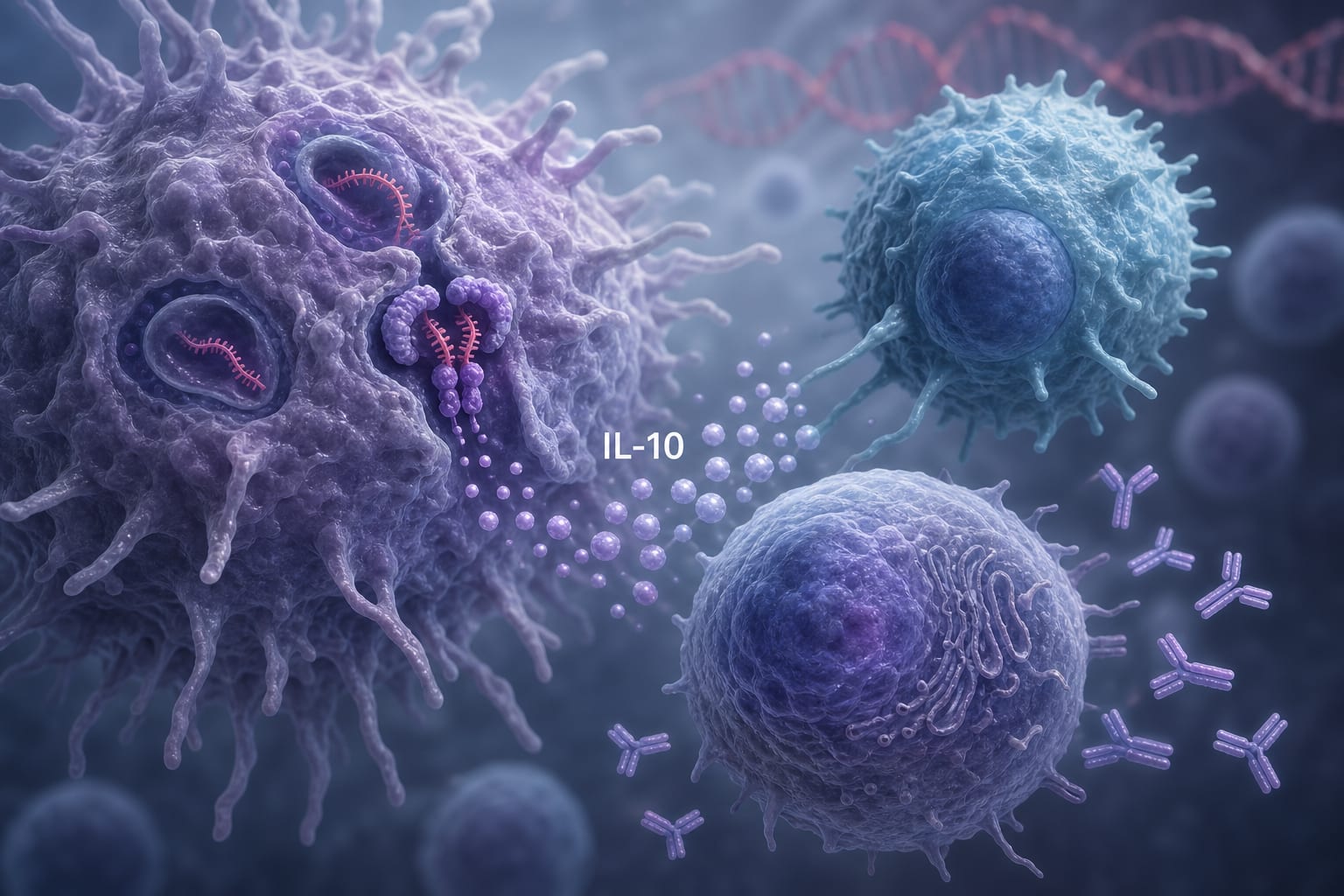
Interleukin-10: A Key Player in Immune Regulation in TLR7-Mediated Lupus
Overview
This study investigates the dual role of interleukin-10 (IL-10) in systemic lupus erythematosus (SLE), highlighting its pro-inflammatory and anti-inflammatory effects. Using a TLR7 agonist-induced murine model, the research demonstrates that IL-10 has both regulatory and inflammatory roles in the disease context.
Background
Systemic lupus erythematosus (SLE) is a complex autoimmune disease characterized by immune dysregulation and chronic inflammation. Cytokines, including IL-10, play a role in modulating immune responses. Understanding IL-10's dual role in SLE is important.
Data Highlights
No numerical data or trial data presented in the article.
Key Findings
IL-10 exhibits both pro-inflammatory and anti-inflammatory effects in SLE.
Blockade of IL-10R leads to increased IL-17 and reduced regulatory T cell frequencies.
IL-10R blockade also decreases IL-10 and interferon gamma (IFN-γ) expression.
STAT3 signaling is activated in T effector cells and regulatory T cells by IL-10.
Heightened sensitivity of Tregs to IL-10R blockade may be due to elevated IL-10R expression.
Clinical Implications
The findings provide insights into IL-10's role in SLE.
Conclusion
This research highlights the complexity of IL-10's role in lupus.
by Johanna Pauline Williams, Anaïs Amend, Anna-Lena Schäfer, Paola Fernanda Ruiz-Aparicio, Antoine Nicolas Kraemer, Aileen Qian Luo, Laura Riechert, Lara Weber, Baerbel Keller, Rudolf Armin Manz, Reinhard Edmund Voll, Nina Chevalier
Federal prosecutors allege that a Florida physician and research staff fabricated clinical trial records that were submitted into database systems used to evaluate investigational drugs.