Molecular and spatial specialization of lung interstitial macrophage subsets: beyond chemokines
-
By
-
Xin Li
-
Claudia V. Jakubzick
-
June 10, 2026
-
0 min
Clinical Report: Characterization of Molecular and Spatial Diversity Among Lung Interstitial Macrophage Subsets
Overview
This study provides a detailed characterization of interstitial macrophage (IM) subsets in the murine lung, highlighting their distinct molecular profiles and spatial localization. The findings enhance understanding of IM heterogeneity and its implications for lung immunity and disease.
Background
Interstitial macrophages (IMs) play crucial roles in maintaining lung tissue homeostasis and regulating immune responses. Their involvement in various lung diseases, including chronic inflammation and fibrosis, underscores the importance of understanding their molecular and spatial characteristics. This study aims to elucidate the functional diversity of IM subsets and their contributions to lung pathology.
Data Highlights
| IM Subset | Cytokine Profile | Localization |
|---|---|---|
| CD206hi | Distinct cytokine and receptor gene profiles | Bronchovascular bundles |
| CD206lo | Distinct innate immune signatures | Interstitium and periphery |
Key Findings
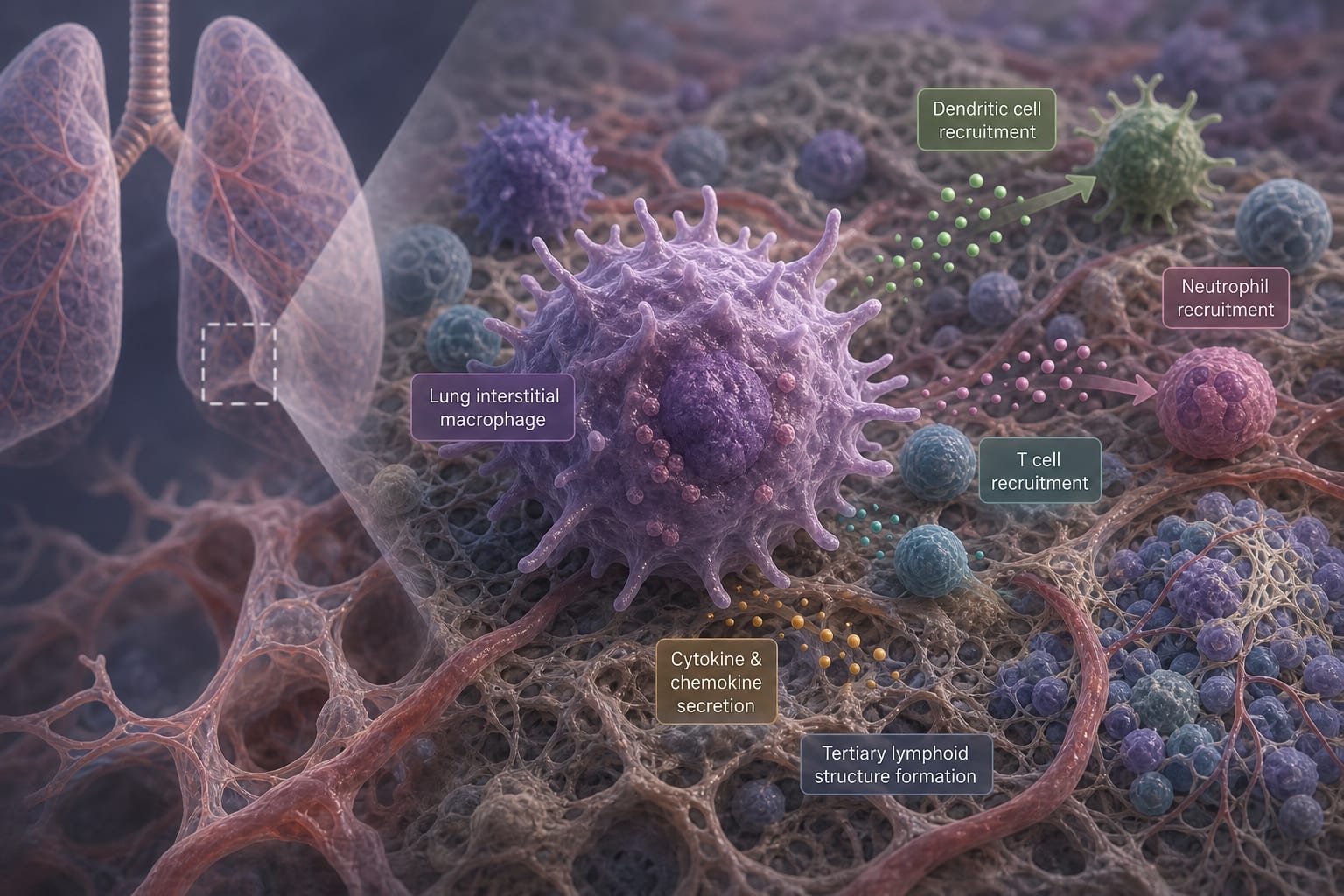
- CD206hi and CD206lo IM subsets exhibit unique cytokine and receptor gene profiles.
- IM subsets display distinct innate immune signatures, including complement components and pattern recognition receptors.
- Spatial transcriptomics revealed specific anatomical niches occupied by IMs, influencing their functional roles.
- Chemokine expression patterns in IMs correlate with the positioning of T cells and B cells in the lung.
- The study provides a framework for understanding IM contributions to lung immunity and disease pathology.
Clinical Implications
Understanding the molecular and spatial diversity of IM subsets can inform therapeutic strategies targeting lung diseases characterized by chronic inflammation and tissue remodeling. This knowledge may lead to more effective interventions that modulate immune responses in the lung microenvironment.
Conclusion
The study advances the understanding of interstitial macrophage heterogeneity, providing insights into their roles in lung immunity and disease. Further research is warranted to explore the therapeutic potential of targeting these macrophage subsets.
Related Resources & Content
- Basic Research in Cardiology, 2020 -- Cardiac Resident Macrophages: Essential Regulators of Cardiac Physiology and Pathology
- The Journal of Infectious Diseases, 2023 -- Genetically Diverse Mycobacterium tuberculosis Isolates Manipulate Inflammasome and Interleukin 1β Secretion Independently of Macrophage Metabolic Rewiring
- Archives of Toxicology, 2021 -- Innate-like B-1 lymphocytes in mice enhance granuloma formation and inflammation triggered by inhaled particles in collaboration with macrophages
- Frontiers in Immunology, 2026 -- Macrophage dysregulation in inflammatory bowel disease: cellular heterogeneity, pathogenic mechanism, and treatment
- Physiological Reviews, 2025 -- The cell with many faces: lung macrophage plasticity and function in response to environmental and pathogenic insults
- European Respiratory Society, 2025 -- Update of the international multidisciplinary classification of the interstitial pneumonias: an ERS/ATS statement
- GOLD REPORT 2026 KEY CHANGES SUMMARY
- Phase 3 Trial of Inhaled Molgramostim in Autoimmune Pulmonary Alveolar Proteinosis
- Nerandomilast in Patients with Idiopathic Pulmonary Fibrosis
- aTyr Pharma Announces Topline Results from Phase 3 EFZO-FIT™ Study of Efzofitimod in Pulmonary Sarcoidosis
- Transcriptomics of interstitial lung disease: a systematic review and meta-analysis
- The cell with many faces: lung macrophage plasticity and function in response to environmental and pathogenic insults | Physiological Reviews | American Physiological Society
- Update of the international multidisciplinary classification of the interstitial pneumonias: an ERS/ATS statement | European Respiratory Society
This content is an AI-generated, fully rewritten summary based on a published scholarly article. It does not reproduce the original text and is not a substitute for the original publication. Readers are encouraged to consult the source for full context, data, and methodology.