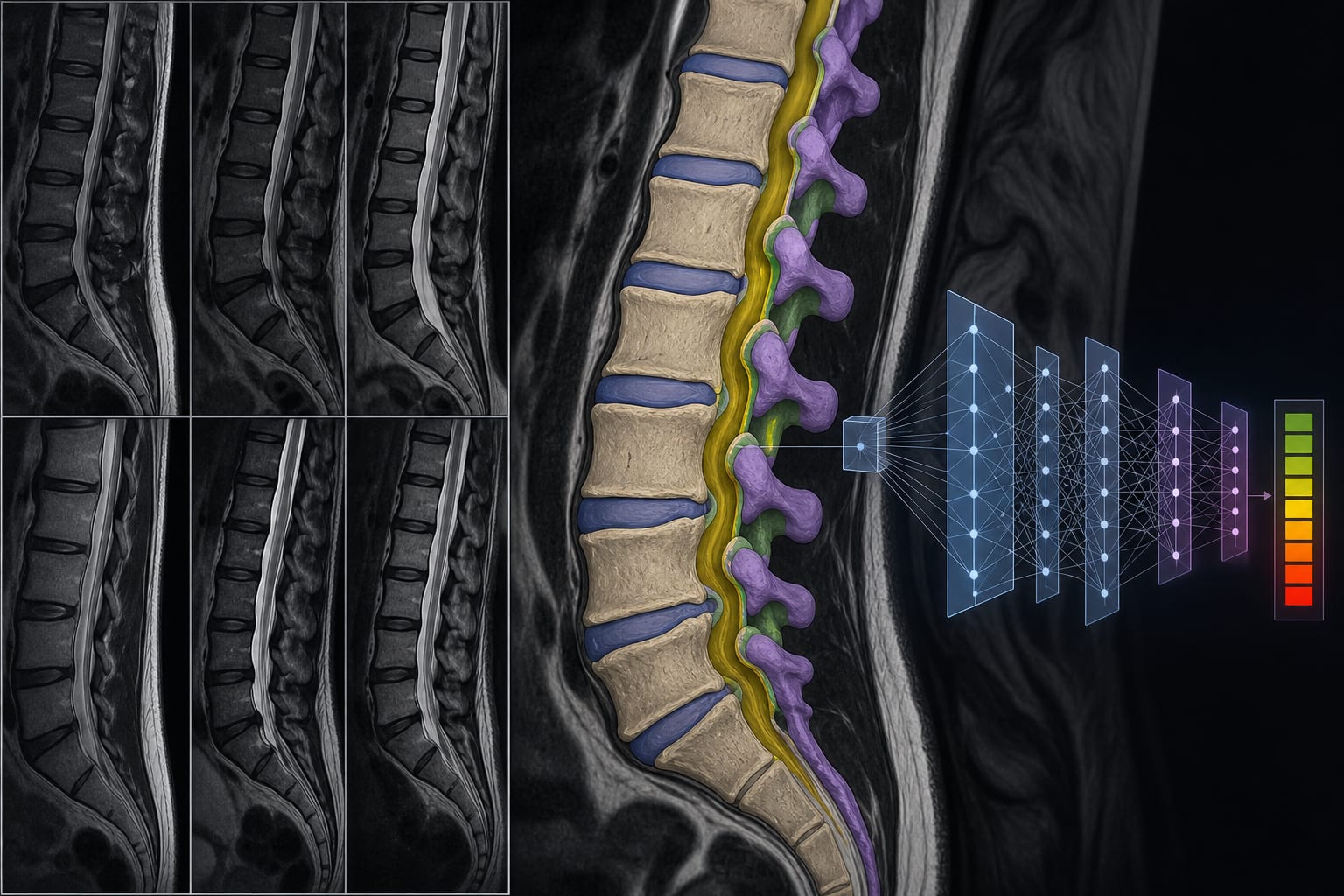
Clinical Report: Anatomy-Informed Contextual Deep Learning for Grading Lumbar Degenerative Disorders
Overview
This study presents a novel anatomy-guided deep learning framework for grading lumbar degenerative diseases and assessing patient-level risk via MRI.
Background
Lumbar degenerative disorders are prevalent causes of low back pain and functional limitations in adults, with MRI being the primary diagnostic tool. Despite advancements in automated MRI analysis, challenges remain in achieving reliable burden assessments due to anatomical ambiguities and insufficient modeling of inter-level dependencies.
Data Highlights
Metric
Value
Macro F1-score
0.783 ± 0.010
Cohen's Kappa
0.765 ± 0.012
Weighted log loss
0.463 ± 0.018
Patient-level AUC
0.891 ± 0.009
Key Findings
The proposed framework integrates anatomical parsing, multi-sequence MRI patches, and quantitative biomarkers for improved grading.
It achieves a Macro F1-score of 0.783.
Ablation studies confirm that each component of the framework contributes to its overall performance.
Explicit integration of anatomical priors enhances diagnostic accuracy and interpretability.
Clinical Implications
The findings suggest that incorporating anatomical context and structured biomarkers can enhance the reliability of lumbar MRI assessments. This approach may lead to more standardized and transparent evaluations in radiological practice.
Conclusion
The study presents an anatomy-guided deep learning framework to improve the grading of lumbar degenerative disorders and patient-level risk assessment.