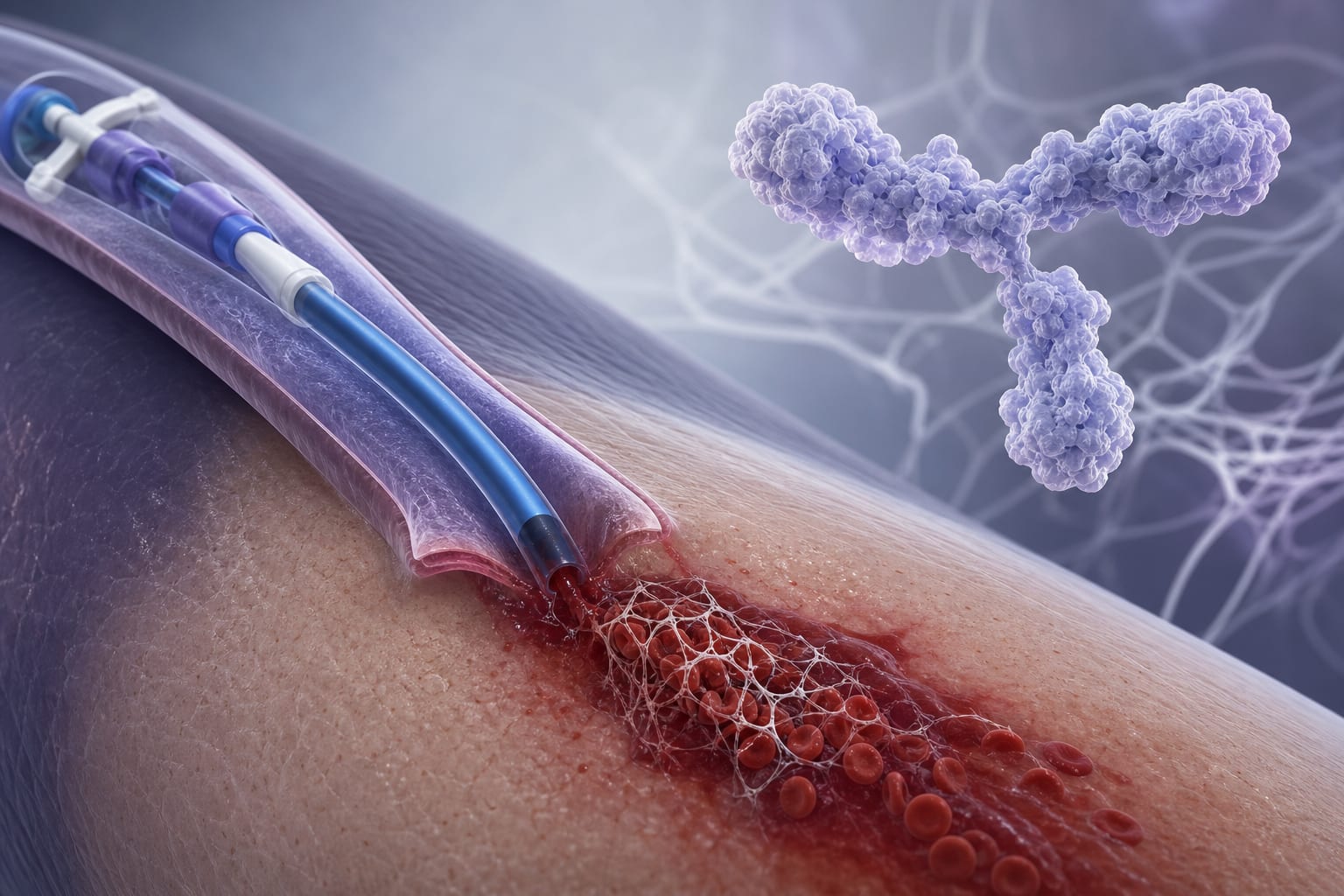
Fibrinogen and catheter advancement difficulty: unveiling the key predictors of early in-situ bleeding after peripherally inserted central catheter insertion - Report - MDSpire

Fibrinogen and catheter advancement difficulty: unveiling the key predictors of early in-situ bleeding after peripherally inserted central catheter insertion

  • By

  • Shusheng Jiao

  • Hongjie Yang

  • Jianling Yang

  • Jianxia Zhi

  • July 15, 2026

Share

Fibrinogen Levels and Challenges in Catheter Placement: Identifying Key Predictors of Early Bleeding at the Insertion Site Following PICC Placement

Overview

This study identifies lower fibrinogen levels and catheter advancement difficulty as independent risk factors for early bleeding following PICC placement. A tumor diagnosis was associated with a reduced risk of bleeding, but this finding should be regarded as hypothesis-generating rather than conclusive.

Background

PICC placement is a common procedure for long-term venous access, yet early bleeding at the insertion site can lead to significant complications and increased healthcare costs. Understanding the risk factors associated with this complication is essential for improving patient outcomes and developing targeted prevention strategies.

Data Highlights

VariableOdds Ratio (OR)95% Confidence Interval (CI)p-value
Fibrinogen Level0.7620.583–0.9950.046
Catheter Advancement Difficulty2.5601.010–6.4850.047
Tumor Diagnosis0.3310.142–0.7680.011
Puncture Attempts1.661-0.060

Key Findings

  • In-situ hemorrhage incidence was 21.9% among the study cohort.
  • Lower fibrinogen levels were identified as an independent risk factor for early bleeding (OR = 0.762).
  • Catheter advancement difficulty was also a significant predictor of bleeding (OR = 2.560).
  • A tumor diagnosis was unexpectedly associated with a reduced risk of bleeding (OR = 0.331).
  • The number of puncture attempts showed a trend toward significance in relation to bleeding risk (p = 0.060).

Clinical Implications

Pre-procedural assessment of fibrinogen levels may help identify patients at higher risk for bleeding complications following PICC placement.

Conclusion

Lower fibrinogen level and catheter advancement difficulty are independent risk factors for early PICC-related bleeding, while a tumor diagnosis appears protective.

Related Resources & Content

  1. Frontiers in Medicine, 2026 -- Rapid laboratory identification of fibrinogen Longmont: a case report and literature review
  2. Pediatric Cardiology, 2024 -- Cost Assessment of Perioperative Thrombosis and Hyper-coagulation Following Congenital Heart Surgery
  3. Frontiers in Cardiovascular Medicine, 2026 -- Risk factors of bleeding in patients with atrial fibrillation undergoing percutaneous coronary intervention: an analysis from the MANJUSRI study
  4. Pediatric Cardiology, 2022 -- A Randomized Pilot Study Evaluating the Impact of Human Fibrinogen Concentrate on Reducing Cryoprecipitate Utilization and Blood Loss in Infants Undergoing Cardiopulmonary Bypass
  5. Society of Interventional Radiology Consensus Guidelines for the Periprocedural Management of Thrombotic and Bleeding Risk in Patients Undergoing Percutaneous Image-Guided Interventions-Part II: Recommendations
  6. Platelet Transfusion before CVC Placement in Patients with Thrombocytopenia
  7. Rapid haemostasis to achieve dressing longevity: evaluation trial results using StatSeal catheter exit site protection
  8. Society of Interventional Radiology Consensus Guidelines for the Periprocedural Management of Thrombotic and Bleeding Risk in Patients Undergoing Percutaneous Image-Guided Interventions-Part II: Recommendations

Original Source(s)

Related Content