Multi-scale feature refinement network for lower limb fracture detection in X-ray images - Report - MDSpire

Multi-scale feature refinement network for lower limb fracture detection in X-ray images

  • By

  • Zhengguo Wan

  • Yanling Wang

  • Rong Tang

  • Ke Zhang

  • Penghua Liu

  • Zheyu Zhao

  • Yujie Shi

  • Huaran Huo

  • July 2, 2026

  • 0 min

Share

Clinical Report: Multi-Scale Feature Enhancement Network for Detecting Lower Limb Fractures in X-Ray Imaging

Overview

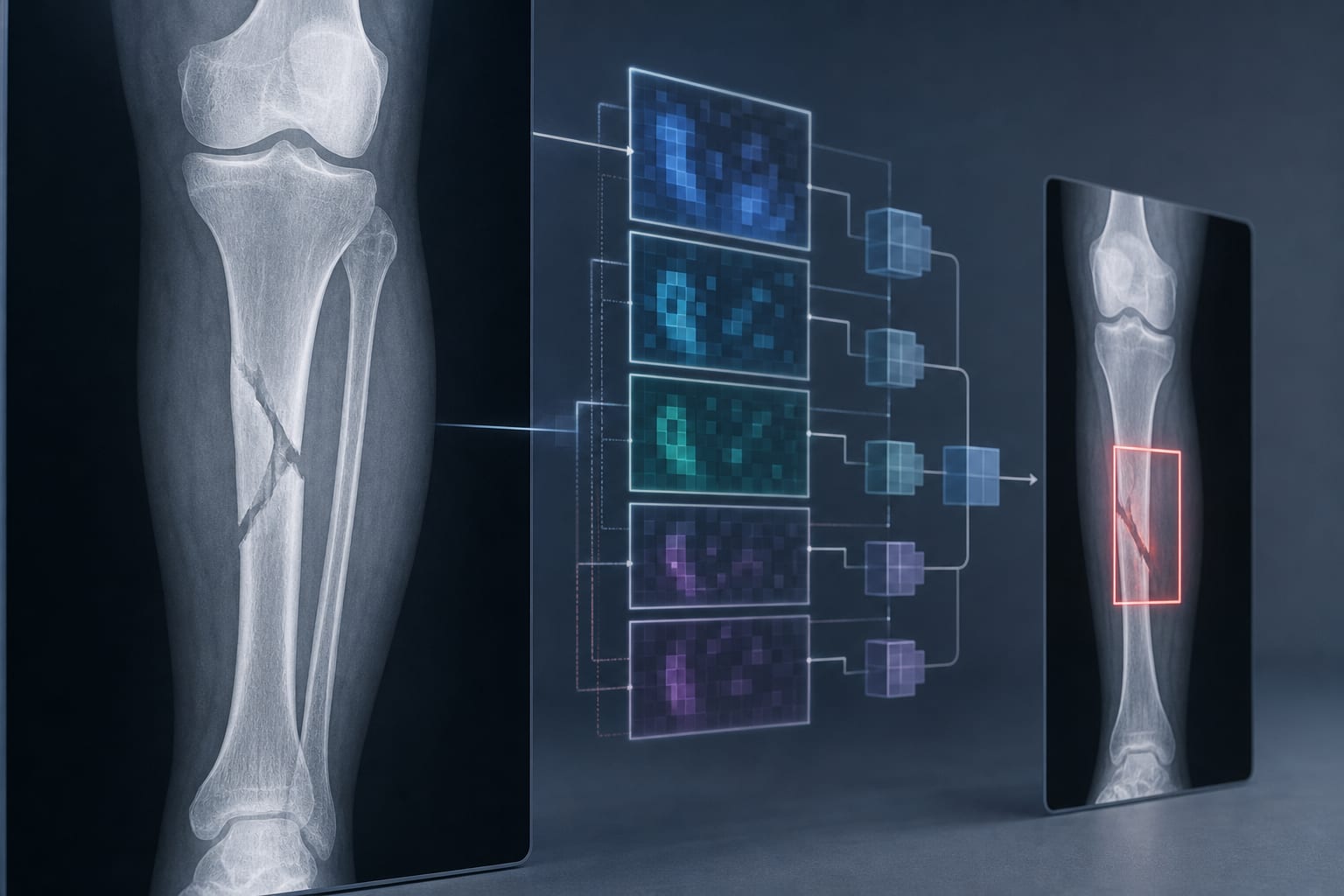
The proposed MFRNet demonstrates high detection accuracy for lower limb fractures, achieving 89.1% mAP with only 3.8 million parameters.

Background

Lower limb fractures are prevalent in orthopedic emergencies, often resulting from traffic accidents, sports injuries, and falls. Rapid and accurate diagnosis is crucial to prevent complications such as malunion or nonunion, which can severely affect patients' mobility and quality of life. Traditional X-ray imaging, while cost-effective, presents challenges in detecting subtle fractures due to complex anatomy and low contrast.

Data Highlights

MetricValue
mAP89.1%
mAP50-9552.2%
Parameters3.8 M

Key Findings

  • MFRNet utilizes an Adaptive Feature Perception Block (AFPB) to enhance fracture features and reduce background noise.
  • The Multi-Scale Dilated Attention Module (MSDAM) expands the receptive field to capture multi-scale contextual information.
  • MFRNet outperforms existing object detection models in lower limb fracture detection.
  • The model balances high detection accuracy with parameter efficiency.
  • Future work will focus on multi-center validation and mobile deployment of the model.

Clinical Implications

The MFRNet model offers a promising tool for computer-aided diagnosis in detecting lower limb fractures, potentially improving diagnostic accuracy in clinical settings. Its efficiency may facilitate quicker decision-making in emergency situations.

Conclusion

MFRNet represents a significant advancement in the detection of lower limb fractures in X-ray imaging, combining high accuracy with a compact model size. Further validation and deployment are anticipated to enhance its clinical utility.
Related Resources & Content

  1. Enhancing Neural Network Applications with Multiclass Datasets: A Case Study on Ankle Radiographs, Springer, 2023 -- Title
  2. Automated Identification and Categorization of Peri-Prosthetic Femoral Fractures, Springer, 2021 -- Title
  3. Automated Alignment of Ultrasound Images for Diagnosing Distal Forearm Fractures in Children, Springer, 2025 -- Title
  4. ACR Introduces New Clinical Topics in Latest Appropriateness Criteria Update, ACR, 2026 -- Title
  5. American College of Radiology ACR Appropriateness Criteria® Acute Trauma to the Ankle, ACR -- Title
  6. Recommendations | Hip fracture: management | Guidance | NICE, NICE -- Title
  7. Frontiers in Medicine — PEYOLO: a wrist fracture detection network based on multi-level receptive field feature extraction and cross-scale fusion
  8. ACR Introduces New Clinical Topics in Latest Appropriateness Criteria Update
  9. American College of Radiology ACR Appropriateness Criteria® Acute Trauma to the Ankle
  10. https://acsearch.acr.org/list/GenerateAppendixPDF?TopicId=78
  11. ACR Appropriateness Criteria® Major Blunt Trauma: Update 2025 - ScienceDirect
  12. Recommendations | Hip fracture: management | Guidance | NICE
  13. Full article: Enhanced fracture detection on radiographs with AI assistance for clinicians: a systematic review and meta-analysis
  14. Artificial intelligence in commercial fracture detection products: a systematic review and meta-analysis of diagnostic test accuracy | Scientific Reports
  15. Real-world clinical impact of three commercial AI algorithms on musculoskeletal radiography interpretation: A prospective crossover reader study - PubMed
  16. ISRCTN - ISRCTN23087950: Medical utility of artificial intelligence for fracture detection in the emergency department
  17. The AI implementation gap in trauma radiography: standalone versus discretionary AI-integrated fracture detection | European Radiology Experimental | Springer Nature Link

Original Source(s)

Related Content