On-treatment change in bone turnover markers predicts 2-year bone mineral density after sequential therapy following romosozumab: a real-world cohort study - Report - MDSpire
Conexiant’s news site is now MDSpire News. Learn more
Advertisement
Change in Bone Turnover Markers During Treatment as a Predictor of Two-Year Bone Mineral Density Following Sequential Romosozumab Therapy: Insights from a Real-World Cohort Study
Clinical Report: Change in Bone Turnover Markers During Treatment as a Predictor of Two-Year Bone Mineral Density Following Sequential Romosozumab Therapy
Overview
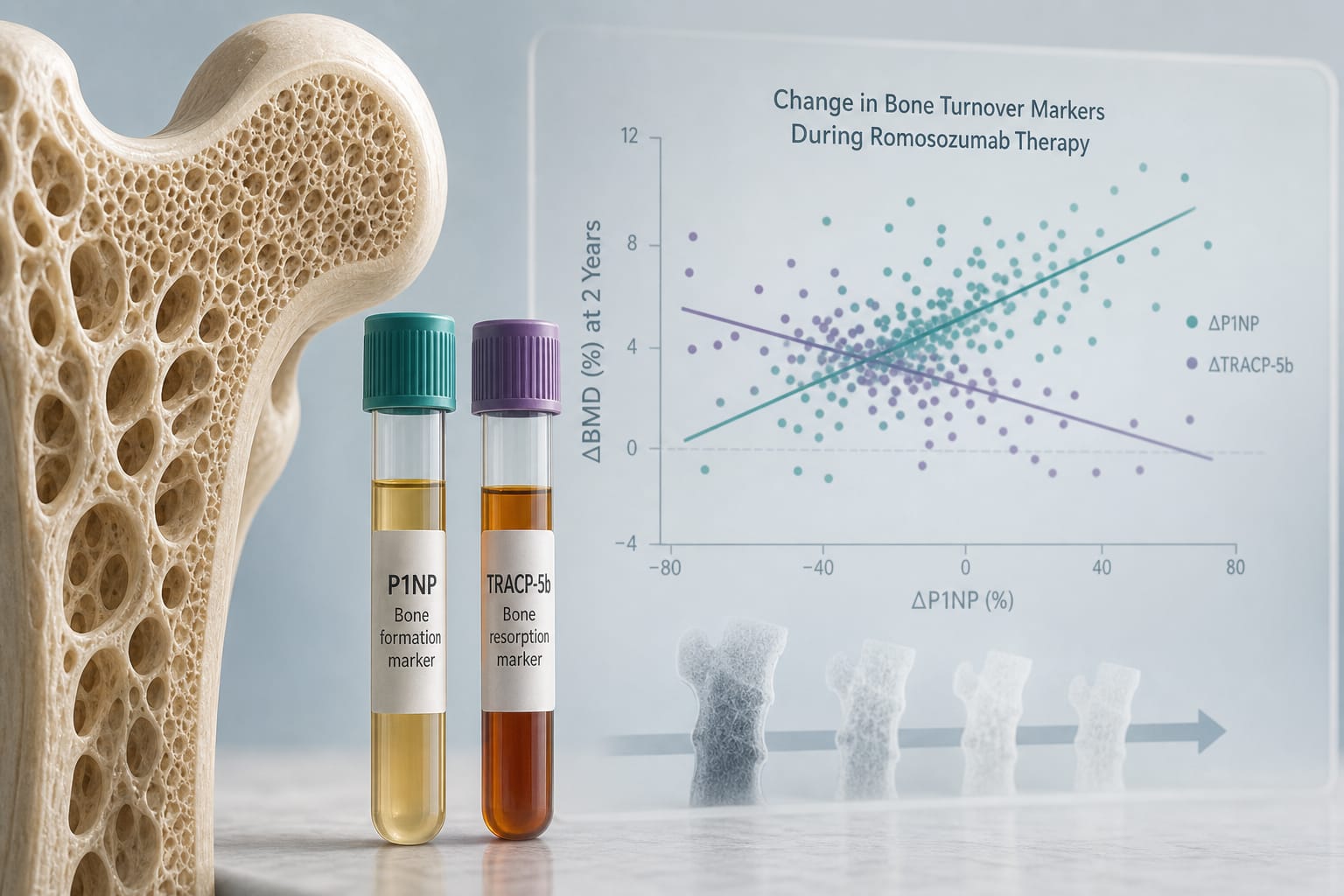
This study investigates the relationship between changes in bone turnover markers (BTMs) during romosozumab treatment and subsequent bone mineral density (BMD) gains over two years. It identifies ΔP1NP as a significant predictor of cumulative LS-BMD changes, particularly in treatment-naïve patients.
Background
Romosozumab is an effective anabolic therapy for osteoporosis, significantly increasing BMD and reducing fracture risk. However, predicting which patients will achieve the most substantial long-term BMD improvements after sequential therapy remains a challenge. Understanding the role of BTMs during treatment could enhance patient management and outcomes.
Data Highlights
Measure
Correlation Coefficient (ρ)
p-value
Sample Size (n)
ΔP1NP with LS-BMD change
−0.375
<0.0001
129
ΔTRACP-5b with LS-BMD change
−0.348
0.0001
114
ΔP1NP cutoff for good response
−40.3 μg/L
AUC = 0.761
Key Findings
ΔP1NP decline during romosozumab treatment predicts greater cumulative LS-BMD gain.
Patients in the highest ΔP1NP decline tertile achieved a 23.5% cumulative LS-BMD gain.
ΔTRACP-5b also correlated with LS-BMD changes, though less strongly than ΔP1NP.
The predictive value of ΔP1NP was stronger in treatment-naïve patients compared to previously treated patients.
ΔP1NP remained an independent predictor of 2-year cumulative BMD after adjusting for multiple covariates.
Clinical Implications
Monitoring BTMs, particularly ΔP1NP, during romosozumab therapy can help clinicians predict long-term BMD outcomes. This information may guide treatment decisions and patient management strategies, especially for treatment-naïve individuals.
Conclusion
The study underscores the importance of on-treatment BTM changes as predictors of long-term BMD gains following romosozumab therapy, highlighting the need for further validation in broader patient populations.
Federal prosecutors allege that a Florida physician and research staff fabricated clinical trial records that were submitted into database systems used to evaluate investigational drugs.