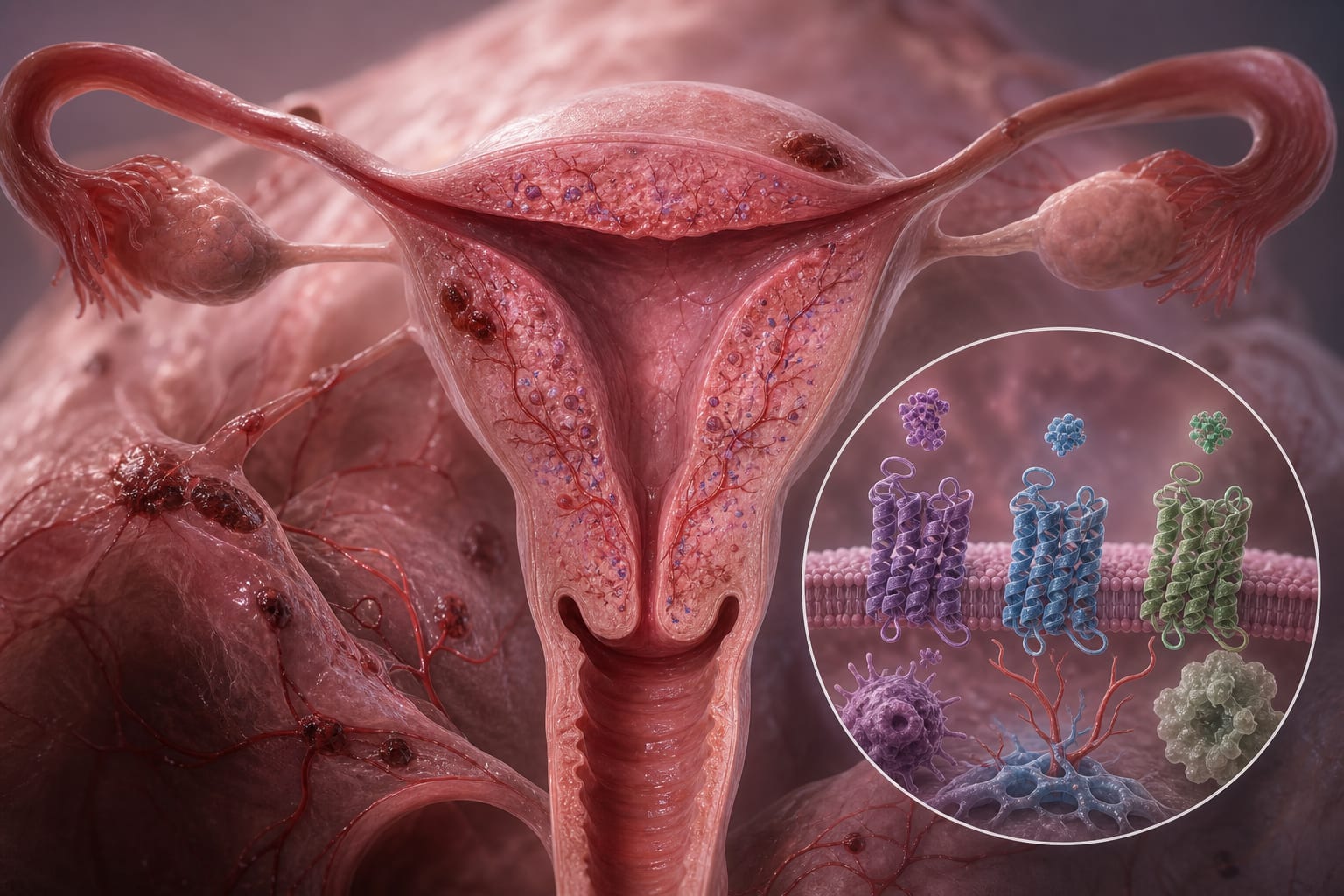
The opioid system in endometriosis: implications for endometrial receptivity and reproductive outcomes - Report - MDSpire

The opioid system in endometriosis: implications for endometrial receptivity and reproductive outcomes

  • By

  • Estibaliz Olabarrieta

  • Lide Totorikaguena

  • Sara Alonso-Fernández

  • Ekaitz Agirregoitia

  • Naiara Agirregoitia

  • June 29, 2026

  • 0 min

Share

Clinical Report: The Role of the Opioid System in Endometriosis

Overview

This review explores the involvement of the opioid system in endometriosis, highlighting its role in regulating endometrial function and reproductive health.

Background

Endometriosis affects 10-15% of women of reproductive age and is a significant cause of female subfertility. Current management strategies often do not address the underlying reproductive dysfunction associated with the disease. The role of the opioid system is being investigated in relation to the pathogenesis of endometriosis.

Data Highlights

No numerical data or trial data was provided in the article.

Key Findings

  • The opioid system may regulate endometrial function beyond its traditional role in pain management.
  • Opioid receptors and peptides exhibit cyclical fluctuations within the uterine environment.
  • Opioid signaling influences tissue remodeling, angiogenesis, and apoptosis, which are often dysregulated in endometriosis.
  • Endometriotic cells display cancer-like characteristics that may be influenced by opioid pathways.
  • Current research primarily focuses on opioid analgesics, with limited exploration of the endogenous opioid system's role in endometriosis.

Clinical Implications

Understanding the opioid system's role in endometriosis may lead to new insights into the disease.

Conclusion

The integration of opioid signaling in the study of endometriosis presents a new perspective on the disease. Further research is essential to elucidate these complex interactions.

Related Resources & Content

  1. ACOG, ACOG, 2026 -- Diagnosis of Endometriosis
  2. NICE, NICE, 2024 -- NG73 Endometriosis: diagnosis and management: Full guideline
  3. NICE, NICE, 2025 -- Overview | Relugolix–estradiol–norethisterone for treating symptoms of endometriosis
  4. DGGG, PMC, 2025 -- Diagnosis and Therapy of Endometriosis. Guideline of the DGGG, OEGGG and SGGG
  5. Frontiers in Endocrinology — Negative impacts of ovarian endometrioma on preantral follicle development: implications for endometriosis-related infertility
  6. Frontiers in Reproductive Health — Endometrial dysfunction in embryo implantation: from molecular mechanisms to clinical management
  7. Frontiers in Endocrinology — The hypoxia-epigenetics-ncRNA axis in endometriosis: from molecular cascades to self-sustaining pathogenic circuits
  8. Frontiers in Reproductive Health — Research progress on non-invasive testing of endometrial receptivity
  9. Negative impacts of ovarian endometrioma on preantral follicle development
  10. Endometrial dysfunction in embryo implantation
  11. The hypoxia-epigenetics-ncRNA axis in endometriosis
  12. Diagnosis of Endometriosis | ACOG
  13. NG73 Endometriosis: diagnosis and management: Full guideline
  14. Overview | Relugolix–estradiol–norethisterone for treating symptoms of endometriosis | Guidance | NICE
  15. ACR Appropriateness Criteria® Endometriosis - PubMed
  16. Diagnosis and Therapy of Endometriosis. Guideline of the DGGG, OEGGG and SGGG (S2k-Level, AWMF Registry No. 015/045, April 2025) - PMC
  17. Endometriosis as a risk factor: impact on IVF outcomes and reproductive parameters: a systematic review and meta-analysis - PubMed
  18. IVF/ICSI or surgery as first approach for the treatment of infertility associated with ovarian and deep infiltrating endometriosis? A systematic review and meta-analysis
  19. Decrypting spatiotemporal code of human endometrial receptivity - PubMed
  20. Study Details | NCT03970330 | Low-Dose Naltrexone in Combination With Standard Treatment in Women With Endometriosis | ClinicalTrials.gov

Original Source(s)

Related Content