Preoperative phenotypic stratification of primary central nervous system lymphoma using multiparametric MRI-based radiomics: prediction of germinal center B-cell-like and double-expression status - Report - MDSpire
Advertisement
Preoperative phenotypic stratification of primary central nervous system lymphoma using multiparametric MRI-based radiomics: prediction of germinal center B-cell-like and double-expression status
Clinical Report: Preoperative Classification of Primary CNS Lymphoma Phenotypes
Overview
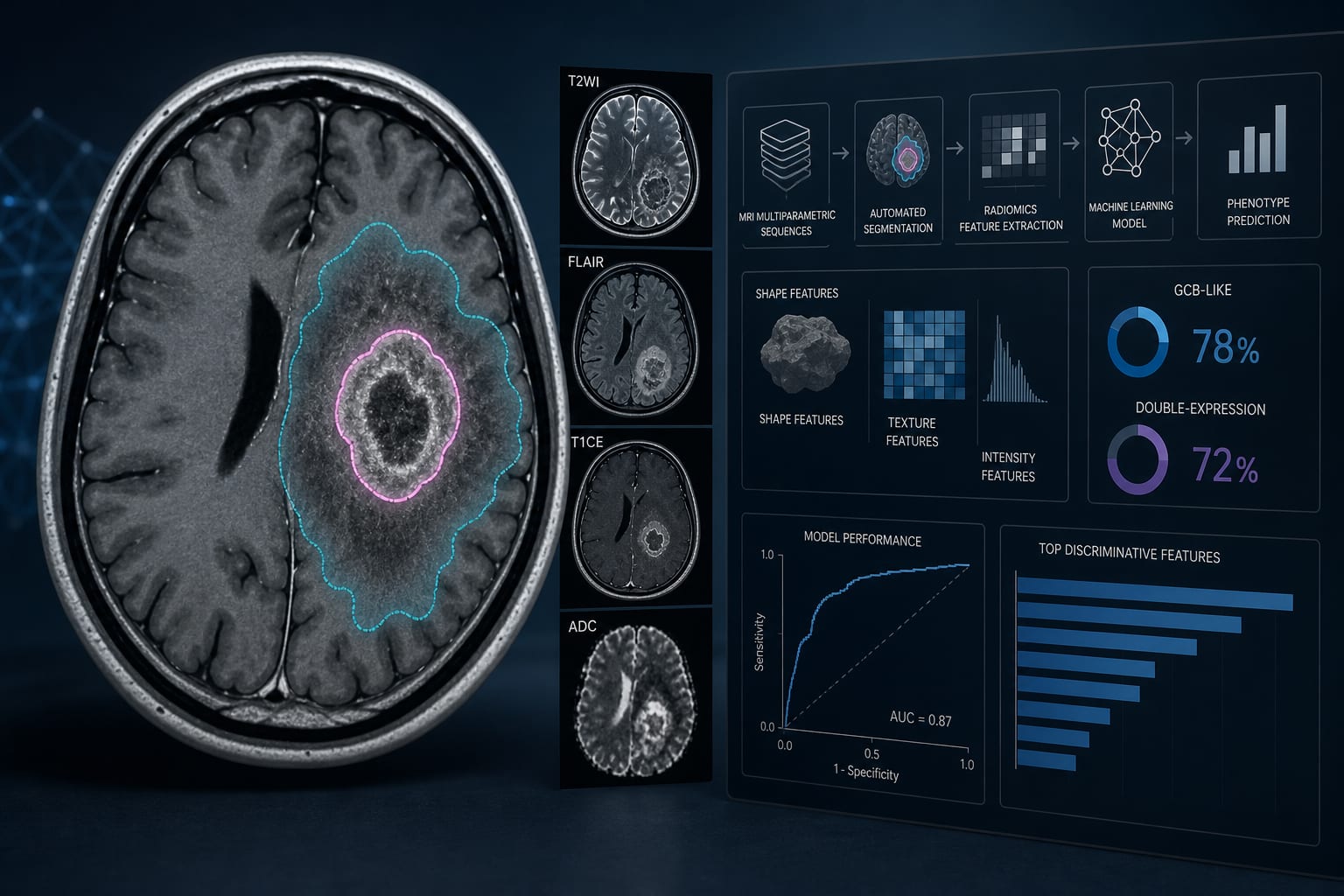
This study developed multiparametric MRI-based radiomics models for preoperative prediction of double-expression lymphoma (DEL) and germinal center B-cell-like (GCB) status in primary central nervous system lymphoma (PCNSL). The models demonstrated AUC values of 0.807 for DEL and 0.897 for GCB classification.
Background
Primary central nervous system lymphoma (PCNSL) is a rare but aggressive form of non-Hodgkin lymphoma confined to the central nervous system. Understanding the biological heterogeneity of PCNSL, particularly between DEL and GCB phenotypes, is crucial for treatment stratification. Noninvasive imaging techniques, such as MRI, may provide insights into tumor characteristics.
Data Highlights
Classification
AUC
Accuracy
Sensitivity
Specificity
DEL
0.807 (95% CI, 0.649–0.936)
0.730
0.714
0.750
GCB
0.897 (95% CI, 0.796–0.973)
0.846
0.792
0.893
Key Findings
Multiparametric MRI sequences were utilized to analyze 160 pathologically confirmed PCNSL patients.
For DEL classification, 12 radiomic features were identified, with the SVM classifier achieving an AUC of 0.807.
For GCB classification, 7 radiomic features were used, with the Random Forest classifier achieving an AUC of 0.897.
The study highlights the use of MRI-derived radiomic features in capturing biological heterogeneity in PCNSL.
Clinical Implications
Multiparametric MRI-based radiomics can aid in the prediction of PCNSL phenotypes.
Conclusion
Multiparametric MRI-based radiomics shows potential for the classification of PCNSL phenotypes.