Clinical Report: Utilizing Near-Infrared Fluorescent Antibodies to Target EpCAM Expression
Overview
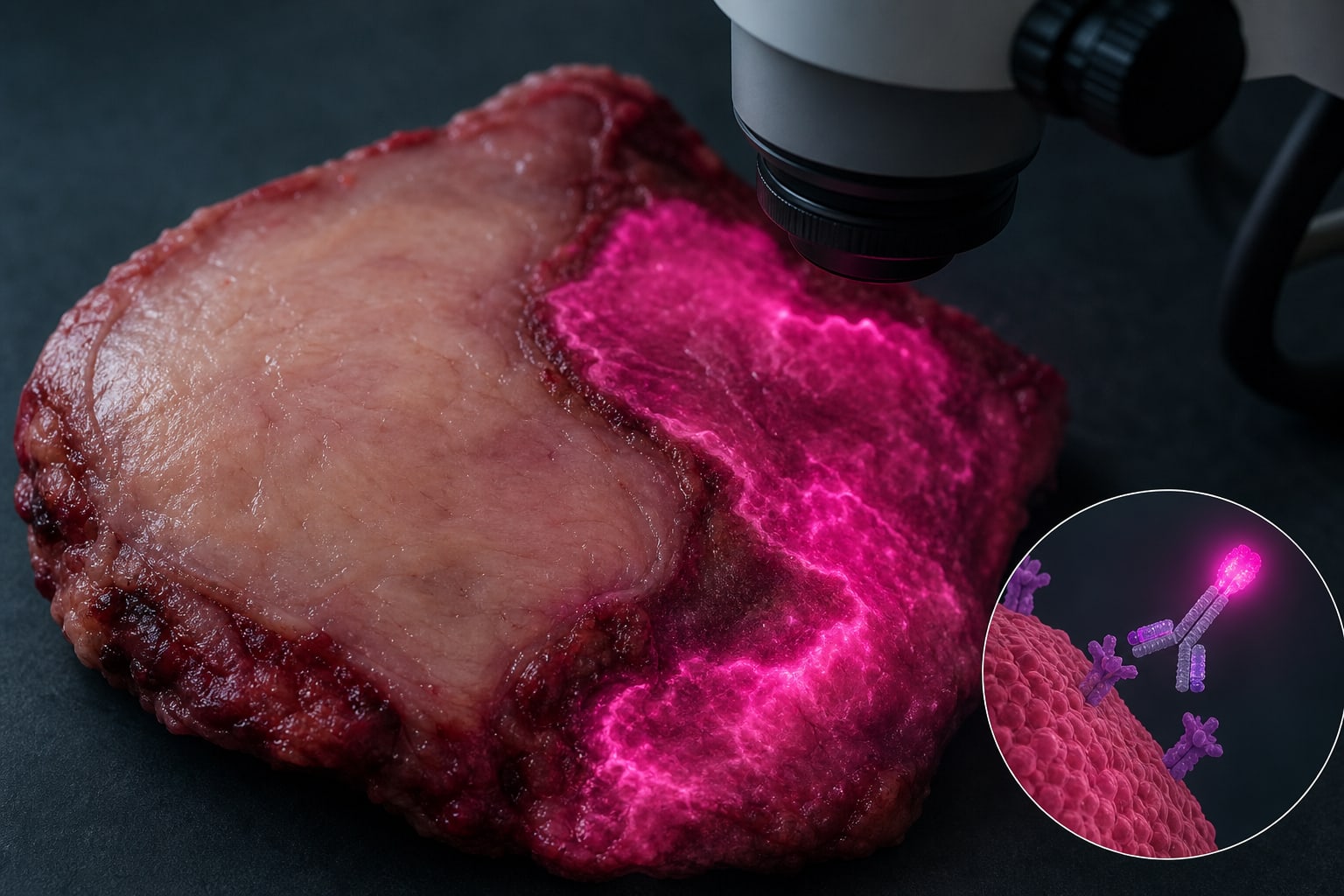
This study investigates the use of near-infrared fluorescent antibodies targeting EpCAM to enhance the microscopic visualization of primary and recurrent head and neck squamous cell carcinoma (HNSCC).
Background
Head and neck cancer, particularly HNSCC, is a significant global health concern, ranking as the seventh most common cancer. Achieving complete tumor resection with negative margins is crucial for improving patient survival and reducing recurrence rates. Current surgical techniques rely heavily on visual inspection and clinical experience.
Data Highlights
No numerical data or trial results were provided in the source material.
Key Findings
Approximately 90% of HNSCC cases exhibit high EpCAM expression, making it a viable target for fluorescence-guided surgery.
The monoclonal antibody VU1D9 shows high affinity for EpCAM and is well-established in scientific literature.
Near-infrared dye IRDye800CW has superior imaging properties, including deeper tissue penetration and reduced background fluorescence.
Current techniques for tumor margin assessment in HNSCC are limited.
Clinical Implications
The use of near-infrared fluorescent antibodies targeting EpCAM could provide surgeons with enhanced tools for intraoperative margin assessment in HNSCC.
Conclusion
The study presents a promising approach to improve surgical precision in HNSCC through the use of targeted fluorescent antibodies. Further research is needed to validate these findings in clinical settings.
by Bernd Uhl, Dennis Eggert, Bojan Smiljanov, Katharina von Thun und Hohenstein, Christoph Walz, Gisela Kranz, Sabina Schwenk-Zieger, Florian Haring, Joshua Luft, Jiahang Song, Vincent Holtmann, Philipp Baumeister, Christoph A. Reichel, Olivier Gires, Martin Canis, Christian Betz