Promoting Problem-Solving Among Low-Income Adults With Type 2 Diabetes: Cluster-Randomized Controlled Trial of a Mobile Health Intervention With SMS Text Messaging (Mobile Diabetes Detective) - Report - MDSpire

Promoting Problem-Solving Among Low-Income Adults With Type 2 Diabetes: Cluster-Randomized Controlled Trial of a Mobile Health Intervention With SMS Text Messaging (Mobile Diabetes Detective)

  • By

  • Lena Mamykina

  • Arlene M Smaldone

  • Suzanne R Bakken

  • Heather Cole-Lewis

  • Elizabeth M Heitkemper

  • Haomiao Jia

  • Rita Kukafka

  • Jonathan N Tobin

  • Andrea Cassells

  • Patricia G Davidson

  • Elizabeth D Mynatt

  • George Hripcsak

  • July 13, 2026

Share

Clinical Report: Enhancing Problem-Solving Skills in Low-Income Adults with Type 2 Diabetes

Overview

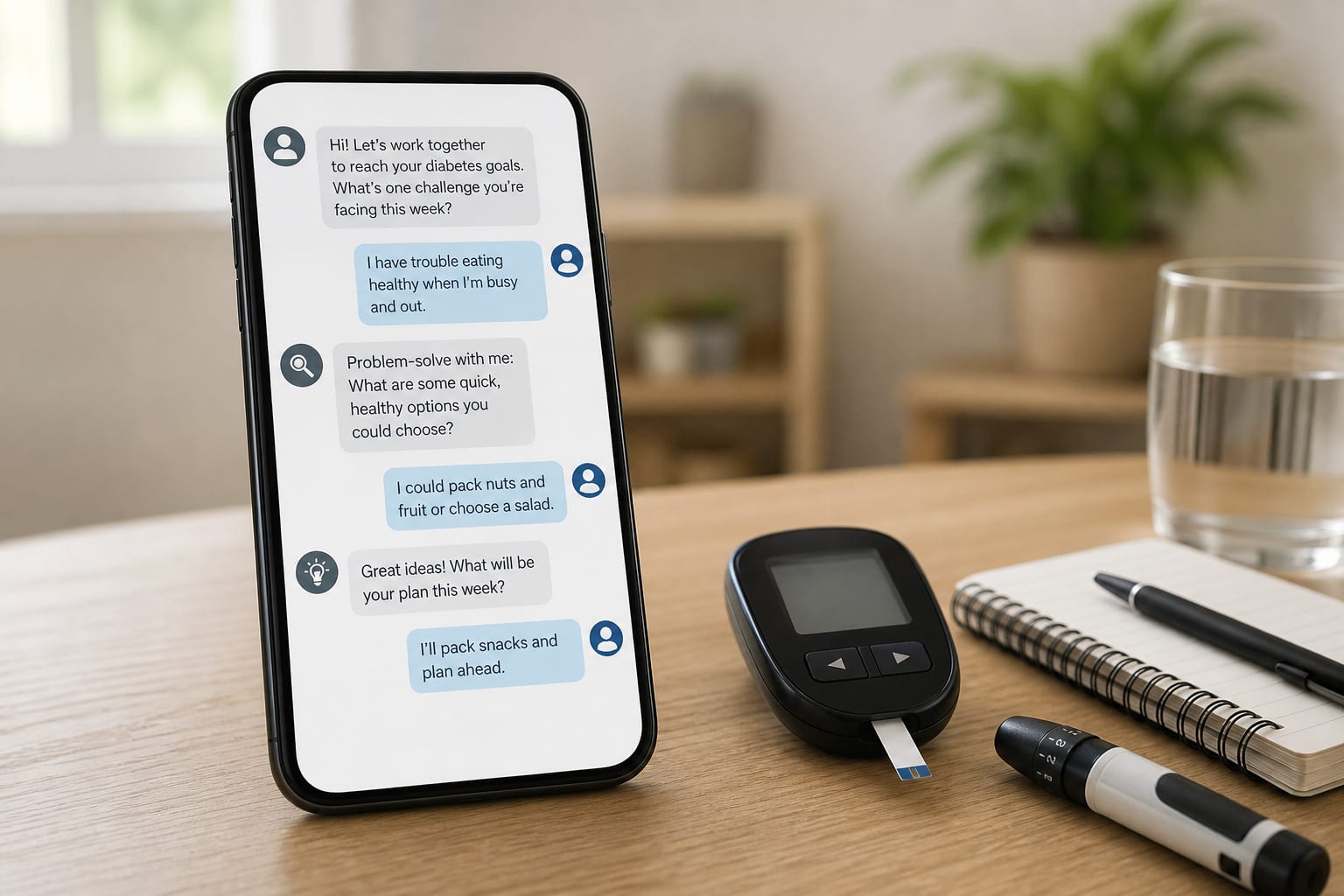
This study evaluates the efficacy of the Mobile Diabetes Detective (MoDD), a mobile health intervention designed to enhance problem-solving skills in low-income adults with type 2 diabetes. The trial demonstrated that MoDD improved glycated hemoglobin (HbA1c) levels compared to standard diabetes education.

Background

Effective problem-solving is crucial for managing type 2 diabetes, as it translates self-care techniques into actionable self-management behaviors. However, traditional problem-solving interventions often require significant resources and may not be accessible to low-income populations. Mobile health (mHealth) interventions like MoDD aim to provide scalable, automated support tailored to individual glycemic challenges.

Data Highlights

The study was a cluster-randomized controlled trial comparing MoDD with standard diabetes education. The primary outcome was the change in HbA1c levels over 12 months.

Key Findings

  • MoDD is an automated mHealth intervention that does not require healthcare professional involvement.
  • The intervention tailors problem-solving support based on individual self-monitoring data.
  • Participants using MoDD showed a reduction in HbA1c levels compared to those receiving standard diabetes education.
  • MoDD complements existing diabetes education.
  • The study was conducted in economically disadvantaged communities.

Clinical Implications

Automated mHealth interventions like MoDD can enhance problem-solving skills in diabetes self-management among low-income populations.

Conclusion

The Mobile Diabetes Detective intervention demonstrates potential in improving diabetes management through enhanced problem-solving skills.

Related Resources & Content

  1. American Diabetes Association, Diabetes Care, 2026 -- Facilitating Positive Health Behaviors and Well-being to Improve Health Outcomes: Standards of Care in Diabetes—2026
  2. Journal of Medical Internet Research (JMIR), 2026 -- User-Centered Diabetes Self-Management App (DiabAid Nexus) in Sub-Saharan Africa: Development and Usability Study
  3. Frontiers in Digital Health, 2026 -- Sugar slay: a gamified decision support ecosystem for type 1 diabetes
  4. DIGITAL HEALTH, 2026 -- Patients’ perspectives on mobile health applications for diabetes self-management: A qualitative study in Malaysia
  5. Journal of Medical Internet Research (JMIR) — A Digital Diabetes Self-Management Education and Support Program Integrated With Continuous Glucose Monitoring for Type 2 Diabetes: Randomized Controlled Trial
  6. 5. Facilitating Positive Health Behaviors and Well-being to Improve Health Outcomes: Standards of Care in Diabetes—2026 | Diabetes Care | American Diabetes Association
  7. Text messaging interventions are associated with reductions in HbA1c among patients with diabetes: a systematic review and meta-analysis - PMC
  8. 1. Improving Care and Promoting Health in Populations: Standards of Care in Diabetes—2026 | Diabetes Care | American Diabetes Association

Original Source(s)

Related Content