Distress disclosure and health behaviours in patients with stroke: a theory-informed serial mediation model of social support, self-efficacy, and self-management - Report - MDSpire
Conexiant’s news site is now MDSpire News. Learn more
Advertisement
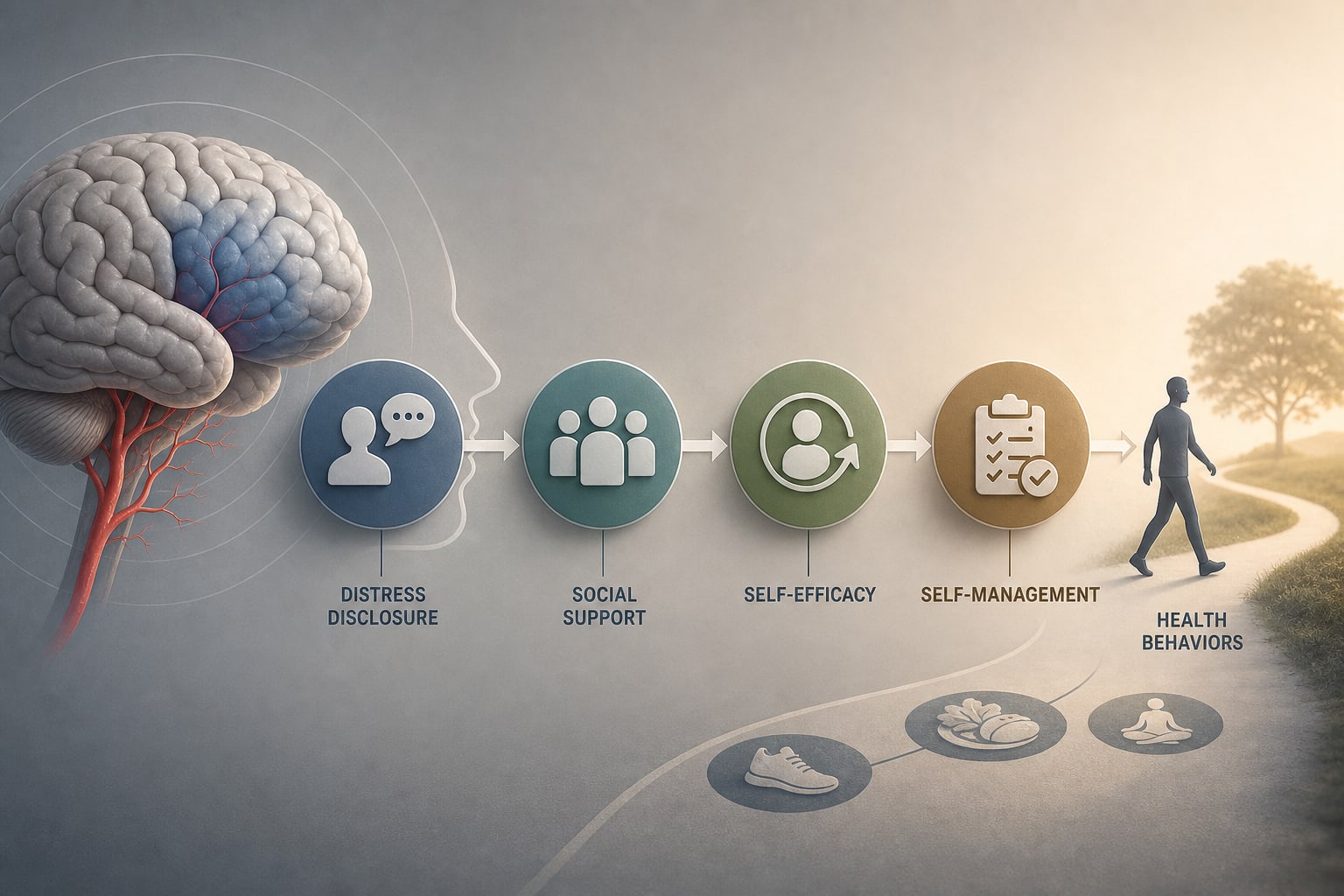
The Relationship Between Distress Disclosure and Health Behaviors in Stroke Patients: A Theory-Based Serial Mediation Analysis of Social Support, Self-Efficacy, and Self-Management
Clinical Report: The Relationship Between Distress Disclosure and Health Behaviors in Stroke Patients
Overview
This study investigates the association between distress disclosure and health behaviors in stroke patients, revealing significant mediation effects through social support, self-efficacy, and self-management.
Background
Stroke is a leading cause of mortality and disability globally, significantly impacting patients' long-term health and quality of life. Effective secondary prevention requires patients to engage in health-promoting behaviors, which are often inadequately implemented. Understanding the psychosocial factors influencing these behaviors is crucial.
Data Highlights
Measure
Mean (SD)
Health Behaviors
60.65 (12.32)
Key Findings
Health behaviors showed a moderate mean score of 60.65 (SD 12.32).
A strong positive correlation was found between distress disclosure and health behaviors (r = 0.828, p < 0.001).
Distress disclosure remained significantly associated with health behaviors after covariate adjustment (B = 1.333, beta = 0.819, p < 0.001).
The total effect of distress disclosure on health behaviors was 1.3327 (95% CI: 1.2494 to 1.4160).
Social support had the largest specific indirect effect on health behaviors (effect = 0.4749; 35.63% of total effect).
The serial indirect association involving social support, self-efficacy, and self-management was significant (effect = 0.0276; 95% CI: 0.0121 to 0.0479).
Clinical Implications
The findings highlight the importance of addressing psychosocial factors such as distress disclosure, social support, self-efficacy, and self-management in stroke rehabilitation.
Conclusion
The study demonstrates the significant role of distress disclosure in promoting health behaviors among stroke patients, mediated by social support, self-efficacy, and self-management.