Clinical Report: Robotic-Assisted Subretinal Injection Over an Ultra-Long Distance
Overview
A single-case report describes remote, robot-assisted subretinal recombinant tissue plasminogen activator (rt-PA) administration for submacular hemorrhage (SMH), with the surgeon and patient approximately 4000 km apart. The procedure was completed without intraoperative complications; the supplied article excerpt does not provide the subsequent visual or anatomical outcomes or the full follow-up safety results.
Background
SMH is associated with neovascular age-related macular degeneration, polypoidal choroidal vasculopathy, and retinal arterial macroaneurysm. Blood beneath the macula can exert mechanical and biochemical toxicity on photoreceptors and the retinal pigment epithelium, potentially causing irreversible damage. Subretinal rt-PA is often administered with pars plana vitrectomy and gas tamponade, but conventional subretinal injection requires exceptional manual precision. The report notes that access to experienced vitreoretinal surgeons is limited in some remote or medically underserved regions.
Data Highlights
Measure
Reported value
Distance between surgeon and patient sites
Approximately 4000 km
Patient
42-year-old man; right-eye symptoms began 2 weeks before presentation
Preoperative right-eye BCVA
0.6 logMAR (20/80); left eye 0 logMAR (20/20)
Preoperative hemorrhage dimensions on OCT
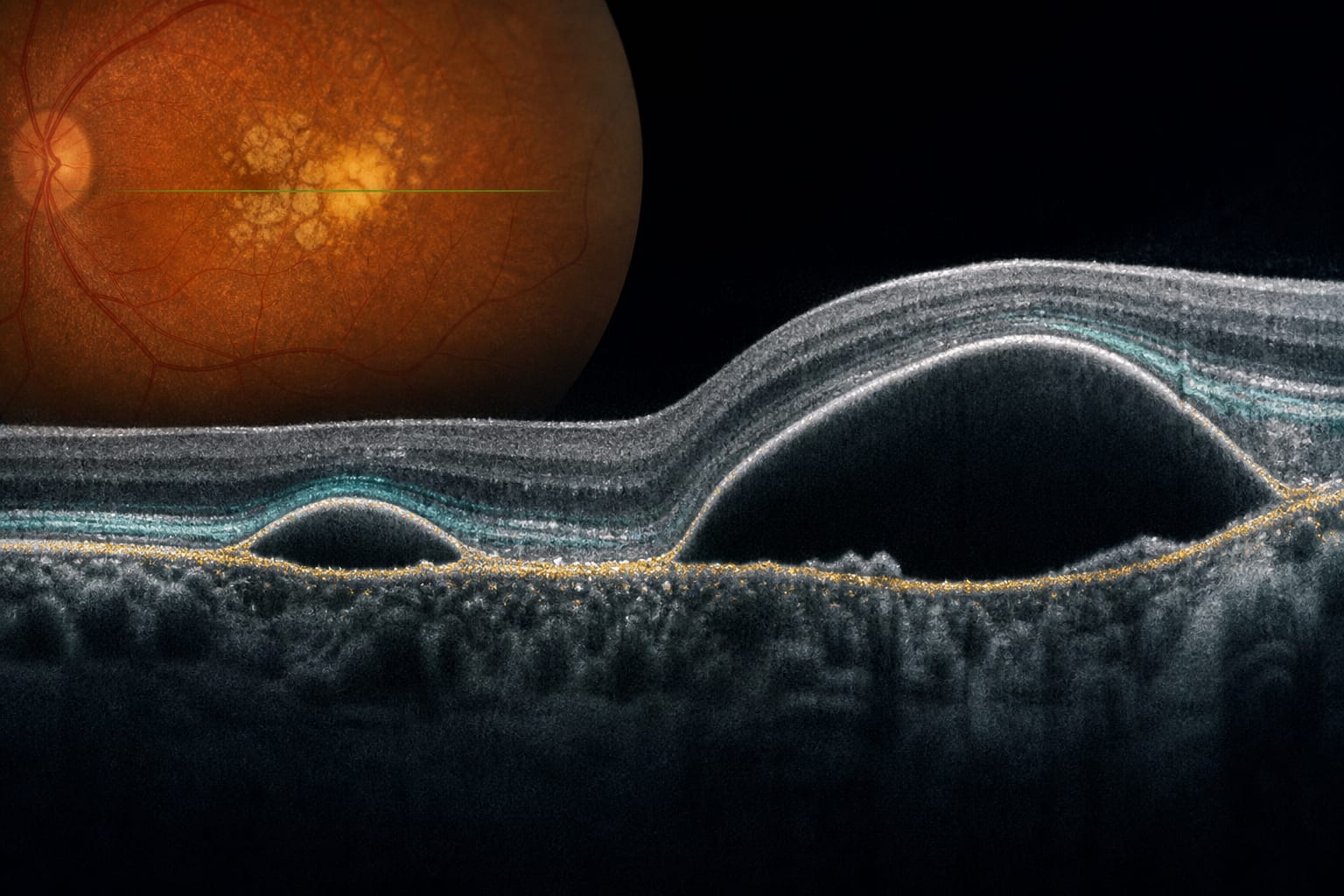
Longest diameter 5062.5 µm; maximum thickness 660.3 µm
rt-PA administration
0.056 mL at 0.5 mg/mL
Operative duration
46 minutes overall; the excerpt reports 7 minutes between robotic ins... [remaining text not provided]
Reported intraoperative outcome
Procedure completed without intraoperative complications or conversion to manual surgery
Key Findings
The surgeon operated from Zhongshan Ophthalmic Center in Guangzhou, while the patient was treated at Xinjiang Production and Construction Corps Hospital in Urumqi.
The teleoperated platform provided three-dimensional visualization, real-time audiovisual communication, and micron-level motion; data transmission used a 5G network with automatic backup switching.
After local 25-gauge pars plana vitrectomy under general anesthesia, an on-site assistant introduced the robotic instrument; the remote surgeon performed needle manipulation and subretinal rt-PA delivery.
Preoperative OCT guided the planned injection site and depth. Robot-controlled low-flow infusion was stopped after formation of the intended bleb, and the instrument was robotically retracted before the local team performed fluid-air exchange.
The procedure was completed successfully without intraoperative complications, using 0.056 mL of rt-PA at 0.5 mg/mL; total surgery time was reported as 46 minutes.
The related article summary reports no serious adverse events during 3 months of follow-up, but the supplied primary-article excerpt does not include detailed follow-up visual acuity or OCT results.
Clinical Implications
The case demonstrates technical feasibility of teleoperated, robot-assisted subretinal rt-PA delivery across approximately 4000 km in one patient, without intraoperative complications. It does not establish comparative efficacy, broader safety, or a standard approach for SMH; the supplied related evidence describes treatment strategies as heterogeneous and optimal therapy as unsettled.
Conclusion
This single case reports successful ultra-long-distance robotic subretinal rt-PA injection for SMH. Further conclusions about clinical outcomes cannot be drawn from the results provided in the excerpt.
by Andi Xu, Bo Yang, Bingqian Liu, Lin Lu, Zhangkai Lian, Wenben Chen, Rihui Song, Wang Guo, Subinuer Alimu, Zhenzhen Liu, Dong Liu, Yanlin Li, Wei Xiao, Mohammad Ali Nasseri, Kai Huang, Haotian Lin