Feasibility and preliminary signal of cerebellar intermittent theta burst stimulation for static balance in cerebellar ataxia: a pilot study - Report - MDSpire

Feasibility and preliminary signal of cerebellar intermittent theta burst stimulation for static balance in cerebellar ataxia: a pilot study

  • By

  • Sumin Lee

  • Eunhee Park

  • Yongjeon Cheong

  • Jihyeong Ro

  • Jungeun Kim

  • Ho-Won Lee

  • Minyoung Jung

  • July 15, 2026

Share

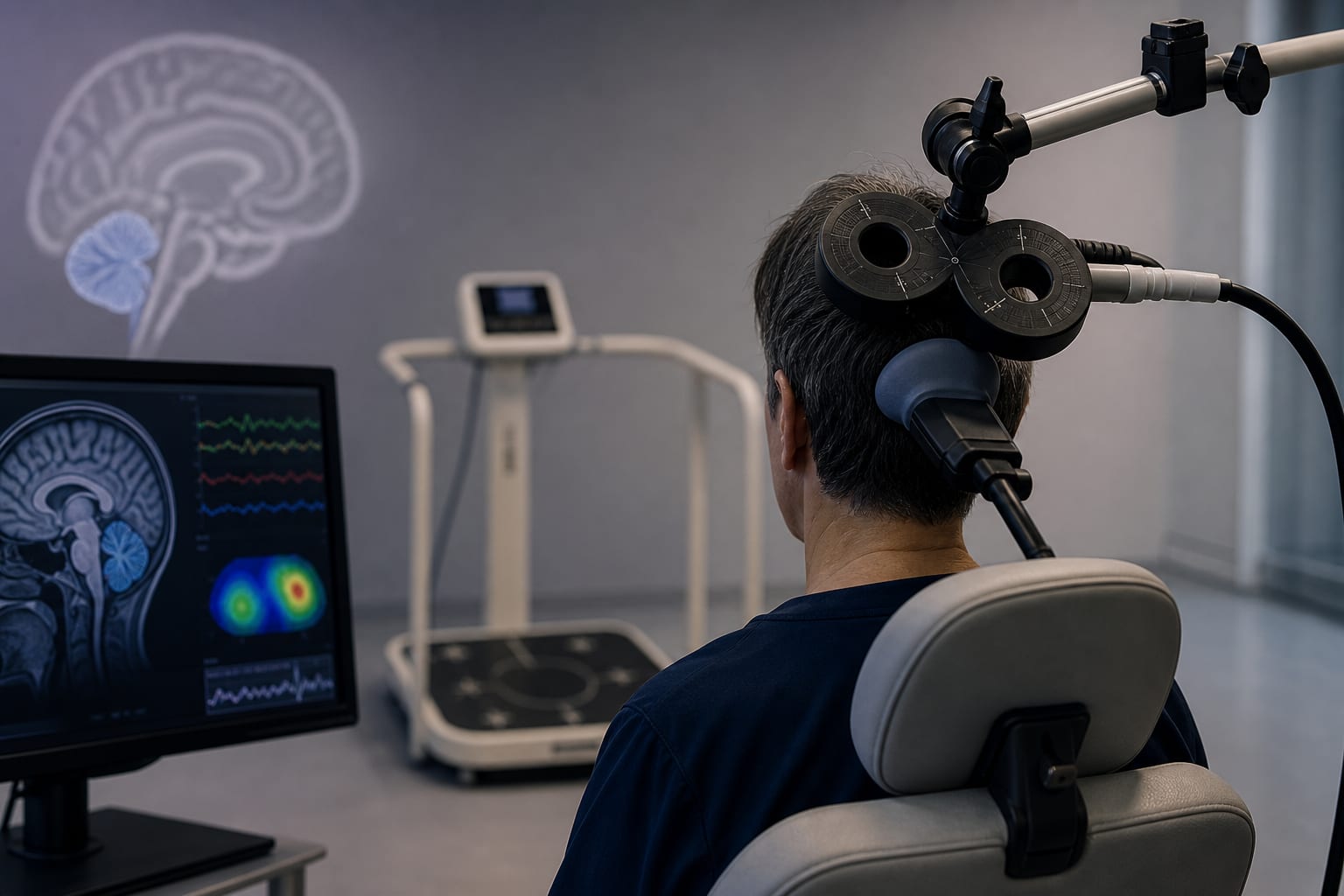
Clinical Report: Exploring the Potential of Cerebellar iTBS for Balance in CA

Overview

This pilot study assessed the effects of 50 Hz cerebellar intermittent theta burst stimulation (iTBS) on static balance in patients with cerebellar ataxia (CA). Results indicated improvements in postural stability immediately post-intervention, although these effects were not sustained after six weeks.

Background

Cerebellar ataxia (CA) is characterized by balance impairment and gait instability due to cerebellar dysfunction. The cerebellum is crucial for motor coordination and postural balance, integrating sensory feedback. Understanding potential therapeutic interventions like iTBS is essential for improving patient outcomes in CA.

Data Highlights

AssessmentConditionChangep-value
Anterior–posterior sway (ΔY)Eyes-openDecreased< 0.05
Total displacement (Δd)Eyes-openDecreased< 0.05
Medial–lateral sway (ΔX)Eyes-closedImproved< 0.05

Key Findings

  • iTBS was administered over five consecutive days for 8 minutes per session.
  • Improvements in balance were observed immediately post-intervention (V1) compared to baseline (V0).
  • Improvements in balance were not sustained at the 6-week follow-up (V2).
  • Dizziness was reported as a mild–moderate adverse event in 50% of participants.
  • Functional near-infrared spectroscopy (fNIRS) indicated cortical engagement during cognitive-motor tasks.

Clinical Implications

Clinicians should be aware of the reported adverse events such as dizziness.

Conclusion

Cerebellar iTBS appears to be a well-tolerated intervention that can enhance postural stability in patients with cerebellar ataxia.

Related Resources & Content

  1. Frontiers in Neurology, 2026 -- High-dose accelerated intermittent theta burst stimulation targeting the primary motor cortex for gait and cognitive functions in cerebral small vessel disease: a randomized controlled trial
  2. Frontiers in Neurology, 2026 -- Intermittent theta burst stimulation enhances the efficacy of brain–computer interface in upper limb rehabilitation post-stroke
  3. Frontiers in Neurology, 2026 -- Synergistic effects of early sequential enhanced external counterpulsation and electric tilt table training on functional recovery in ischemic stroke: study protocol of a randomized controlled trial
  4. Ataxia UK Medical Guidelines, 2025 -- Third Edition
  5. Brain — Enhancing Recovery from Hemianopia: The Role of Interareal Cross-Frequency Brain Stimulation
  6. https://www.euroataxia.org/wp-content/uploads/2025/02/Ataxia-UK-Medical-Guidelines.-Final-Third-Edition.pdf
  7. The efficacy of repetitive transcranial magnetic stimulation in patients with spinocerebellar ataxia: A systematic review and meta-analysis - PMC
  8. Low intensity transcranial electric stimulation: Safety, ethical, legal regulatory and application guidelines (2017–2025: An update) – endorsed by the European Society for Brain Stimulation (ESBS) and by the International Federation for Clinical Neurophysiology (IFCN) - ScienceDirect

Original Source(s)

Related Content