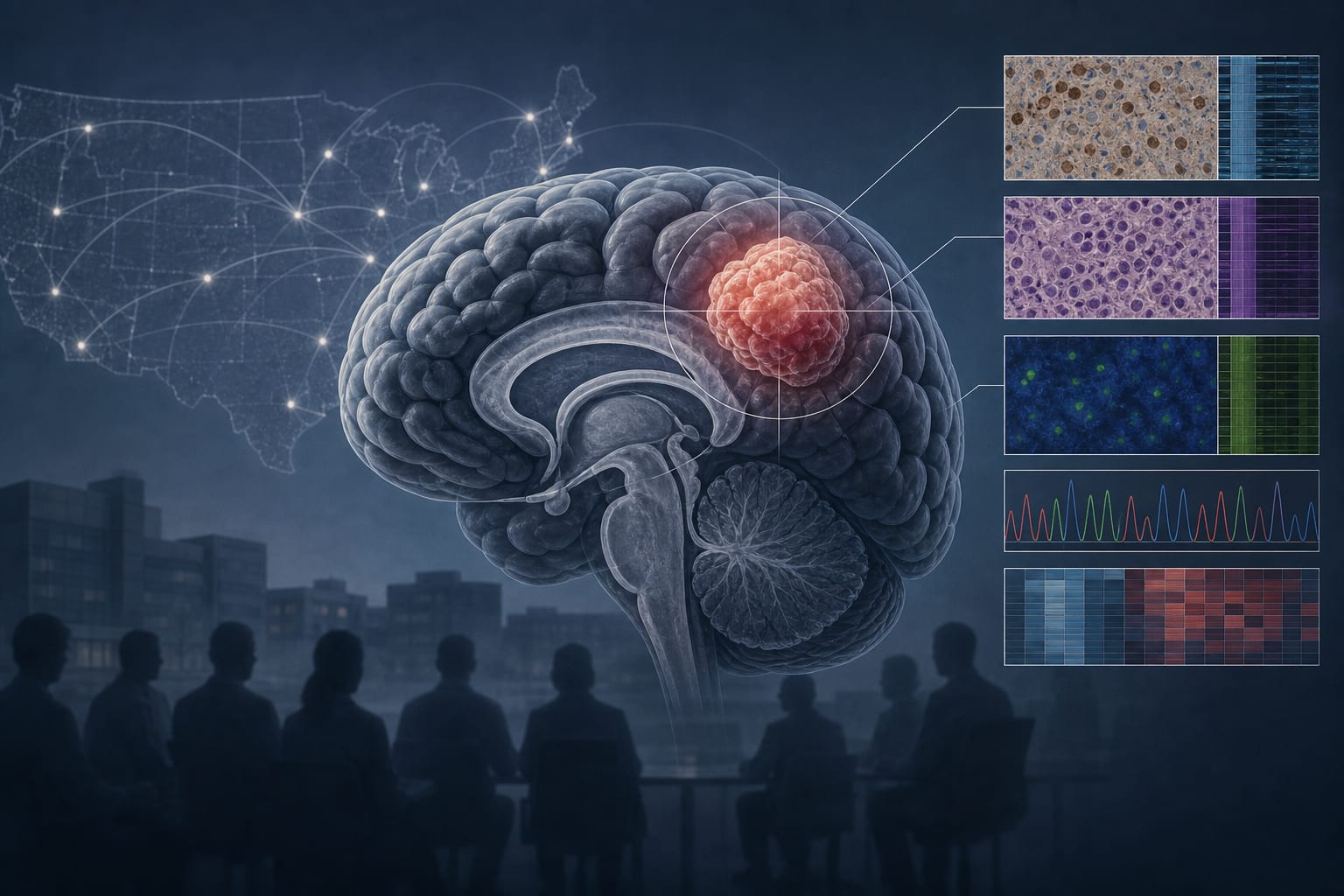
Clinical Report: The Development of Clinical Trials for CNS Tumors by RTOG and NRG Oncology
Overview
RTOG and NRG Oncology trials have significantly influenced the management of CNS tumors by establishing evidence-based standards of care. These trials have addressed the complexities of CNS tumors, including biological heterogeneity and treatment efficacy.
Background
CNS tumors present unique challenges due to their biological diversity and proximity to critical brain structures, making effective treatment difficult. The establishment of multi-institutional trials by RTOG and NRG Oncology has been crucial in developing standardized treatment protocols.
Data Highlights
RTOG and NRG Oncology have conducted numerous trials that have provided critical insights into the treatment of CNS tumors, including the impact of molecular stratification, the efficacy of combination therapies, and the role of advanced imaging techniques in treatment planning.
Key Findings
RTOG trials have demonstrated the clinical significance of molecular stratification in CNS tumors.
Incorporating PCV into radiotherapy doubled survival in patients with 1p19q co-deleted, IDH mutant high-grade gliomas.
RTOG 0525 found no survival benefit with dose-intensified temozolomide compared to standard dosing.
RTOG 0825 showed that adding bevacizumab did not meet survival expectations for glioblastoma.
NRG Oncology trials have evolved to include advanced imaging and cognitive-function preservation strategies.
Clinical Implications
The findings from RTOG and NRG trials emphasize the importance of molecular profiling in guiding treatment decisions for CNS tumors.
Conclusion
The evolution of clinical trials by RTOG and NRG Oncology has been pivotal in shaping the landscape of CNS tumor management.
Related Resources & Content
jadpro — Management of Adverse Events in Early Clinical Trials by Advanced Practice Providers in the Outpatient Setting: The University of Texas MD Anderson Cancer Center Experience
The ASCO Post — Failure of Cilengitide in Newly Diagnosed Glioblastoma With Methylated MGMT Promoter
The ASCO Post — Expert Point of View: Christina I. Tsien, MD Related Articles
Journal of Neuro-Oncology — Cognitive Effects of Treatment in Glioma Patients Over the Mid-Term
Management of Adverse Events in Early Clinical Trials
Failure of Cilengitide in Newly Diagnosed Glioblastoma
Expert Point of View: Christina I. Tsien, MD
Cognitive Effects of Treatment in Glioma Patients
ASCO-SNO Guideline Rapid Recommendation Update
ASTRO Clinical Practice Guideline
NCI's PDQ on CNS Tumors Treatment
Central Nervous System Tumors Treatment (PDQ®) - PDQ Cancer Information Summaries - NCBI Bookshelf
Hippocampal Avoidance During Whole-Brain Radiotherapy Plus Memantine for Patients With Brain Metastases: Phase III Trial NRG Oncology CC001 - PMC
Long-term Analysis of NRG Oncology RTOG 0539: A Phase II Trial of Observation for Low-Risk Meningioma and Radiotherapy for Intermediate- and High-Risk Meningioma - PMC
Modern molecular profiling recontextualizes the NRG/RTOG 0539 trial and reveals hidden high-risk and radiotherapy-resistant meningiomas | Neuro-Oncology | Oxford Academic
by Kavita Sehrawat, Mei-Yin C. Polley, Michael A. Vogelbaum, Mark Gilbert, Arnab Chakravarti, Daniel P. Cahill, Andrew B. Lassman, David R. Raleigh, Erik P. Sulman, Mitch Machtay, Quynh Thu Le, Walter Curran, Vinai Gondi, Minesh P. Mehta
The goal of this clinical trial is to learn if Adaptive Radiation Therapy (ART) is safe and effective in treating patients with locally advanced pancreatic cancer.