First-line durvalumab in combination with trastuzumab deruxtecan in women with locally advanced unresectable or metastatic, hormone-receptor-negative, HER2-low breast cancer: multicenter, open-label, phase 1b/2 BEGONIA platform trial - Report - MDSpire

First-line durvalumab in combination with trastuzumab deruxtecan in women with locally advanced unresectable or metastatic, hormone-receptor-negative, HER2-low breast cancer: multicenter, open-label, phase 1b/2 BEGONIA platform trial

  • By

  • Peter Schmid

  • Seock-Ah Im

  • Zbigniew Nowecki

  • Piotr J. Wysocki

  • Jacek Jassem

  • Kyung Hae Jung

  • Simon Lord

  • Jon Armstrong

  • Ross Stewart

  • Petra Vuković

  • Neelima Denduluri

  • Yeon Hee Park

  • June 8, 2026

  • 0 min

Share

Evaluation of durvalumab with trastuzumab deruxtecan in HER2-low breast cancer

Overview

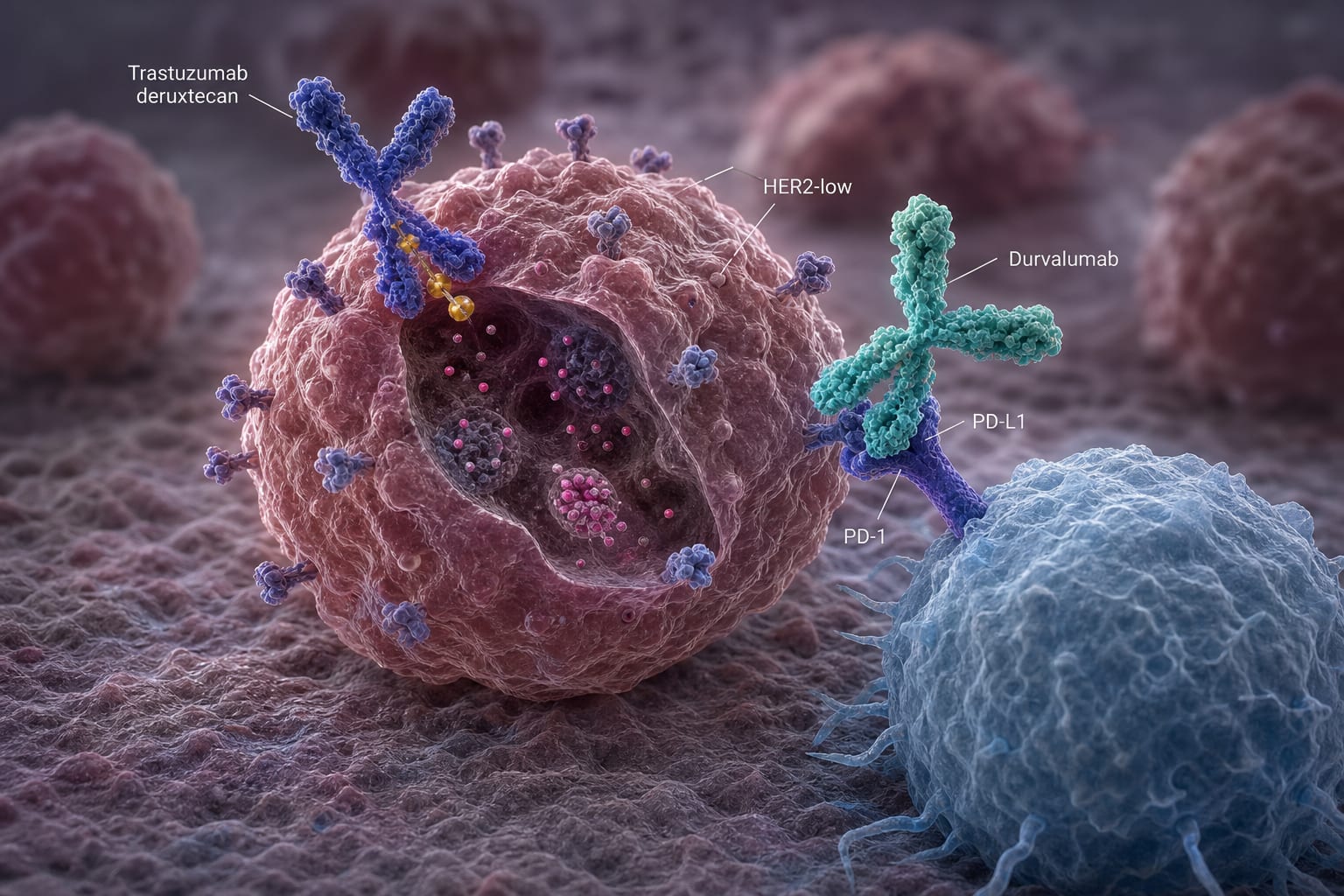
The BEGONIA trial evaluated the combination of durvalumab and trastuzumab deruxtecan (T-DXd) in women with locally advanced unresectable or metastatic hormone-receptor-negative HER2-low breast cancer. Results indicate potential efficacy and safety of this combination therapy in this patient population.

Background

Triple-negative breast cancer (TNBC) represents a significant clinical challenge due to its aggressive nature and poor treatment outcomes. Approximately 15-20% of breast cancers are classified as TNBC, and a subset of these tumors is identified as HER2-low, which may benefit from novel therapeutic strategies. The combination of immune checkpoint inhibitors and targeted therapies like T-DXd offers a promising avenue for improving patient outcomes in this difficult-to-treat population.

Data Highlights

No numerical data provided in the source material.

Key Findings

  • 58 participants with HR-negative, HER2-low breast cancer were enrolled in the durvalumab plus T-DXd arm of the BEGONIA trial.
  • The median age of participants was 54 years, with a diverse racial composition.
  • Durvalumab is a PD-L1 inhibitor that has shown promise in combination with T-DXd for treating TNBC.
  • T-DXd has demonstrated efficacy in HER2-low breast cancer, providing a new treatment option for this subgroup.
  • Preclinical studies suggest that T-DXd may enhance antitumor immunity when combined with immune checkpoint inhibitors.

Clinical Implications

The findings from the BEGONIA trial suggest that the combination of durvalumab and T-DXd may provide a new treatment strategy for patients with HR-negative, HER2-low breast cancer. Clinicians should consider the potential of this combination therapy in managing advanced disease.

Conclusion

The ongoing evaluation of durvalumab in conjunction with T-DXd in the BEGONIA trial highlights the potential for improved treatment options in patients with HER2-low breast cancer. Continued research is necessary to fully understand the efficacy and safety of this combination.

Related Resources & Content

  1. BEGONIA: Phase 1b/2 study of durvalumab combinations in TNBC — Initial results
  2. The ASCO Post — Neoadjuvant Durvalumab Improves Long-Term Outcomes in the GeparNuevo Trial
  3. The ASCO Post — T-DXd Improves Progression-Free Survival vs T-DM1 in Metastatic HER2-Positive Breast Cancer
  4. the asco post — Neoadjuvant Durvalumab and Chemotherapy in Triple-Negative Breast Cancer: Long-Term Follow-Up of GeparNuevo Trial
  5. The ASCO Post — Phase II Study Shows Durvalumab Active in Patients With Recurrent or Metastatic Head and Neck Cancer
  6. Neoadjuvant Durvalumab Improves Long-Term Outcomes in the GeparNuevo Trial
  7. T-DXd Improves Progression-Free Survival vs T-DM1 in Metastatic HER2-Positive Breast Cancer
  8. Neoadjuvant Durvalumab and Chemotherapy in Triple-Negative Breast Cancer: Long-Term Follow-Up of GeparNuevo Trial
  9. Sacituzumab Govitecan With Pembrolizumab Extends Progression-Free Survival 2 for Some People With Metastatic Triple-Negative Breast Cancer - ASCO
  10. Human Epidermal Growth Factor Receptor 2 Testing in Breast Cancer: ASCO–College of American Pathologists Guideline Update | Journal of Clinical Oncology
  11. BEGONIA: Phase 1b/2 study of durvalumab (D) combinations in locally advanced/metastatic triple-negative breast cancer (TNBC)—Initial results from arm 1, d+paclitaxel (P), and arm 6, d+trastuzumab deruxtecan (T-DXd). | Journal of Clinical Oncology

Original Source(s)

Related Content