A targeted behavioral economics-based mobile health intervention to improve medication adherence in patients with hypertension: A three-arm randomized controlled trial - Report - MDSpire
Coming Soon: Introducing MDSpire News. Learn more
Conexiant’s news site is now MDSpire News. Learn more

A Mobile Health Intervention Utilizing Behavioral Economics to Enhance Medication Adherence in Hypertensive Patients: Results from a Three-Arm Randomized Controlled Trial

  • By

  • Jan Strebel

  • Anjali Raja Beharelle

  • Michael Mayr

  • Valeriya Nemtsova

  • Joachim Zahnd

  • Gregoire Wuerzner

  • Georg Ehret

  • Michael Stiefel

  • Emrush Rexhaj

  • Théo Meister

  • Annina S. Vischer

  • Thilo Burkard

  • August 29, 2026

Share

Clinical Report: Mobile Health Intervention to Enhance Medication Adherence

Overview

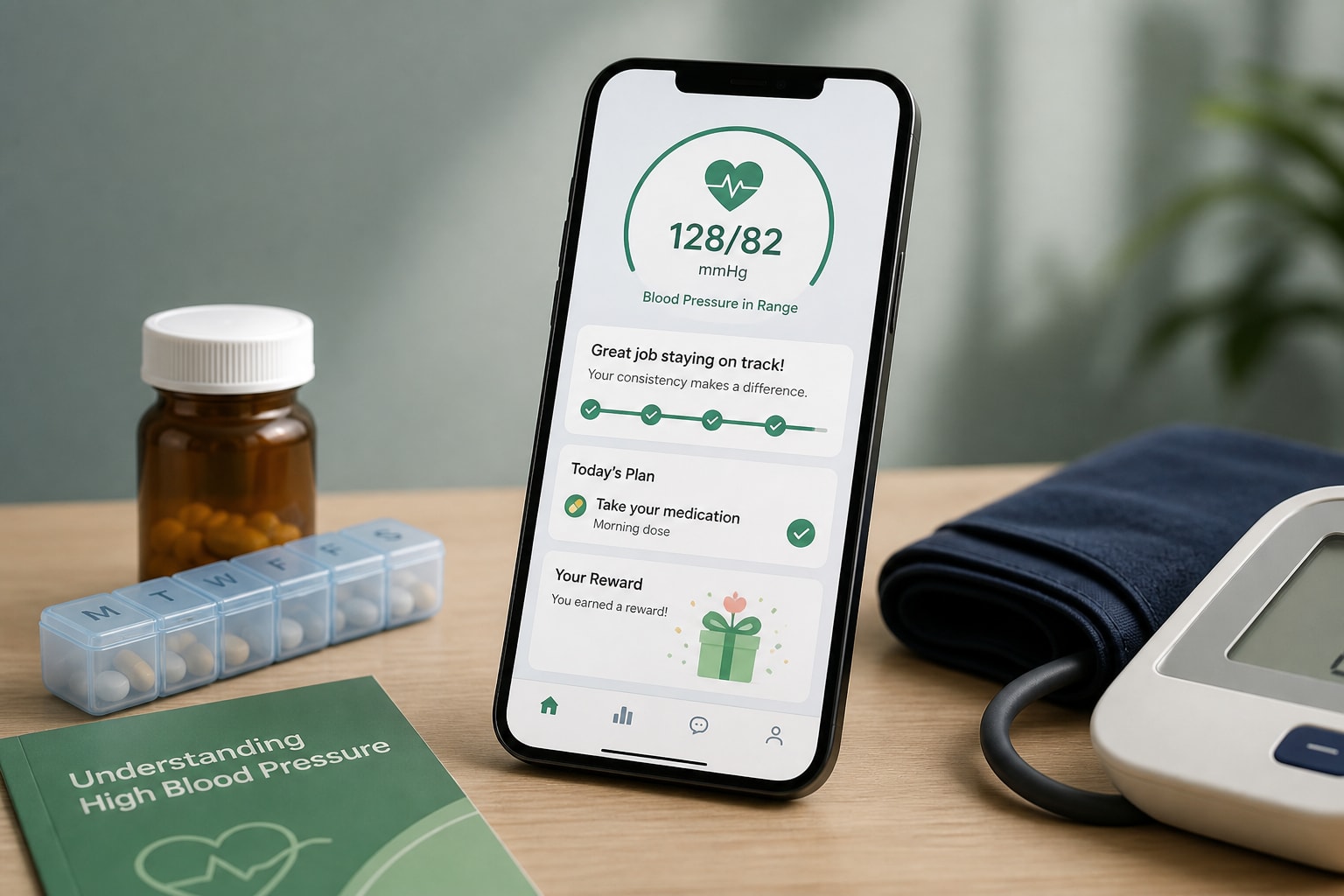
This study evaluated a mobile health application designed to improve medication adherence among hypertensive patients, with and without financial incentives. Results indicated varying impacts on adherence and blood pressure management across different intervention groups.

Background

Hypertension is a significant global health issue, contributing to cardiovascular disease and mortality. Non-adherence to antihypertensive medication is prevalent, with rates reported between 50% and 80%, leading to increased healthcare costs and premature deaths. Effective interventions are crucial for improving adherence and managing hypertension effectively.

Data Highlights

No numerical data or trial results were provided in the source material.

Key Findings

  • The study employed a three-arm randomized controlled trial design.
  • Participants were assigned to either a mobile app with financial incentives, a mobile app without incentives, or standard care.
  • Adherence rates and blood pressure outcomes were assessed at multiple time points throughout the study.
  • Financial incentives were integrated into the intervention to potentially enhance adherence.
  • The study was conducted across five tertiary-care centers in Switzerland.

Clinical Implications

The findings suggest that mobile health interventions, particularly those incorporating financial incentives, may influence medication adherence among hypertensive patients. Understanding the effectiveness of such interventions can guide future strategies in hypertension management.

Conclusion

The study highlights the potential of mobile health applications in improving medication adherence among hypertensive patients, warranting further exploration of their efficacy in clinical practice.

Related Resources & Content

  1. World Health Organization, WHO Global report on hypertension, 2025 -- Hypertension: A leading risk factor
  2. American Heart Association, 2025 AHA/ACC Guideline -- Prevention, Detection, Evaluation and Management of High Blood Pressure
  3. European Heart Journal, 2024 ESC Guidelines -- Management of elevated blood pressure and hypertension
  4. PMC, Medication Adherence and Blood Pressure Control -- A Scientific Statement From the American Heart Association
  5. Clinical Rheumatology — An Intervention Based on Theoretical Frameworks to Enhance Medication Compliance Among Rheumatoid Arthritis Patients: Results from a Randomized Controlled Study
  6. Frontiers in Digital Health — Using the behavior change wheel to develop text messages intervention (MedText-PCI) to promote medication adherence in patients after PCI
  7. Clinical Research in Cardiology — Evaluation of Oral Anticoagulant Adherence through Electronic Monitoring in a Belgian Cohort with Atrial Fibrillation
  8. Journal of Medical Internet Research (JMIR) — Promoting Problem-Solving Among Low-Income Adults With Type 2 Diabetes: Cluster-Randomized Controlled Trial of a Mobile Health Intervention With SMS Text Messaging (Mobile Diabetes Detective)
  9. Uncontrolled high blood pressure puts over a billion people at risk
  10. 2025 AHA/ACC/AANP/AAPA/ABC/ACCP/ACPM/AGS/AMA/ASPC/NMA/PCNA/SGIM Guideline for the Prevention, Detection, Evaluation and Management of High Blood Pressure in Adults: A Report of the American College of Cardiology/American Heart Association Joint Committee on Clinical Practice Guidelines
  11. 2024 ESC Guidelines for the management of elevated blood pressure and hypertension | European Heart Journal | Oxford Academic
  12. Medication Adherence and Blood Pressure Control: A Scientific Statement From the American Heart Association - PMC
  13. 2025 AHA/ACC/AANP/AAPA/ABC/ACCP/ACPM/AGS/AMA/ASPC/NMA/PCNA/SGIM Guideline for the Prevention, Detection, Evaluation and Management of High Blood Pressure in Adults: A Report of the American College of Cardiology/American Heart Association Joint Committee on Clinical Practice Guidelines | Circulation
  14. Behavioral Economics and Medication Adherence for Hypertension: A Randomized Clinical Trial - ScienceDirect
  15. Impact of behavioral economics to improve antihypertensive therapy adherence, a pilot randomized controlled trial in Los Angeles - PMC
  16. Effects of mobile health interventions on blood pressure control and self-management in middle-aged and older adults with hypertension: a systematic review and meta-analysis | Journal of Human Hypertension

Original Source(s)

Related Content