Circadian dimensions in insomnia disorder: mechanistic evidence, candidate phenotypes, and a phenotype-stratified research framework - Report - MDSpire

Circadian Factors in Insomnia Disorder: Mechanistic Insights, Potential Phenotypes, and a Research Framework Based on Phenotype Stratification

  • By

  • Shasha Zhang

  • Yan Liu

  • Jinzhi Tan

  • Wenting Si

  • Hongyi Liu

  • Yini Huang

  • Yanfang Li

  • Jianfen Xiao

  • July 17, 2026

Share

Circadian Factors in Insomnia Disorder: Mechanistic Insights and Framework

Overview

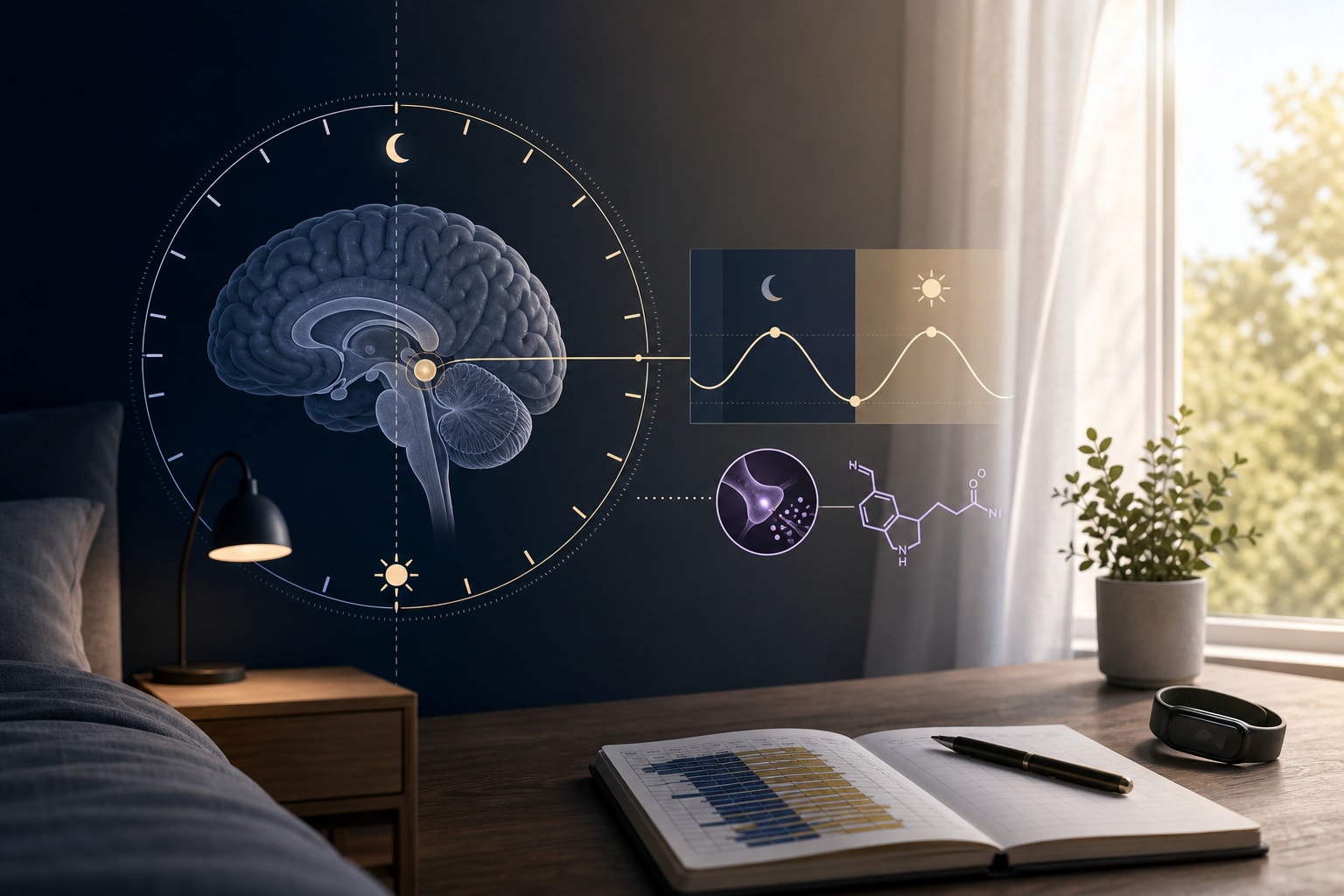
This review discusses the role of circadian factors in insomnia disorder, highlighting the misalignment between endogenous circadian rhythms and sleep patterns in some patients.

Background

Insomnia disorder affects a significant portion of the adult population and is associated with various negative health outcomes. Understanding the mechanistic heterogeneity of insomnia is crucial for effective prevention and intervention strategies.

Data Highlights

No numerical data presented in the source material.

Key Findings

  • Insomnia disorder is characterized by difficulty initiating or maintaining sleep despite adequate opportunity.
  • Some patients with insomnia may experience misalignment between their circadian phase and intended sleep times.
  • Objective measurements indicate that insomnia may be associated with delayed sleep timing and abnormal light exposure patterns.
  • The proposed circadian phenotyping framework includes various assessment methods to distinguish different insomnia subtypes.
  • Cognitive behavioral therapy for insomnia (CBT-I) is the first-line treatment.

Clinical Implications

Clinicians should consider the potential impact of circadian factors when evaluating patients with insomnia.

Conclusion

Future research should focus on validating the proposed phenotyping framework.

Related Resources & Content

  1. American Academy of Sleep Medicine, PubMed, 2021 -- Behavioral and psychological treatments for chronic insomnia disorder in adults: an American Academy of Sleep Medicine clinical practice guideline
  2. Effectiveness of morning blue light therapy on sleep and daytime symptoms in adults with primary and comorbid insomnia: A systematic review and meta-analysis of randomized control trials - PubMed
  3. BMC Psychiatry (Springer) — Digital multi-modal approaches to subtyping insomnia disorder (DIMOSI): study design, rationale, digital platform, and preliminary baseline characteristics of a national prospective cohort study
  4. DIGITAL HEALTH — Insomnia severity modifies diary-based sleep-continuity and sleep-initiation associations with next-day daytime HRV in a real-world wearable dataset
  5. DIGITAL HEALTH — Heart rate circadian phase and hyperarousal as wearable digital phenotyping of insomnia: An interpretable machine learning study
  6. Frontiers in Psychiatry — Physical factor therapies for insomnia: a narrative review of mechanisms, clinical evidence, and phenotype-guided applications
  7. Behavioral and psychological treatments for chronic insomnia disorder in adults: an American Academy of Sleep Medicine clinical practice guideline - PubMed
  8. Effectiveness of morning blue light therapy on sleep and daytime symptoms in adults with primary and comorbid insomnia: A systematic review and meta-analysis of randomized control trials - PubMed

Original Source(s)

Related Content